
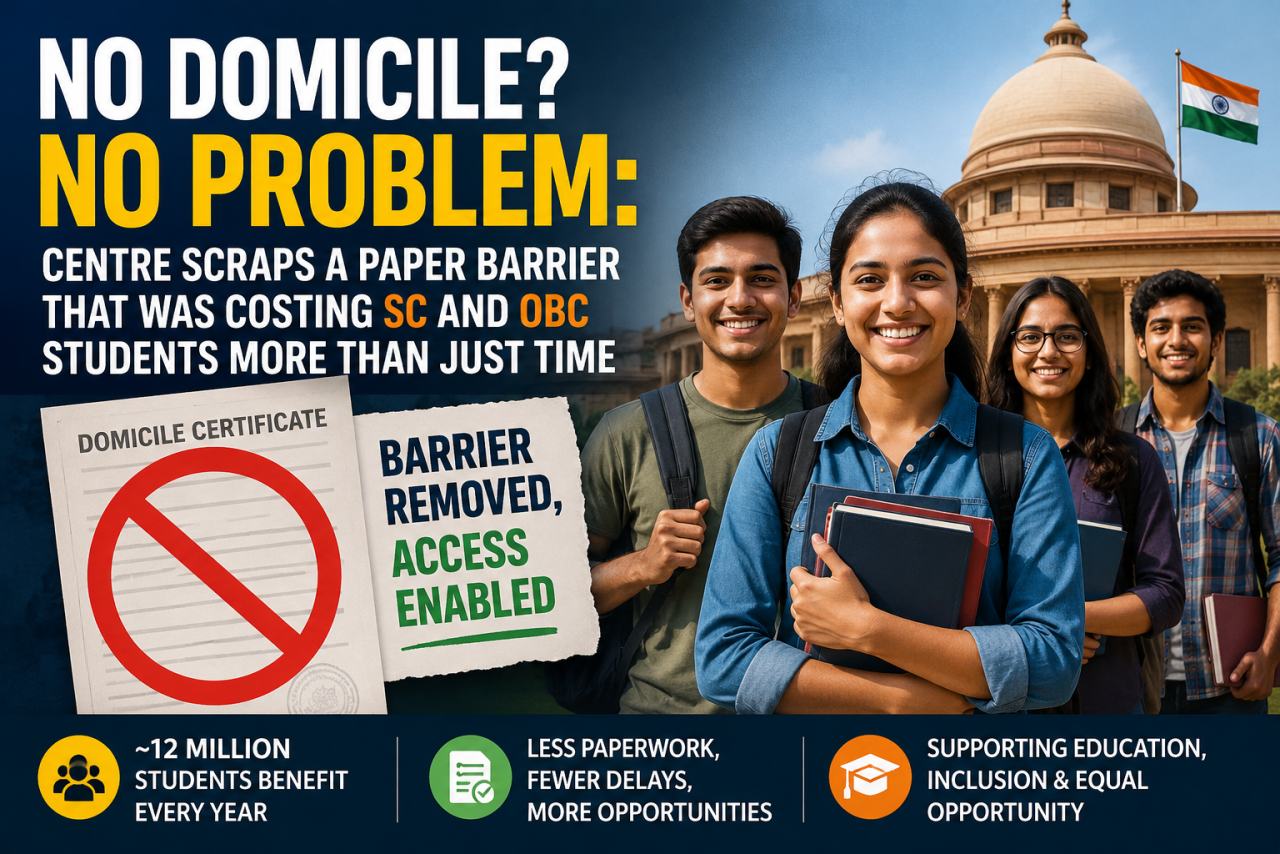
For years, a single document kept countless eligible students from receiving scholarships. The Centre has now removed that hurdle—but will the reform reach those who need it most?
For millions of students from Scheduled Caste (SC) and Other Backward Class (OBC) backgrounds, applying for a government scholarship has long involved a ritual that had little to do with merit or financial need—tracking down a domicile certificate.
Issued by state governments to certify permanent residency, this document became a recurring nightmare for students studying away from their home districts. It often meant travelling back home during the academic session, forcing parents to lose wages, and, in some cases, quietly paying middlemen to expedite paperwork. The certificate added little to determining eligibility; instead, it highlighted how difficult the system could be to navigate.
That requirement is now gone.
The Department of Social Justice and Empowerment, under the Ministry of Social Justice and Empowerment (MoSJE), has removed the mandatory domicile certificate requirement for students applying under the Pre-Matric and Post-Matric Scholarship Schemes for SCs and OBCs. The decision affects nearly 12 million students who receive benefits under these schemes every year—a quiet but significant administrative reform that could improve access to welfare without changing a single eligibility criterion.
The Scale of the Problem
To understand why this matters, consider the numbers.
According to Ministry of Education data, 5.8 million SC students and 14.7 million OBC students are currently enrolled in Indian universities, representing 14.2% and 35.8%, respectively, of the country's total higher education enrolment of 41.3 million.
National Sample Survey and Census migration data indicate that roughly 30–35% of higher education students study outside their home district.
For this sizeable group, obtaining a domicile certificate from their native state is not merely an administrative formality—it is a genuine logistical challenge. A student from rural Bihar studying in Pune, for example, may have to coordinate with family members, depend on local government offices hundreds of kilometres away, and navigate bureaucratic timelines that rarely align with academic calendars.
What the Schemes Cover
The Pre-Matric Scholarship for SC students supports those studying in Classes 9 and 10 whose family income does not exceed ₹2.5 lakh annually. The Post-Matric Scholarship extends assistance from Class 11 through postgraduate and doctoral education.
For OBC students, separate Pre-Matric and Post-Matric scholarship schemes operate with annual income ceilings of ₹2.5 lakh and ₹1 lakh, respectively.
These are not scholarships designed for the economically secure claiming category-based advantages. They are income-linked welfare schemes aimed at students from economically vulnerable households, where even a seemingly minor procedural hurdle can become a decisive barrier.
A Reform Long Overdue
Senior ministry officials have described the decision as an effort to reduce documentation requirements, lower compliance costs, and make scholarship delivery more efficient.
That explanation is accurate, but it understates the reality experienced by many applicants.
When a welfare programme requires a document that contributes little to determining eligibility—the caste certificate and income certificate already serve that purpose—it functions less as a safeguard and more as an administrative filter.
In India's bureaucratic ecosystem, where certificate-related delays remain common and middlemen continue to operate in many government offices, such filters disproportionately affect those least able to overcome them: students who cannot afford repeated travel, cannot take time away from studies or work, and cannot pay unofficial fees to speed up the process.
Removing the domicile certificate requirement does not expand eligibility. It simply removes a procedural barrier that prevented many eligible students from accessing benefits that were already intended for them.
The SETU Initiative
Alongside this reform, MoSJE has launched SETU (Scholarship for Educational Transformation and Upliftment) on the UMANG platform.
Designed as a single-window digital interface, SETU integrates scholarship application, tracking, and disbursement into one platform, reducing the need for students to navigate multiple portals and offices.
The ministry has presented these twin reforms as part of a broader effort to improve inclusion, reduce procedural complexity, and strengthen welfare delivery.
While these objectives are not new, India's welfare system has often struggled with the gap between policy intent and implementation. The success of these reforms will ultimately depend on whether the supporting digital and administrative infrastructure is capable of delivering the promised ease of access.
Final Take
India's welfare architecture has long suffered from a structural weakness: it often demands the greatest amount of documentation from those least equipped to produce it.
Domicile certificates, income proofs, caste certificates, bonafide certificates—each may be defensible when viewed individually. Collectively, however, they can become an exhausting bureaucratic burden, especially for first-generation college students navigating government processes without institutional support.
Removing the domicile certificate requirement is a relatively small administrative change, but it addresses a much larger structural problem.
If nearly 12 million students each year can access scholarship benefits with fewer visits to government offices, fewer procedural delays, and fewer opportunities for rent-seeking intermediaries, the cumulative impact on educational access and student retention among India's most marginalised communities could be substantial.
The real test, however, lies ahead.
State governments must align their administrative processes, the UMANG platform must be able to handle increased demand efficiently, and awareness of the new rules must reach students in the country's most remote regions.
Policy announcements are comparatively easy.
Last-mile delivery remains the true measure of reform.
For millions of students from Scheduled Caste (SC) and Other Backward Class (OBC) backgrounds, applying for a government scholarship has long involved a ritual that had little to do with merit or financial need—tracking down a domicile certificate.
Issued by state governments to certify permanent residency, this document became a recurring nightmare for students studying away from their home districts. It often meant travelling back home during the academic session, forcing parents to lose wages, and, in some cases, quietly paying middlemen to expedite paperwork. The certificate added little to determining eligibility; instead, it highlighted how difficult the system could be to navigate.
That requirement is now gone.
The Department of Social Justice and Empowerment, under the Ministry of Social Justice and Empowerment (MoSJE), has removed the mandatory domicile certificate requirement for students applying under the Pre-Matric and Post-Matric Scholarship Schemes for SCs and OBCs. The decision affects nearly 12 million students who receive benefits under these schemes every year—a quiet but significant administrative reform that could improve access to welfare without changing a single eligibility criterion.
The Scale of the Problem
To understand why this matters, consider the numbers.
According to Ministry of Education data, 5.8 million SC students and 14.7 million OBC students are currently enrolled in Indian universities, representing 14.2% and 35.8%, respectively, of the country's total higher education enrolment of 41.3 million.
National Sample Survey and Census migration data indicate that roughly 30–35% of higher education students study outside their home district.
For this sizeable group, obtaining a domicile certificate from their native state is not merely an administrative formality—it is a genuine logistical challenge. A student from rural Bihar studying in Pune, for example, may have to coordinate with family members, depend on local government offices hundreds of kilometres away, and navigate bureaucratic timelines that rarely align with academic calendars.
What the Schemes Cover
The Pre-Matric Scholarship for SC students supports those studying in Classes 9 and 10 whose family income does not exceed ₹2.5 lakh annually. The Post-Matric Scholarship extends assistance from Class 11 through postgraduate and doctoral education.
For OBC students, separate Pre-Matric and Post-Matric scholarship schemes operate with annual income ceilings of ₹2.5 lakh and ₹1 lakh, respectively.
These are not scholarships designed for the economically secure claiming category-based advantages. They are income-linked welfare schemes aimed at students from economically vulnerable households, where even a seemingly minor procedural hurdle can become a decisive barrier.
A Reform Long Overdue
Senior ministry officials have described the decision as an effort to reduce documentation requirements, lower compliance costs, and make scholarship delivery more efficient.
That explanation is accurate, but it understates the reality experienced by many applicants.
When a welfare programme requires a document that contributes little to determining eligibility—the caste certificate and income certificate already serve that purpose—it functions less as a safeguard and more as an administrative filter.
In India's bureaucratic ecosystem, where certificate-related delays remain common and middlemen continue to operate in many government offices, such filters disproportionately affect those least able to overcome them: students who cannot afford repeated travel, cannot take time away from studies or work, and cannot pay unofficial fees to speed up the process.
Removing the domicile certificate requirement does not expand eligibility. It simply removes a procedural barrier that prevented many eligible students from accessing benefits that were already intended for them.
The SETU Initiative
Alongside this reform, MoSJE has launched SETU (Scholarship for Educational Transformation and Upliftment) on the UMANG platform.
Designed as a single-window digital interface, SETU integrates scholarship application, tracking, and disbursement into one platform, reducing the need for students to navigate multiple portals and offices.
The ministry has presented these twin reforms as part of a broader effort to improve inclusion, reduce procedural complexity, and strengthen welfare delivery.
While these objectives are not new, India's welfare system has often struggled with the gap between policy intent and implementation. The success of these reforms will ultimately depend on whether the supporting digital and administrative infrastructure is capable of delivering the promised ease of access.
Final Take
India's welfare architecture has long suffered from a structural weakness: it often demands the greatest amount of documentation from those least equipped to produce it.
Domicile certificates, income proofs, caste certificates, bonafide certificates—each may be defensible when viewed individually. Collectively, however, they can become an exhausting bureaucratic burden, especially for first-generation college students navigating government processes without institutional support.
Removing the domicile certificate requirement is a relatively small administrative change, but it addresses a much larger structural problem.
If nearly 12 million students each year can access scholarship benefits with fewer visits to government offices, fewer procedural delays, and fewer opportunities for rent-seeking intermediaries, the cumulative impact on educational access and student retention among India's most marginalised communities could be substantial.
The real test, however, lies ahead.
State governments must align their administrative processes, the UMANG platform must be able to handle increased demand efficiently, and awareness of the new rules must reach students in the country's most remote regions.
Policy announcements are comparatively easy.
Last-mile delivery remains the true measure of reform.




















Leave a Comment