
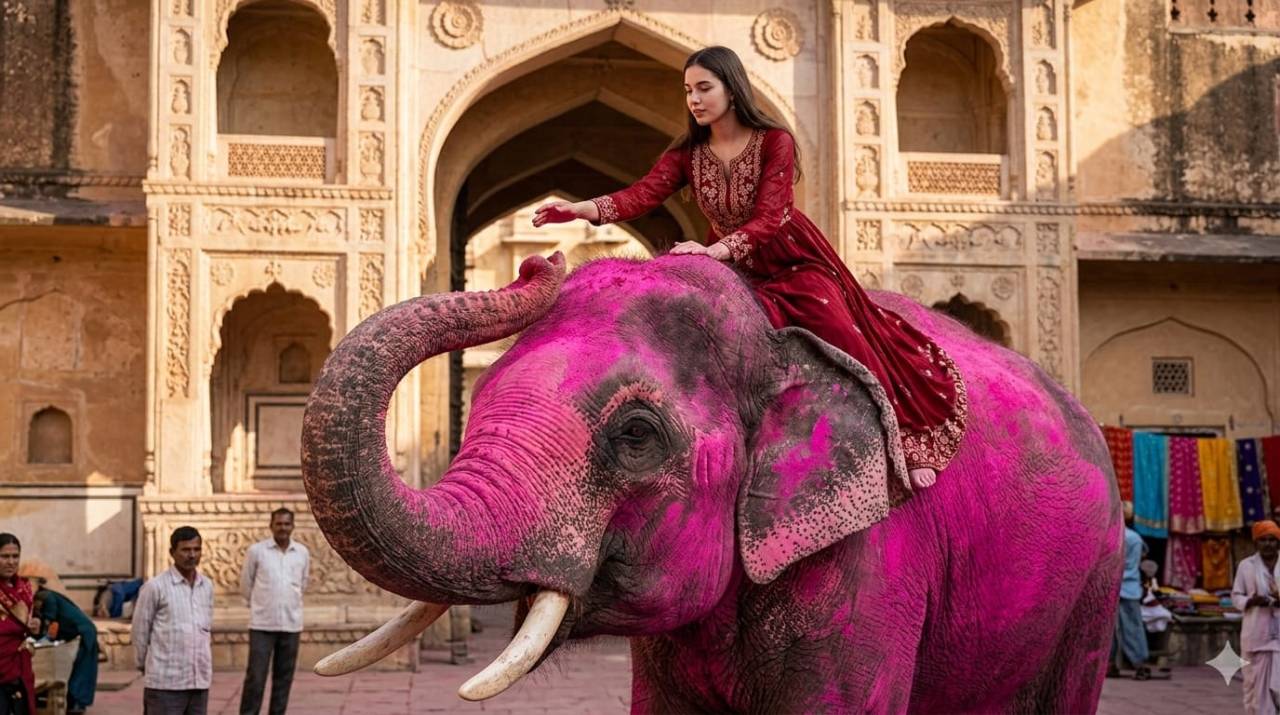
What happens when art stops observing life—and starts exploiting it? The viral “pink elephant” controversy forces us to confront an uncomfortable truth about beauty, power, and responsibility.
In the age of the viral image, the line between "capturing a moment" and "creating a spectacle" has become increasingly blurred. A recent controversy involving Russian artist Julia Buruleva and a 65-year-old elephant named Chanchal has reignited a fierce global debate: Where does artistic freedom end, and ethical responsibility begin?
The story, which gained significant traction after a photoshoot in late 2025, centers on the decision to paint an elderly elephant bright pink using gulaal (colored powder) for a series of stylized photographs. When news emerged months later that Chanchal had passed away, social media erupted. While the elephant’s owner and the artist maintain the death was due to old age and unrelated to the shoot, the public outcry focuses on a deeper, more systemic issue: the commodification of sentient beings for "the grid."
The Myth of the "Harmless" Stunt
The defense often used in these scenarios is that the materials—in this case, colored powder—are non-toxic. However, a fresh perspective suggests that physical toxicity is only one metric of harm. For a 65-year-old elephant, an animal that thrives on routine and sensory stability, the process of being painted, posed, and surrounded by a production crew is an undeniable stressor.
To view an animal as a "canvas" is to strip it of its agency. When we prioritize the visual impact of a "pink elephant" over the dignity of a geriatric animal, we are signaling that nature is merely a prop for human storytelling.
The Echo Chamber of Accountability
Buruleva’s response to the backlash—claiming media "hype" and requesting support via hashtags—highlights a modern disconnect. The artist views the criticism as a personal attack on her career; the public views it as a necessary stand against animal exploitation.
This friction points to a shift in "Common People’s" expectations. In decades past, such a photo might have been seen as whimsical or avant-garde. Today, an increasingly eco-conscious public recognizes that:
- Aesthetics do not justify agitation: An elderly animal should be in a sanctuary or a place of rest, not a high-pressure photoshoot.
- The "Likes" Economy is dangerous: When creators push boundaries for engagement, the most vulnerable (animals, environments, marginalized communities) often pay the price.
Moving Toward Compassionate Creativity
The "pink elephant" row serves as a cautionary tale for the creative industry. For an article or an image to be truly "important" in 2026, it must be rooted in ethics, not just optics.
True artistic innovation doesn't involve manipulating a living creature for a fleeting digital trend. Instead, it involves using technology—like AI-augmented imagery or digital painting—to achieve surreal visuals without imposing on the physical well-being of a living soul.
A Call for Higher Standards
We must ask ourselves: Is the photo worth the peace of the subject? If the answer requires defending oneself against allegations of cruelty, the artistic merit is already lost.
As consumers of media, our power lies in our attention. By holding artists accountable and demanding that "the aesthetic" never comes at the expense of "the living," we can ensure that stories like Chanchal’s lead to a more empathetic and responsible creative world. The goal should not be to "cancel" the artist, but to cancel the outdated notion that animals are tools for our vanity.





















Leave a Comment