
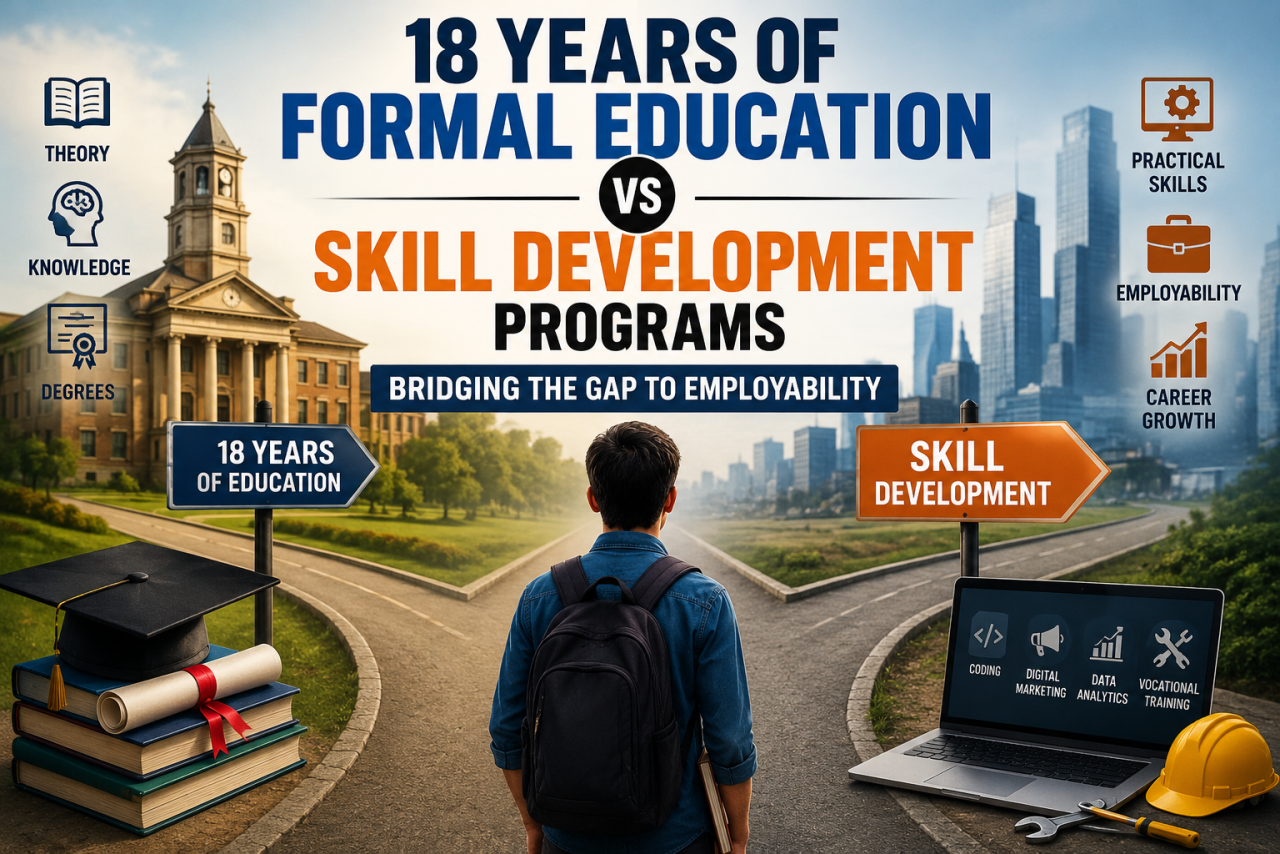
Can 18 years of education still fail to guarantee a job? India's rising dependence on skill development programs exposes a widening gap between academic degrees, practical skills, and real-world employability.
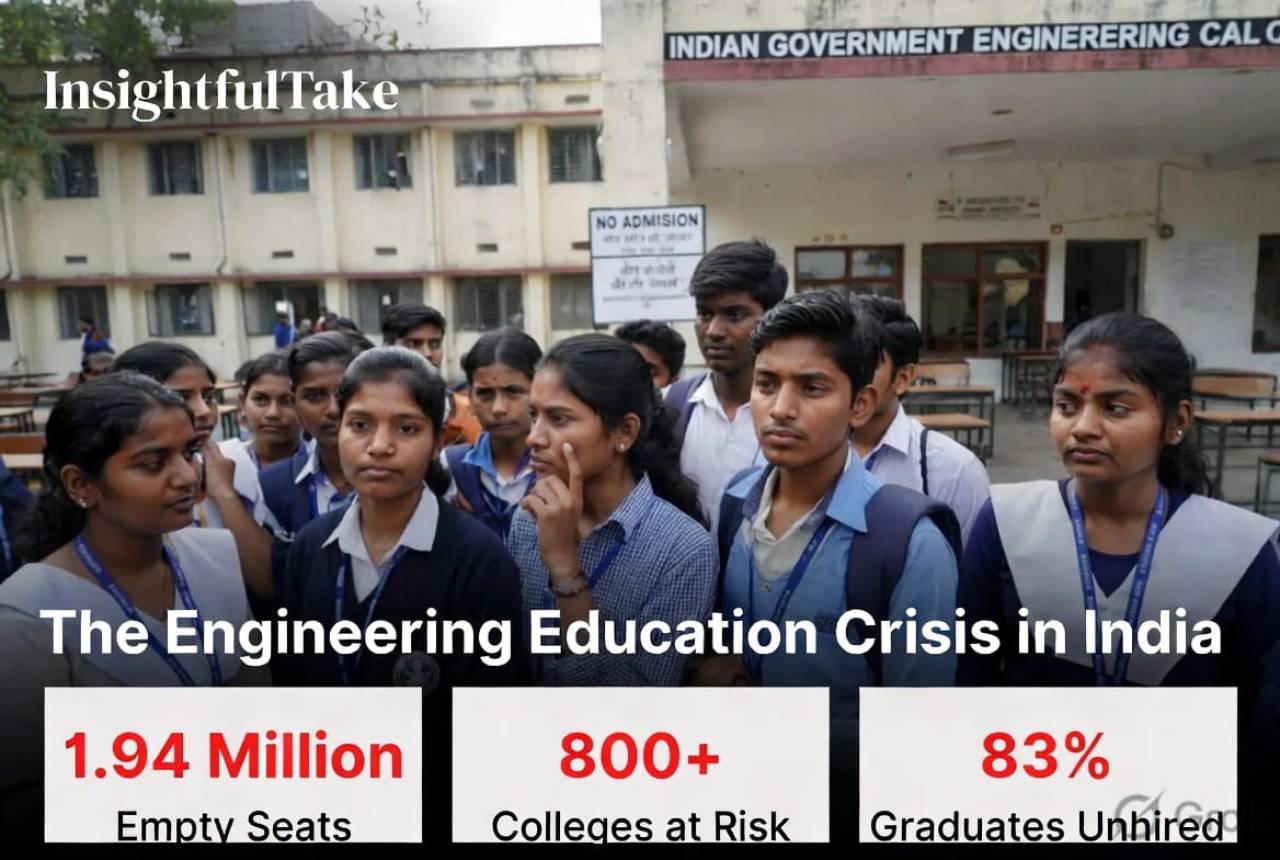
In India today, an individual spends nearly 18 years in formal education, beginning with kindergarten and continuing through a university degree. Yet for many graduates, this long educational journey does not end with employment. Instead, it often leads to uncertainty and prolonged job searches. According to the Centre for Monitoring Indian Economy (CMIE)'s Consumer Pyramids Household Survey, India's unemployment rate rose to 8.1% in April 2024 from 7.4% in March. Rural unemployment increased from 7.1% to 7.8%, while urban unemployment climbed from 8.1% to 8.7%. These figures reveal a growing disconnect between education and employability, raising serious concerns about the effectiveness of the country's education system.
As this gap has widened, skill development programs have rapidly expanded across the country. From short-term crash courses to year-long certification programs, these institutes promise to equip students with industry-ready skills that are often missing from conventional education. Courses in digital marketing, coding, data analytics, graphic design, and vocational trades have become increasingly popular. In many ways, these institutes now function as a parallel education system. Their growing popularity raises an important question: if students still require additional training after nearly two decades of formal education, is the existing education system adequately preparing them for the workplace?
Ideally, formal education should do far more than prepare students for jobs. Its primary purpose is to develop critical thinking, analytical reasoning, creativity, scientific inquiry, and problem-solving abilities. These qualities enable societies to produce researchers, innovators, entrepreneurs, policymakers, and scientists who shape the future. Skill development programs, on the other hand, focus on practical application. They train individuals to perform specific tasks efficiently and adapt to existing technologies and workplace requirements. Both systems have distinct roles, but they should complement one another rather than compete.
Unfortunately, India's growing emphasis on immediate employability has shifted attention away from intellectual development. Practical skills are increasingly valued over conceptual understanding and subject expertise. While technical skills certainly improve employment prospects, excessive dependence on short-term training can weaken a nation's ability to innovate. Companies may find skilled workers capable of operating existing systems, but they often struggle to find professionals who can design new technologies, develop original products, or solve complex problems. A knowledge-driven economy requires more than operational skills; it demands deep academic understanding.
The rapid rise of Artificial Intelligence (AI) has further complicated this challenge. As automation continues to replace repetitive and routine tasks, many skill-based jobs are becoming vulnerable. India has traditionally relied on its large skilled workforce as a competitive advantage, but AI is gradually transforming the nature of work. In this changing environment, continuous upskilling and reskilling have become essential. However, these efforts can only succeed when they are built upon a strong academic foundation that enables individuals to learn, adapt, and innovate throughout their careers.
One of the biggest weaknesses of India's education system is its continued dependence on theoretical learning and examination-based evaluation. Although the National Education Policy (NEP) 2020 introduced several progressive reforms, implementation remains uneven. In many schools, rote learning, board examination scores, and percentage-based competition continue to dominate academic life. Students are often judged more by marks than by their aptitude, creativity, or interests.
A common example can be seen in many private schools across Delhi-NCR, where students scoring below 80% in the Class 10 board examinations are frequently denied admission to the science stream, regardless of their interest or potential. Such rigid policies reinforce academic elitism and limit opportunities for countless capable students. Instead of encouraging diverse talents, the system often rewards only high examination scores.
The experience of one student illustrates this problem clearly. After scoring below 60% in the 2024 CBSE board examinations, he was denied admission to his preferred subjects by his school, Mayo International School in New Delhi. Despite approaching several other schools, he was unable to secure admission in the stream of his choice. While this may not represent every institution, it reflects a broader issue in which academic performance alone determines future opportunities, leaving little room for individual potential or personal growth.
The disconnect extends beyond education and into the job market. Even entry-level job advertisements frequently demand an unrealistic combination of qualifications and experience. Employers often expect fresh graduates to possess technical expertise, communication skills, leadership qualities, analytical abilities, digital proficiency, and prior work experience simultaneously. Such expectations create unnecessary barriers for young professionals who are just beginning their careers. Instead of allowing graduates to learn and grow on the job, organisations increasingly seek candidates who already possess every possible competency.
As a result, higher qualifications have become almost mandatory for securing stable employment. At the same time, entrepreneurship demands versatility across finance, technology, marketing, and operations. This mismatch between academic education and industry expectations has contributed to structural imbalances in India's economy. While the service sector continues to expand, manufacturing and research-driven industries often face shortages of highly specialised professionals capable of driving innovation and technological advancement.
The debate between formal education and skill development should not be viewed as a choice between two competing systems. India needs both. Formal education must become more practical, interdisciplinary, and industry-oriented without compromising its focus on intellectual growth. Similarly, skill development programs should move beyond task-specific training and strengthen conceptual understanding, critical thinking, and problem-solving abilities.
Only by integrating strong academic foundations with practical skills can India produce graduates who are not only employable but also capable of innovation, leadership, and lifelong learning. Bridging the gap between education and employment requires structural reforms that value knowledge and skills equally. Such a balanced approach will better prepare young Indians for an economy that demands both competence and creativity in equal measure.
In India today, an individual spends nearly 18 years in formal education, beginning with kindergarten and continuing through a university degree. Yet for many graduates, this long educational journey does not end with employment. Instead, it often leads to uncertainty and prolonged job searches. According to the Centre for Monitoring Indian Economy (CMIE)'s Consumer Pyramids Household Survey, India's unemployment rate rose to 8.1% in April 2024 from 7.4% in March. Rural unemployment increased from 7.1% to 7.8%, while urban unemployment climbed from 8.1% to 8.7%. These figures reveal a growing disconnect between education and employability, raising serious concerns about the effectiveness of the country's education system.
As this gap has widened, skill development programs have rapidly expanded across the country. From short-term crash courses to year-long certification programs, these institutes promise to equip students with industry-ready skills that are often missing from conventional education. Courses in digital marketing, coding, data analytics, graphic design, and vocational trades have become increasingly popular. In many ways, these institutes now function as a parallel education system. Their growing popularity raises an important question: if students still require additional training after nearly two decades of formal education, is the existing education system adequately preparing them for the workplace?
Ideally, formal education should do far more than prepare students for jobs. Its primary purpose is to develop critical thinking, analytical reasoning, creativity, scientific inquiry, and problem-solving abilities. These qualities enable societies to produce researchers, innovators, entrepreneurs, policymakers, and scientists who shape the future. Skill development programs, on the other hand, focus on practical application. They train individuals to perform specific tasks efficiently and adapt to existing technologies and workplace requirements. Both systems have distinct roles, but they should complement one another rather than compete.
Unfortunately, India's growing emphasis on immediate employability has shifted attention away from intellectual development. Practical skills are increasingly valued over conceptual understanding and subject expertise. While technical skills certainly improve employment prospects, excessive dependence on short-term training can weaken a nation's ability to innovate. Companies may find skilled workers capable of operating existing systems, but they often struggle to find professionals who can design new technologies, develop original products, or solve complex problems. A knowledge-driven economy requires more than operational skills; it demands deep academic understanding.
The rapid rise of Artificial Intelligence (AI) has further complicated this challenge. As automation continues to replace repetitive and routine tasks, many skill-based jobs are becoming vulnerable. India has traditionally relied on its large skilled workforce as a competitive advantage, but AI is gradually transforming the nature of work. In this changing environment, continuous upskilling and reskilling have become essential. However, these efforts can only succeed when they are built upon a strong academic foundation that enables individuals to learn, adapt, and innovate throughout their careers.
One of the biggest weaknesses of India's education system is its continued dependence on theoretical learning and examination-based evaluation. Although the National Education Policy (NEP) 2020 introduced several progressive reforms, implementation remains uneven. In many schools, rote learning, board examination scores, and percentage-based competition continue to dominate academic life. Students are often judged more by marks than by their aptitude, creativity, or interests.
A common example can be seen in many private schools across Delhi-NCR, where students scoring below 80% in the Class 10 board examinations are frequently denied admission to the science stream, regardless of their interest or potential. Such rigid policies reinforce academic elitism and limit opportunities for countless capable students. Instead of encouraging diverse talents, the system often rewards only high examination scores.
The experience of one student illustrates this problem clearly. After scoring below 60% in the 2024 CBSE board examinations, he was denied admission to his preferred subjects by his school, Mayo International School in New Delhi. Despite approaching several other schools, he was unable to secure admission in the stream of his choice. While this may not represent every institution, it reflects a broader issue in which academic performance alone determines future opportunities, leaving little room for individual potential or personal growth.
The disconnect extends beyond education and into the job market. Even entry-level job advertisements frequently demand an unrealistic combination of qualifications and experience. Employers often expect fresh graduates to possess technical expertise, communication skills, leadership qualities, analytical abilities, digital proficiency, and prior work experience simultaneously. Such expectations create unnecessary barriers for young professionals who are just beginning their careers. Instead of allowing graduates to learn and grow on the job, organisations increasingly seek candidates who already possess every possible competency.
As a result, higher qualifications have become almost mandatory for securing stable employment. At the same time, entrepreneurship demands versatility across finance, technology, marketing, and operations. This mismatch between academic education and industry expectations has contributed to structural imbalances in India's economy. While the service sector continues to expand, manufacturing and research-driven industries often face shortages of highly specialised professionals capable of driving innovation and technological advancement.
The debate between formal education and skill development should not be viewed as a choice between two competing systems. India needs both. Formal education must become more practical, interdisciplinary, and industry-oriented without compromising its focus on intellectual growth. Similarly, skill development programs should move beyond task-specific training and strengthen conceptual understanding, critical thinking, and problem-solving abilities.
Only by integrating strong academic foundations with practical skills can India produce graduates who are not only employable but also capable of innovation, leadership, and lifelong learning. Bridging the gap between education and employment requires structural reforms that value knowledge and skills equally. Such a balanced approach will better prepare young Indians for an economy that demands both competence and creativity in equal measure.


















Leave a Comment