
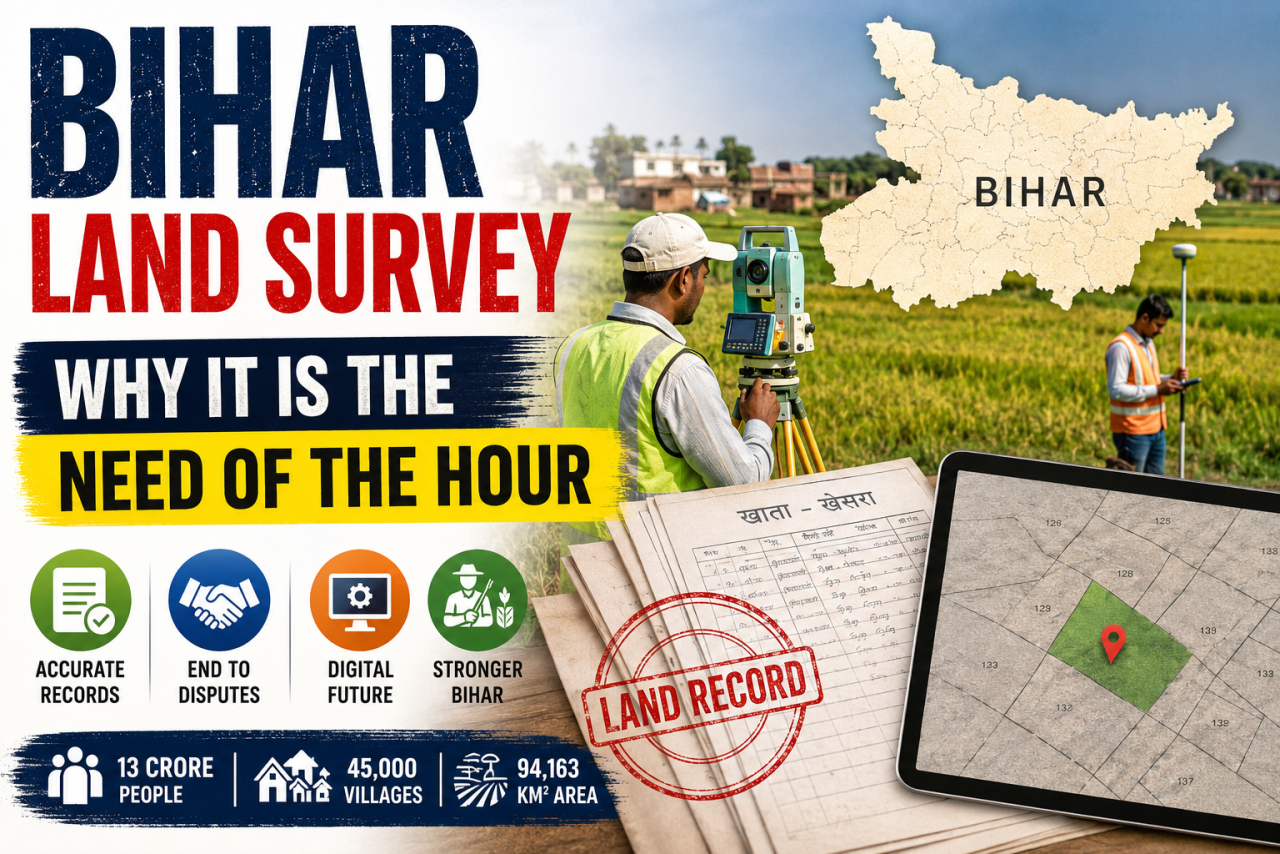
Bihar’s land survey is not just about updating records. It is about protecting ownership rights, reducing disputes and creating the foundation for the state’s economic future.
Bihar’s land records have long remained a source of confusion, disputes and administrative complications. The first major land survey of Bihar was undertaken after the abolition of the Zamindari system and the implementation of land reforms. Decades later, the state is once again undertaking a comprehensive land survey across all 38 districts, covering nearly 45,000 villages. The exercise is not merely an administrative formality. It could become one of the most important foundations for Bihar’s economic and social development.
Yet, a basic question remains: why has Bihar taken so long to undertake a comprehensive updating and digitisation of its land records?
Bihar is predominantly an agricultural state, with a population of around 13 crore people. Land remains one of the most valuable assets for millions of families, particularly in rural areas. However, ownership records are often based on documents inherited from previous generations, some of which are decades or even centuries old. In many cases, the names appearing in official records no longer correspond with the people who actually possess or cultivate the land.
This makes the current survey both necessary and urgent.
India has already moved towards digitising land records in several states and Union Territories. Bihar, too, needs a reliable and accessible digital land database covering its entire geographical area of nearly 94,000 square kilometres. The government has mobilised thousands of officials and survey personnel for this massive exercise. However, the scale of the task makes its implementation particularly challenging.
The biggest challenge is not simply surveying the land. It is collecting, verifying and reconciling the documents of millions of landholders.
Landowners are required to provide details such as Khata and Khesra numbers, ownership information, names of shareholders, details of adjoining plots and, in many cases, a Vanshavali or genealogical record establishing succession. For an ordinary villager, completing these formalities can be extremely difficult.
Bihar’s literacy rate also presents a serious challenge. A significant proportion of the population has limited literacy, while many historical land records are written in Kaithi, an old script that is unfamiliar to most people today. Translating and interpreting these documents requires specialised knowledge. Without adequate assistance, ordinary landowners may find themselves dependent on intermediaries, lawyers, document writers or officials.
This is precisely where the danger of corruption emerges.
Whenever a complicated administrative process meets limited public awareness, the possibility of exploitation increases. People who are unable to understand their documents or complete the required procedures may be forced to depend on middlemen. Reports of difficulties at the circle-office level therefore deserve serious attention. A land survey intended to bring transparency must not become another layer of bureaucracy and corruption.
Recognising these difficulties, the Bihar government has decided to pause the exercise for three months in order to provide additional training and address problems related to old land records, including those written in Kaithi. Such a pause should not be viewed as a failure. Rather, it should be used to make the process more accessible, transparent and technically sound.
The larger objective of the survey should be much more ambitious than simply updating records. Bihar needs a modern, tamper-resistant and easily accessible digital land-record system that clearly establishes ownership, inheritance and boundaries.
Land disputes constitute a major burden on the judicial system and cause prolonged social and economic uncertainty. Families can spend years fighting over ancestral property, while disputed land remains economically unproductive. Clear and digitally verifiable records can significantly reduce such conflicts and provide greater security to landowners.
The land survey is therefore not merely a government programme. It is an opportunity to build the foundation for Bihar’s next phase of development.
For a state aspiring to attract investment, create employment and modernise agriculture, secure land ownership is indispensable. The real test, however, will be whether the government can complete the survey without excluding the poor, illiterate and technologically disadvantaged sections of society.
Bihar does not merely need a land survey. It needs a land-record revolution.
After decades of delay, the opportunity has finally arrived. The state must ensure that it is completed with transparency, accuracy and public participation, so that land stops being a source of uncertainty and becomes an instrument of security, productivity and economic growth.
Bihar’s land records have long remained a source of confusion, disputes and administrative complications. The first major land survey of Bihar was undertaken after the abolition of the Zamindari system and the implementation of land reforms. Decades later, the state is once again undertaking a comprehensive land survey across all 38 districts, covering nearly 45,000 villages. The exercise is not merely an administrative formality. It could become one of the most important foundations for Bihar’s economic and social development.
Yet, a basic question remains: why has Bihar taken so long to undertake a comprehensive updating and digitisation of its land records?
Bihar is predominantly an agricultural state, with a population of around 13 crore people. Land remains one of the most valuable assets for millions of families, particularly in rural areas. However, ownership records are often based on documents inherited from previous generations, some of which are decades or even centuries old. In many cases, the names appearing in official records no longer correspond with the people who actually possess or cultivate the land.
This makes the current survey both necessary and urgent.
India has already moved towards digitising land records in several states and Union Territories. Bihar, too, needs a reliable and accessible digital land database covering its entire geographical area of nearly 94,000 square kilometres. The government has mobilised thousands of officials and survey personnel for this massive exercise. However, the scale of the task makes its implementation particularly challenging.
The biggest challenge is not simply surveying the land. It is collecting, verifying and reconciling the documents of millions of landholders.
Landowners are required to provide details such as Khata and Khesra numbers, ownership information, names of shareholders, details of adjoining plots and, in many cases, a Vanshavali or genealogical record establishing succession. For an ordinary villager, completing these formalities can be extremely difficult.
Bihar’s literacy rate also presents a serious challenge. A significant proportion of the population has limited literacy, while many historical land records are written in Kaithi, an old script that is unfamiliar to most people today. Translating and interpreting these documents requires specialised knowledge. Without adequate assistance, ordinary landowners may find themselves dependent on intermediaries, lawyers, document writers or officials.
This is precisely where the danger of corruption emerges.
Whenever a complicated administrative process meets limited public awareness, the possibility of exploitation increases. People who are unable to understand their documents or complete the required procedures may be forced to depend on middlemen. Reports of difficulties at the circle-office level therefore deserve serious attention. A land survey intended to bring transparency must not become another layer of bureaucracy and corruption.
Recognising these difficulties, the Bihar government has decided to pause the exercise for three months in order to provide additional training and address problems related to old land records, including those written in Kaithi. Such a pause should not be viewed as a failure. Rather, it should be used to make the process more accessible, transparent and technically sound.
The larger objective of the survey should be much more ambitious than simply updating records. Bihar needs a modern, tamper-resistant and easily accessible digital land-record system that clearly establishes ownership, inheritance and boundaries.
Land disputes constitute a major burden on the judicial system and cause prolonged social and economic uncertainty. Families can spend years fighting over ancestral property, while disputed land remains economically unproductive. Clear and digitally verifiable records can significantly reduce such conflicts and provide greater security to landowners.
The land survey is therefore not merely a government programme. It is an opportunity to build the foundation for Bihar’s next phase of development.
For a state aspiring to attract investment, create employment and modernise agriculture, secure land ownership is indispensable. The real test, however, will be whether the government can complete the survey without excluding the poor, illiterate and technologically disadvantaged sections of society.
Bihar does not merely need a land survey. It needs a land-record revolution.
After decades of delay, the opportunity has finally arrived. The state must ensure that it is completed with transparency, accuracy and public participation, so that land stops being a source of uncertainty and becomes an instrument of security, productivity and economic growth.


























Leave a Comment