
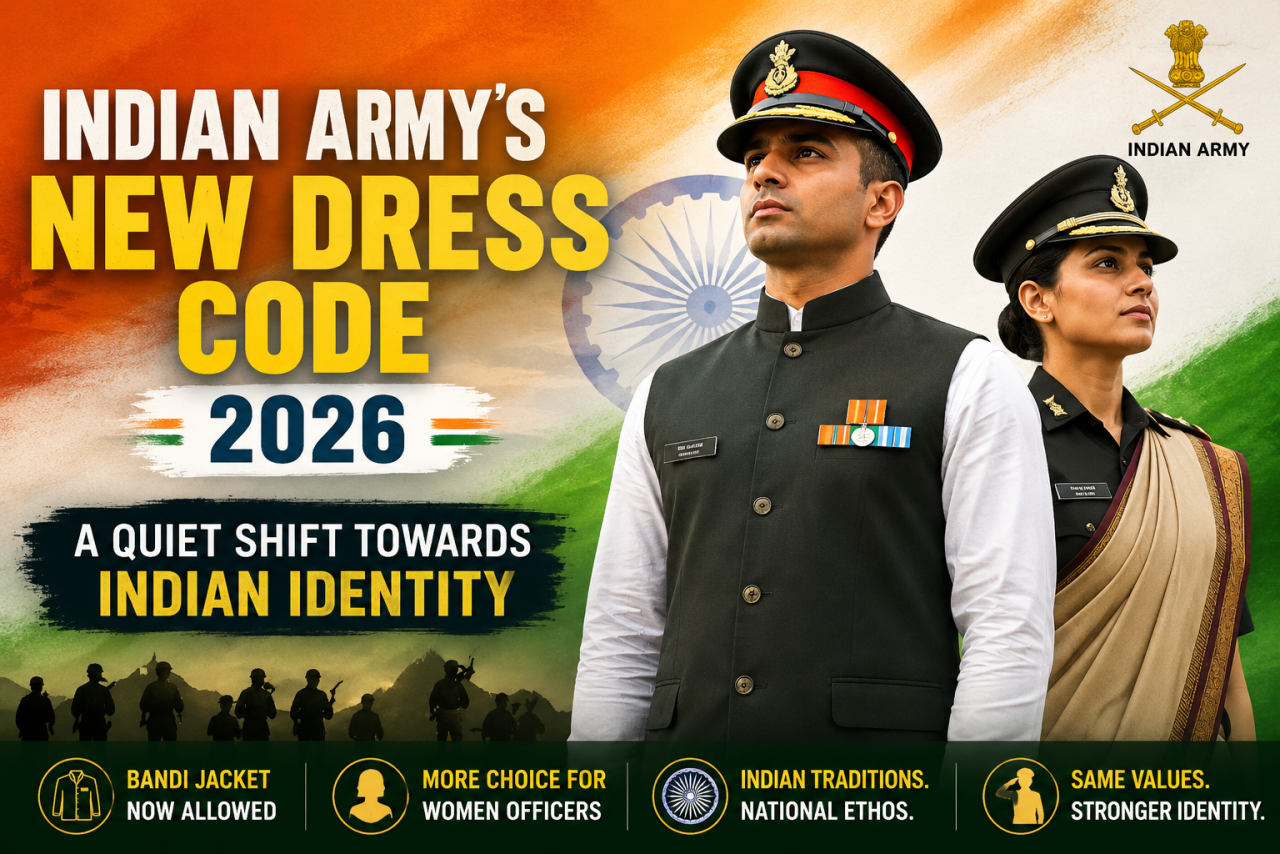
Can a uniform tell the story of a nation's confidence? Nearly eight decades after Independence, the Indian Army's new dress code is more than a wardrobe update—it reflects India's growing comfort with its own identity and traditions.
For most Indians, the uniform of the Indian Army is more than clothing. It represents discipline, sacrifice, courage, and service to the nation. That is why a seemingly simple change in the Army's dress regulations in 2026 is actually a significant moment in India's journey of self-confidence and cultural identity.
After nearly eight decades of Independence, the Indian Army has introduced a revised dress code that places greater emphasis on Indian traditions and national ethos while maintaining the professionalism and dignity of one of the world's most respected military forces.
At first glance, the changes may appear modest. Officers can now wear the traditional bandi jacket as part of formal attire. Women officers have been given more flexibility to wear Indian formal clothing such as salwar-kameez and sarees on appropriate occasions. Several colonial-era customs and terms have also been removed or revised.
But the importance of these changes goes beyond fashion.
A Uniform That Reflects India
When India became independent in 1947, many military structures, customs, and regulations continued from the British era. This was understandable. The newly independent nation needed continuity and stability.
Over the years, however, India has transformed dramatically. It has become a major economic power, a technological leader, and a confident global voice. Yet some institutional practices still carried traces of colonial influence.
The revised Army dress regulations recognise a simple reality: an Indian soldier can be modern, professional, and globally respected while also being visibly connected to India's own cultural traditions.
The inclusion of the bandi jacket is a symbolic example. Frequently worn by Indian leaders and diplomats, the jacket has become a recognised expression of Indian formal wear. Its acceptance within Army regulations sends a message that Indian traditions deserve equal space alongside long-established military conventions.
More Than a Change of Clothes
The real story is not about jackets or ceremonial attire.
It is about how India sees itself.
For generations, many Indians were taught that professionalism often meant copying Western norms. The new regulations challenge that mindset. They suggest that Indian institutions can confidently draw from their own heritage without compromising standards or efficiency.
An Army officer wearing Indian formal attire does not become less professional. Instead, the officer represents a nation that is comfortable with its own identity.
This reflects a broader trend visible across India today—from the promotion of indigenous technologies and defence equipment to the growing use of Indian symbols and traditions in public life.
The Army's Evolution Continues
The Indian Army has never been static. It has continuously adapted to new technologies, new threats, and changing social realities.
Today's Army includes women in expanding roles, uses advanced indigenous weapon systems, and increasingly emphasises self-reliance in defence production. The updated dress code fits naturally within this larger process of evolution.
Importantly, the changes do not abandon military traditions. The core values of discipline, honour, and professionalism remain untouched. Instead, the Army is modernising its appearance while aligning it more closely with contemporary Indian identity.
Why Ordinary Indians Should Care
Many citizens may wonder why dress regulations deserve attention when the country faces larger challenges.
The answer is that symbols matter.
Nations are held together not only by laws and institutions but also by shared stories, traditions, and symbols. Uniforms are among the most visible symbols of national identity.
When the Indian Army chooses to incorporate more Indian elements into its formal appearance, it sends a message to every citizen: India does not need to borrow its identity from anyone else.
The country can honour its heritage while embracing modernity. It can respect global standards while remaining rooted in its own civilisation.
A Quiet but Meaningful Milestone
The 2026 dress code reforms will not dominate headlines for weeks. They are not as dramatic as a military operation or a major defence acquisition.
Yet they represent something deeper.
They reflect an India that is increasingly confident in its own culture, traditions, and values. An India that no longer feels the need to define itself through colonial-era frameworks.
The Indian Army's strength has always come from its soldiers. But the symbols that accompany that strength matter too.
In that sense, the new dress code is not merely a change in appearance. It is a quiet reminder that the world's largest democracy continues to shape its future while remaining firmly connected to its own roots.
And sometimes, a nation's confidence can be seen not only on the battlefield, but also in the uniform it chooses to wear.
For most Indians, the uniform of the Indian Army is more than clothing. It represents discipline, sacrifice, courage, and service to the nation. That is why a seemingly simple change in the Army's dress regulations in 2026 is actually a significant moment in India's journey of self-confidence and cultural identity.
After nearly eight decades of Independence, the Indian Army has introduced a revised dress code that places greater emphasis on Indian traditions and national ethos while maintaining the professionalism and dignity of one of the world's most respected military forces.
At first glance, the changes may appear modest. Officers can now wear the traditional bandi jacket as part of formal attire. Women officers have been given more flexibility to wear Indian formal clothing such as salwar-kameez and sarees on appropriate occasions. Several colonial-era customs and terms have also been removed or revised.
But the importance of these changes goes beyond fashion.
A Uniform That Reflects India
When India became independent in 1947, many military structures, customs, and regulations continued from the British era. This was understandable. The newly independent nation needed continuity and stability.
Over the years, however, India has transformed dramatically. It has become a major economic power, a technological leader, and a confident global voice. Yet some institutional practices still carried traces of colonial influence.
The revised Army dress regulations recognise a simple reality: an Indian soldier can be modern, professional, and globally respected while also being visibly connected to India's own cultural traditions.
The inclusion of the bandi jacket is a symbolic example. Frequently worn by Indian leaders and diplomats, the jacket has become a recognised expression of Indian formal wear. Its acceptance within Army regulations sends a message that Indian traditions deserve equal space alongside long-established military conventions.
More Than a Change of Clothes
The real story is not about jackets or ceremonial attire.
It is about how India sees itself.
For generations, many Indians were taught that professionalism often meant copying Western norms. The new regulations challenge that mindset. They suggest that Indian institutions can confidently draw from their own heritage without compromising standards or efficiency.
An Army officer wearing Indian formal attire does not become less professional. Instead, the officer represents a nation that is comfortable with its own identity.
This reflects a broader trend visible across India today—from the promotion of indigenous technologies and defence equipment to the growing use of Indian symbols and traditions in public life.
The Army's Evolution Continues
The Indian Army has never been static. It has continuously adapted to new technologies, new threats, and changing social realities.
Today's Army includes women in expanding roles, uses advanced indigenous weapon systems, and increasingly emphasises self-reliance in defence production. The updated dress code fits naturally within this larger process of evolution.
Importantly, the changes do not abandon military traditions. The core values of discipline, honour, and professionalism remain untouched. Instead, the Army is modernising its appearance while aligning it more closely with contemporary Indian identity.
Why Ordinary Indians Should Care
Many citizens may wonder why dress regulations deserve attention when the country faces larger challenges.
The answer is that symbols matter.
Nations are held together not only by laws and institutions but also by shared stories, traditions, and symbols. Uniforms are among the most visible symbols of national identity.
When the Indian Army chooses to incorporate more Indian elements into its formal appearance, it sends a message to every citizen: India does not need to borrow its identity from anyone else.
The country can honour its heritage while embracing modernity. It can respect global standards while remaining rooted in its own civilisation.
A Quiet but Meaningful Milestone
The 2026 dress code reforms will not dominate headlines for weeks. They are not as dramatic as a military operation or a major defence acquisition.
Yet they represent something deeper.
They reflect an India that is increasingly confident in its own culture, traditions, and values. An India that no longer feels the need to define itself through colonial-era frameworks.
The Indian Army's strength has always come from its soldiers. But the symbols that accompany that strength matter too.
In that sense, the new dress code is not merely a change in appearance. It is a quiet reminder that the world's largest democracy continues to shape its future while remaining firmly connected to its own roots.
And sometimes, a nation's confidence can be seen not only on the battlefield, but also in the uniform it chooses to wear.












Leave a Comment