
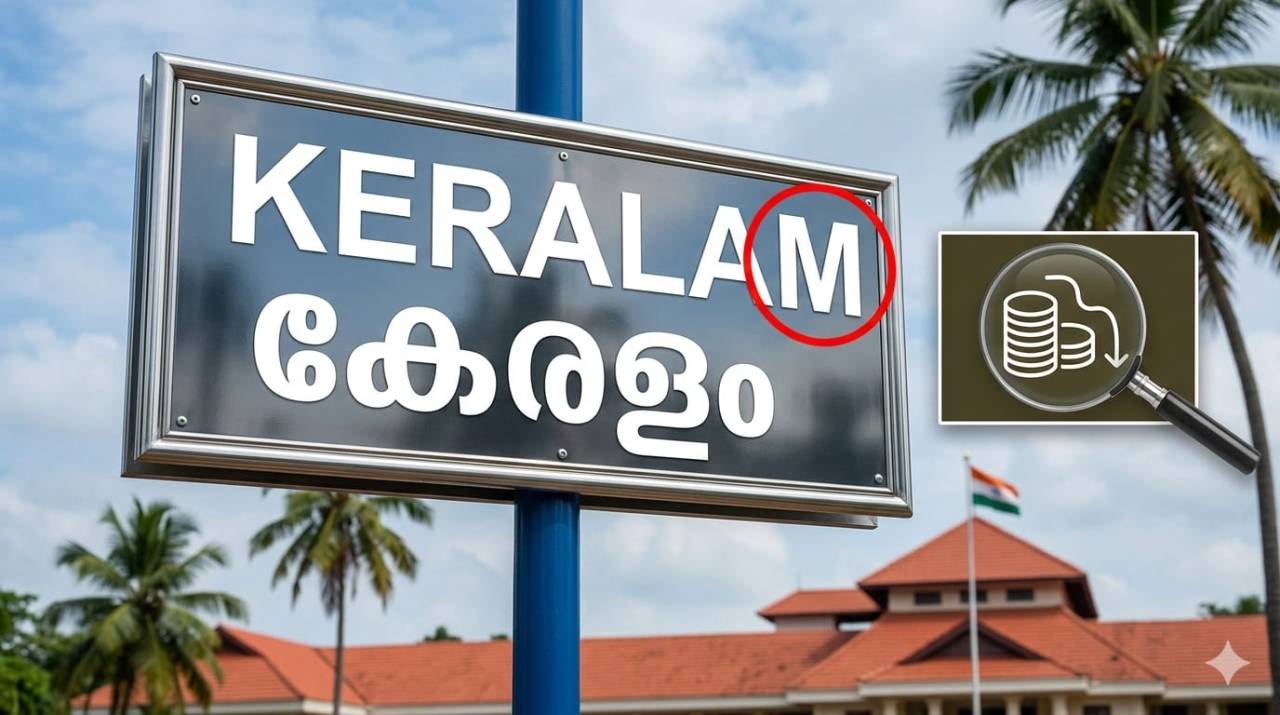
Can a single letter change the identity of a state—or just drain its treasury? As Kerala moves to become “Keralam,” the debate is no longer about pronunciation, but about whether cultural pride is worth the price of rewriting an entire system.
For nearly seventy years, the state on India’s southwest coast has carried two names. On official maps and in government records, it has been known as Kerala. But in the Malayalam language spoken by its people, it has always been called Keralam. Now, the Union government has cleared the state’s request to officially change its name to Keralam. What may seem like a small change—the addition of just one letter, “M”—has opened up a larger debate about identity, culture, and cost.
Supporters of the change say this is about cultural pride. The word “Keralam” comes from “keram,” the Malayalam word for coconut, which reflects the state’s landscape filled with coconut trees. They argue that the state’s official name should match the way people actually pronounce it in their own language. For many residents, this is not just about spelling. It is about respect for local identity and linguistic heritage.
However, critics believe the issue is more complicated. Changing a state’s name is not as simple as updating a few documents. It involves a long administrative process. Every government department will need to update its official seal and letterhead. Court documents, university degrees, school textbooks, public signboards, and official websites will all need to be revised. Even state-owned companies and sports teams may have to rebrand. The cumulative cost of these changes could be significant.
Kerala is already facing financial challenges. The state government has often raised concerns about limited funds and increasing debt. In such a situation, critics question whether spending money on a name change is a priority. They argue that funds could instead be used for public services like healthcare, education, and infrastructure. For them, the issue is not about rejecting cultural pride but about choosing practical needs over symbolic gestures.
Some observers also point out that many places around the world have different names in different languages without needing a complete official overhaul. For example, several European cities are known by one name in English and another in their native language. These variations exist without causing confusion or requiring expensive changes. According to this view, “Kerala” could continue to be used in English, while “Keralam” remains the preferred name in Malayalam.
This move is different from major name changes in India’s past. In the mid-20th century, states such as Madras were renamed Tamil Nadu, and Mysore became Karnataka. Those changes were part of a larger reorganization of states based on language after independence. They aimed to create a stronger sense of unity among people who shared a common language. Kerala itself was formed in 1956 by merging Travancore, Kochi, and Malabar to create a Malayalam-speaking state. The current proposal does not involve a new political structure but focuses mainly on correcting the English version of the name.
The debate over names is not limited to Kerala. In West Bengal, Chief Minister Mamata Banerjee has also pushed for a name change. She has argued that the word “West” no longer makes sense after the Partition of India and that the state should be called “Bangla.” She has even pointed out that because “West Bengal” starts with the letter “W,” it appears near the end of alphabetical lists, meaning her state often gets a chance to speak later at official meetings. While this may sound minor, it shows how names can carry political and emotional meaning.
In the end, the question is whether the symbolic value of the extra “M” justifies the financial and administrative burden. For many people, “Keralam” feels more authentic and culturally accurate. For others, the timing raises concerns about priorities during economic strain.
The decision now moves from approval to implementation, and the real impact will become clear only over time. What is certain is that a single letter has sparked a serious discussion about language, identity, and responsible governance.











Leave a Comment