
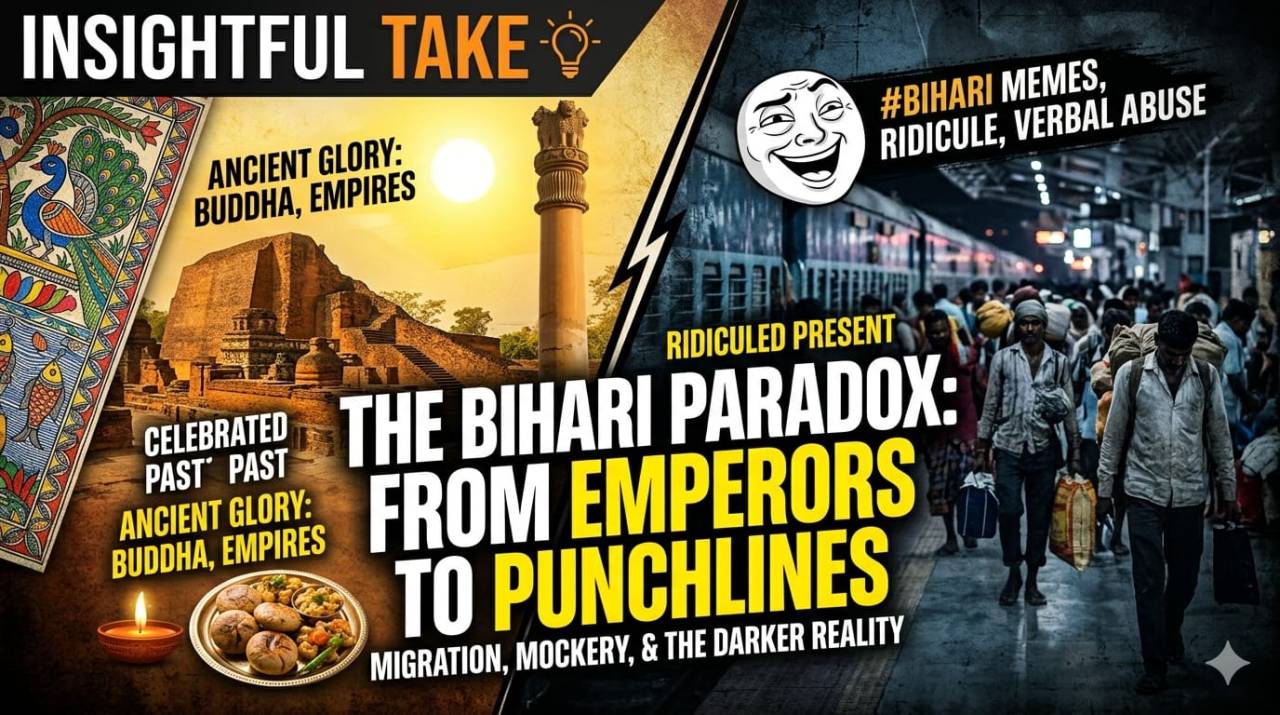
India often takes pride in its ancient past, and Bihar stands at the center of that legacy. Once the seat of the powerful Magadh Empire, this land shaped governance, philosophy, and education for centuries. Under Ashoka, one of history’s largest empires flourished. The political wisdom of Chanakya continues to influence modern thought. Great centers of learning like Nalanda University attracted scholars from across the world.
Bihar was not just a region. It was a symbol of power, intellect, and cultural depth.
Yet today, the word “Bihari” often carries a very different meaning.
The Shift from Power to Perception
The transformation of Bihar’s identity did not happen suddenly. It is rooted in decades of economic and structural challenges. Even today, Bihar ranks among the lowest in India in terms of per capita income. While the national average income has crossed ₹1.5 lakh annually, Bihar’s remains significantly lower.
Industrial growth has been limited. Employment opportunities within the state have struggled to keep pace with its large and young population. As a result, migration has become a defining feature of Bihar’s modern identity.
Millions of people from Bihar move to cities like Delhi, Mumbai, Surat, and Bengaluru in search of work. According to labour estimates, migrant workers from Bihar form a substantial part of the workforce in construction, manufacturing, and informal sectors across India.
This is where the paradox begins.
Builders Without Recognition
Bihari workers are among the key contributors to India’s urban expansion. They build highways, metro systems, housing complexes, and commercial spaces. In many major cities, a significant portion of the construction workforce comes from states like Bihar.
Yet, their contribution is rarely acknowledged with dignity.
Instead, they are often treated as outsiders. From regional tensions in the past to everyday discrimination, Bihari migrants have repeatedly faced hostility. They live in cramped spaces, work long hours, and send a large part of their income back home—supporting families and local economies.
Their labour builds the nation, but their identity is reduced to a stereotype.
The Role of Media and Language
Popular culture has played a major role in shaping this perception.
For decades, films and television have portrayed characters with Bihari accents in limited roles—often as comic figures, criminals, or uneducated workers. The rich linguistic diversity of Bihar, including Bhojpuri, Maithili, and Magahi, is rarely represented with authenticity or respect.
This repeated portrayal has influenced how people perceive the identity in real life.
A student from Patna or Darbhanga moving to a metro city often feels the need to change how they speak. Accents are softened. Words are adjusted. Identity becomes something to hide rather than celebrate.
Digital Age, Deeper Divide
Social media has amplified these stereotypes.
Online trends frequently label content associated with rural or economically weaker backgrounds as “cringe.” The term “Bihari” is often used casually in memes, reinforcing negative perceptions. What is seen as “quirky” or “creative” in urban contexts is mocked when it comes from smaller towns.
This digital behavior normalizes bias. It allows discrimination to exist under the cover of humor.
The Burden of Historical Labels
Bihar’s image is also shaped by long-standing labels. The term “BIMARU,” once used to describe economically weaker states, continues to influence perception even today.
In education and employment, this bias can be subtle but real. Students from Bihar often have to prove themselves beyond their achievements. High performance is sometimes met with skepticism, influenced by isolated incidents that are unfairly generalized.
This creates a cycle where success becomes a means of escape rather than a tool for development within the state.
Data Tells a Different Story
Despite these challenges, Bihar’s reality is not one-dimensional.
The state has one of the youngest populations in India, offering a strong demographic advantage. Literacy rates have improved significantly over the past two decades. School enrollment has increased, and more students are entering higher education and competitive exams.
Bihar continues to produce a large number of candidates for civil services and national-level examinations. Its workforce plays a crucial role in sustaining both urban economies and rural households through remittances.
This reflects resilience, not weakness.
Redefining Identity
The reduction of Bihar’s identity from empire to stereotype is not just about economics. It is about perception shaped by history, media, and social attitudes.
The reality is more complex.
Bihar’s past represents power and knowledge. Its present reflects struggle and adaptation. Its people continue to contribute, build, and move forward despite systemic challenges.
The real question is not whether Bihar has changed.
It is whether India is willing to change how it sees Bihar.
Beyond the Stereotype
Respect for Bihar cannot remain limited to its history. It must extend to its people in the present.
A migrant worker building a city deserves the same dignity as the history that built a civilization. A student from Bihar deserves recognition without prejudice. An identity should not be reduced to a punchline.
Bihar does not lack power.
What it lacks is fair perception.
Until the word “Bihari” is used with the same respect as the legacy it represents, the journey from empire to stereotype will remain incomplete—not as a failure of Bihar, but as a reflection of society itself.




















Leave a Comment