
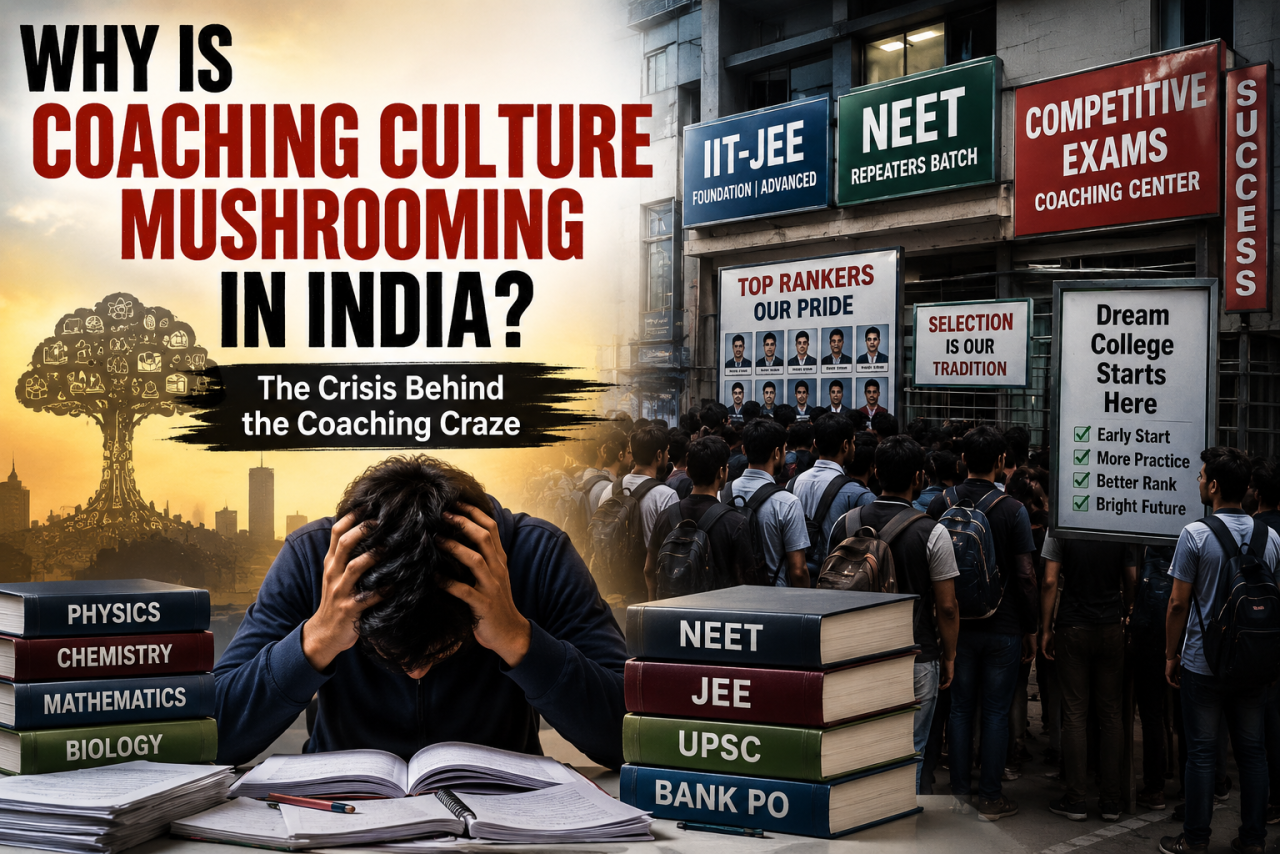
Why does a student need coaching after spending 12 years in school and several more years in college? India’s booming coaching industry exposes a deeper crisis in the country’s education system.
India’s coaching culture is no longer a parallel support system for education. It has become an industry in its own right. From schoolchildren preparing for entrance examinations to graduates chasing government jobs, coaching centres have become an almost unavoidable part of the Indian education journey.
But why has this culture grown so rapidly?
The biggest reason is the inability of the formal education system to prepare students adequately for the highly competitive examinations that determine access to some of the country’s most sought-after careers. Successive governments, regardless of political affiliation, have contributed to this situation, either through policy failures, inadequate investment or an inability to reform the system according to changing aspirations and employment patterns.
If a student spends nearly 12 years in school and several more years in college but still needs another institution to prepare for an examination that determines his or her career, it raises an uncomfortable question. What exactly is the formal education system preparing students for?
The problem is not simply that students want coaching. The deeper issue is that schools and colleges have increasingly failed to bridge the gap between classroom education and the demands of competitive examinations and the employment market.
Education Has Become a Two-Tier System
The expansion of private education has created another layer of inequality. Families who can afford expensive schools, private tutors and coaching institutes can provide their children with multiple opportunities to prepare for competitive examinations. Those who cannot afford them are often left dependent on government schools and colleges that may not have comparable infrastructure, teaching resources or academic support.
This has gradually produced a two-tier education system.
India also faces a huge geographical gap in access to education. A large share of the country's population lives in rural areas, where quality schools and higher educational institutions remain unevenly distributed. Colleges are often concentrated in district headquarters and larger towns. Students from villages may have to travel considerable distances to pursue degree-level education.
The result is that education itself becomes an economic burden long before a student enters the job market.
In many urban families, educating a child from nursery to Class 12 can cost several lakhs of rupees, particularly when private schooling, transportation, extracurricular activities and other expenses are included. After such expenditure, parents are often confronted with another financial demand: coaching.
The question that needs to be asked is simple. If formal education requires coaching to make students competitive, who is responsible for the gap?
Coaching Has Turned Into a Business Model
The education sector has attracted large private players because the demand is enormous. Competitive examinations such as NEET and JEE create a market where millions of students and their families are willing to spend heavily in the hope of securing a limited number of seats.
This is where the psychology of aspiration becomes important.
Parents are not merely buying classes. They are buying the possibility of a better future for their children.
Coaching companies understand this perfectly. Their advertisements frequently highlight extraordinary success stories, top rankers and students who transformed their lives after joining a particular institute. Such stories may be genuine, but they rarely communicate the complete picture.
For every student who secures a top rank, thousands of others may not achieve the desired result.
The enormous gap between the number of aspirants and available seats makes this reality even more important. Millions compete for a relatively small number of seats in premier institutions and professional courses. Yet the coaching industry often presents competitive examinations as if disciplined preparation alone can guarantee success.
That creates expectations that the education system and the coaching industry are both struggling to manage responsibly.
Why Do Students Still Choose Engineering and Medicine?
India has thousands of career possibilities, but social expectations continue to push students towards a narrow set of professions.
Engineering and medicine remain particularly powerful symbols of success. A doctor is seen as secure and respected. An engineer, especially from a prestigious institution, is associated with financial stability and social mobility.
For many parents, therefore, NEET and JEE are not simply examinations. They are perceived as gateways to a secure life.
The problem begins when this aspiration becomes pressure.
A student who may be naturally talented in design, law, journalism, teaching, research, sports, entrepreneurship, hospitality or hundreds of other fields can be made to believe that failure in NEET or JEE means failure in life.
That is a dangerous message to send to young people.
The increasing anxiety around competitive examinations has also raised concerns about student mental health and extreme academic pressure. When children are told repeatedly that one examination will determine their future, failure can appear much bigger than it actually is.
The Coaching Industry Is Starting Earlier
Perhaps the most worrying development is the shrinking age at which competitive-examination preparation begins.
Coaching is no longer restricted to students in Classes 11 and 12. Many institutions now encourage parents to start preparing children years in advance.
Class 8 students can be told that their future depends on beginning preparation for NEET or JEE early. The logic is simple: more years of preparation supposedly mean a greater probability of success.
But childhood cannot become an extended examination-preparation programme.
When coaching begins too early, students may lose opportunities to explore their interests, develop creativity, participate in sports, read widely or simply experience childhood without constant academic pressure.
Schools Cannot Escape Accountability
The rise of coaching culture should not be blamed entirely on coaching institutes. Schools, colleges and governments must also examine their own responsibilities.
A school should not merely complete a syllabus. It should help students develop conceptual understanding, communication skills, problem-solving abilities and confidence. Colleges should similarly provide meaningful academic and professional exposure rather than functioning merely as degree-distribution centres.
Governments, meanwhile, must address the shortage of quality educational institutions, improve teacher training, strengthen government schools and make higher education accessible beyond major cities.
The answer is not to eliminate private education or coaching. Private institutions can play an important role in expanding educational opportunities. The real requirement is accountability, transparency and regulation.
Coaching advertisements should not create unrealistic expectations. Fee structures should be transparent. Student safety and mental well-being must receive greater attention. Parents should also be provided with realistic information about selection rates instead of being exposed primarily to promotional success stories.
Coaching Is a Symptom, Not the Disease
India's coaching culture is ultimately a symptom of a much larger problem.
When millions of students compete for limited seats and even fewer quality employment opportunities, families naturally search for every possible advantage. Coaching centres simply occupy the space created by that demand.
Therefore, attacking coaching institutes alone will not solve the problem.
India needs better schools, stronger colleges, wider career awareness, more vocational opportunities and, most importantly, an economy capable of creating meaningful employment for its young population.
The country cannot build its future by making every child compete for a handful of seats.
Nor can education become a race in which parents pay repeatedly at every stage, first for school, then for college and finally for coaching to compensate for what school and college could not provide.
The real question is not why coaching centres are mushrooming.
The real question is why India's formal education system has allowed an entire industry to emerge around the gaps it was supposed to fill.
Until that question is confronted honestly, coaching culture will continue to grow, parents will continue to spend, students will continue to compete and the education system will continue to pass the responsibility from one institution to another.
India’s coaching culture is no longer a parallel support system for education. It has become an industry in its own right. From schoolchildren preparing for entrance examinations to graduates chasing government jobs, coaching centres have become an almost unavoidable part of the Indian education journey.
But why has this culture grown so rapidly?
The biggest reason is the inability of the formal education system to prepare students adequately for the highly competitive examinations that determine access to some of the country’s most sought-after careers. Successive governments, regardless of political affiliation, have contributed to this situation, either through policy failures, inadequate investment or an inability to reform the system according to changing aspirations and employment patterns.
If a student spends nearly 12 years in school and several more years in college but still needs another institution to prepare for an examination that determines his or her career, it raises an uncomfortable question. What exactly is the formal education system preparing students for?
The problem is not simply that students want coaching. The deeper issue is that schools and colleges have increasingly failed to bridge the gap between classroom education and the demands of competitive examinations and the employment market.
Education Has Become a Two-Tier System
The expansion of private education has created another layer of inequality. Families who can afford expensive schools, private tutors and coaching institutes can provide their children with multiple opportunities to prepare for competitive examinations. Those who cannot afford them are often left dependent on government schools and colleges that may not have comparable infrastructure, teaching resources or academic support.
This has gradually produced a two-tier education system.
India also faces a huge geographical gap in access to education. A large share of the country's population lives in rural areas, where quality schools and higher educational institutions remain unevenly distributed. Colleges are often concentrated in district headquarters and larger towns. Students from villages may have to travel considerable distances to pursue degree-level education.
The result is that education itself becomes an economic burden long before a student enters the job market.
In many urban families, educating a child from nursery to Class 12 can cost several lakhs of rupees, particularly when private schooling, transportation, extracurricular activities and other expenses are included. After such expenditure, parents are often confronted with another financial demand: coaching.
The question that needs to be asked is simple. If formal education requires coaching to make students competitive, who is responsible for the gap?
Coaching Has Turned Into a Business Model
The education sector has attracted large private players because the demand is enormous. Competitive examinations such as NEET and JEE create a market where millions of students and their families are willing to spend heavily in the hope of securing a limited number of seats.
This is where the psychology of aspiration becomes important.
Parents are not merely buying classes. They are buying the possibility of a better future for their children.
Coaching companies understand this perfectly. Their advertisements frequently highlight extraordinary success stories, top rankers and students who transformed their lives after joining a particular institute. Such stories may be genuine, but they rarely communicate the complete picture.
For every student who secures a top rank, thousands of others may not achieve the desired result.
The enormous gap between the number of aspirants and available seats makes this reality even more important. Millions compete for a relatively small number of seats in premier institutions and professional courses. Yet the coaching industry often presents competitive examinations as if disciplined preparation alone can guarantee success.
That creates expectations that the education system and the coaching industry are both struggling to manage responsibly.
Why Do Students Still Choose Engineering and Medicine?
India has thousands of career possibilities, but social expectations continue to push students towards a narrow set of professions.
Engineering and medicine remain particularly powerful symbols of success. A doctor is seen as secure and respected. An engineer, especially from a prestigious institution, is associated with financial stability and social mobility.
For many parents, therefore, NEET and JEE are not simply examinations. They are perceived as gateways to a secure life.
The problem begins when this aspiration becomes pressure.
A student who may be naturally talented in design, law, journalism, teaching, research, sports, entrepreneurship, hospitality or hundreds of other fields can be made to believe that failure in NEET or JEE means failure in life.
That is a dangerous message to send to young people.
The increasing anxiety around competitive examinations has also raised concerns about student mental health and extreme academic pressure. When children are told repeatedly that one examination will determine their future, failure can appear much bigger than it actually is.
The Coaching Industry Is Starting Earlier
Perhaps the most worrying development is the shrinking age at which competitive-examination preparation begins.
Coaching is no longer restricted to students in Classes 11 and 12. Many institutions now encourage parents to start preparing children years in advance.
Class 8 students can be told that their future depends on beginning preparation for NEET or JEE early. The logic is simple: more years of preparation supposedly mean a greater probability of success.
But childhood cannot become an extended examination-preparation programme.
When coaching begins too early, students may lose opportunities to explore their interests, develop creativity, participate in sports, read widely or simply experience childhood without constant academic pressure.
Schools Cannot Escape Accountability
The rise of coaching culture should not be blamed entirely on coaching institutes. Schools, colleges and governments must also examine their own responsibilities.
A school should not merely complete a syllabus. It should help students develop conceptual understanding, communication skills, problem-solving abilities and confidence. Colleges should similarly provide meaningful academic and professional exposure rather than functioning merely as degree-distribution centres.
Governments, meanwhile, must address the shortage of quality educational institutions, improve teacher training, strengthen government schools and make higher education accessible beyond major cities.
The answer is not to eliminate private education or coaching. Private institutions can play an important role in expanding educational opportunities. The real requirement is accountability, transparency and regulation.
Coaching advertisements should not create unrealistic expectations. Fee structures should be transparent. Student safety and mental well-being must receive greater attention. Parents should also be provided with realistic information about selection rates instead of being exposed primarily to promotional success stories.
Coaching Is a Symptom, Not the Disease
India's coaching culture is ultimately a symptom of a much larger problem.
When millions of students compete for limited seats and even fewer quality employment opportunities, families naturally search for every possible advantage. Coaching centres simply occupy the space created by that demand.
Therefore, attacking coaching institutes alone will not solve the problem.
India needs better schools, stronger colleges, wider career awareness, more vocational opportunities and, most importantly, an economy capable of creating meaningful employment for its young population.
The country cannot build its future by making every child compete for a handful of seats.
Nor can education become a race in which parents pay repeatedly at every stage, first for school, then for college and finally for coaching to compensate for what school and college could not provide.
The real question is not why coaching centres are mushrooming.
The real question is why India's formal education system has allowed an entire industry to emerge around the gaps it was supposed to fill.
Until that question is confronted honestly, coaching culture will continue to grow, parents will continue to spend, students will continue to compete and the education system will continue to pass the responsibility from one institution to another.























Leave a Comment