
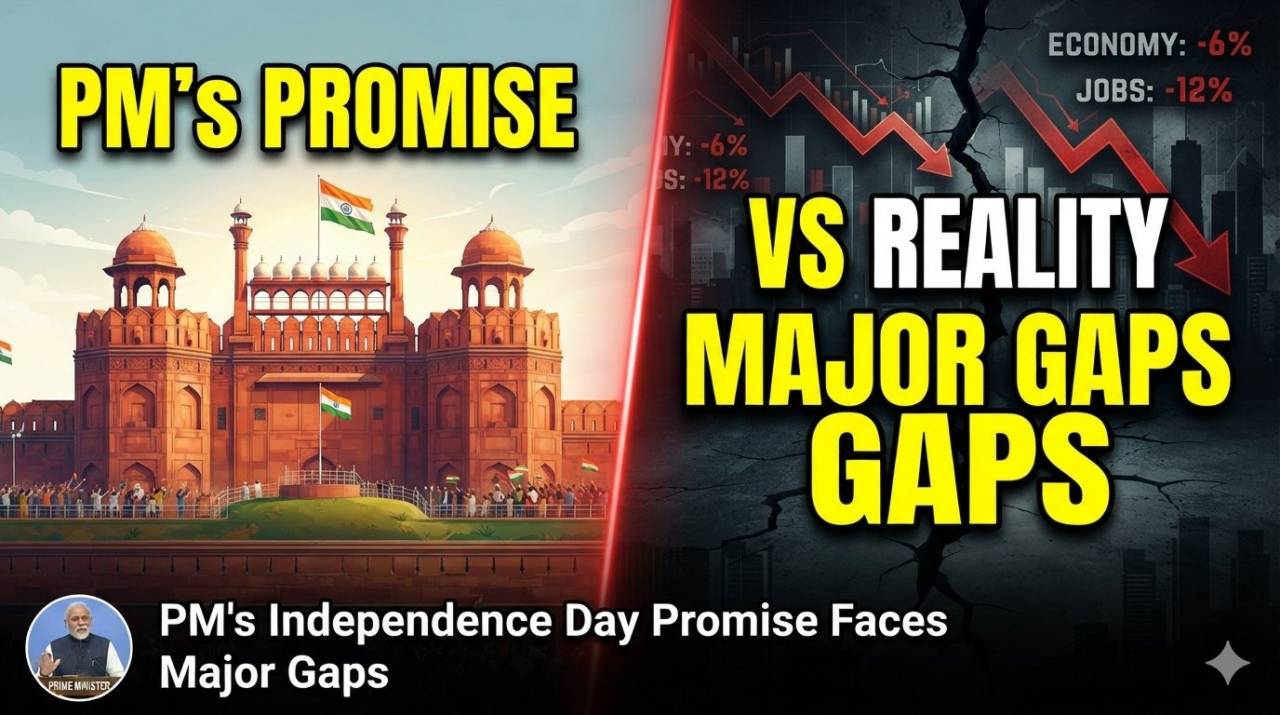
Free coaching sounds like a game changer, but can an online solution reach the students who need it most?
Prime Minister Narendra Modi’s Independence Day announcement of free online coaching for competitive exams sounds like the answer to a problem millions of Indian families know too well. But a closer look at how the promise is meant to work reveals a plan built more on good intentions than on ground reality.
A Digital Solution for a Country That Isn’t Fully Digital
The government’s plan rests on one crucial assumption that the students across India have reliable internet access to attend online classes.
That assumption does not hold up.
According to Telecom Regulatory Authority of India data for early 2026, rural India had just over 48 internet subscribers per 100 people, compared with nearly 127 per 100 in urban areas. The gap is significant. A large section of rural India still faces limited digital access.
The families the Prime Minister says he wants to help, particularly poor and middle-class households that cannot afford expensive coaching, are disproportionately located in areas where connectivity remains weakest.
A free coaching platform that cannot be reliably accessed is not free education. It risks becoming a promise aimed at students who already have better access to digital resources.
A Track Record That Raises Questions
This is also not India’s first attempt to reduce dependence on private coaching through digital platforms.
SWAYAM and DIKSHA have existed for years with government backing, offering thousands of free courses. SATHEE, the IIT Kanpur platform cited in the same announcement, has enrolled more than 21 lakh learners since its launch in 2023.
Those numbers are significant, but they represent only a fraction of the 7.1 crore students the coaching industry claims to serve every year.
That raises an obvious question: what will be different this time?
If an established government-backed platform with several years of operation has reached only a relatively small share of potential aspirants, a new announcement needs to explain not just what will be offered, but how it will reach the millions who remain outside the digital ecosystem.
The government’s own numbers on its AI training programme offer another reason for caution.
The Skilling for AI Readiness programme, launched in mid-2025 with the stated goal of building AI capabilities among students, had enrolled about 2.3 lakh learners by March 2026. Only around 29,800 had completed certification, implying a completion rate of roughly 13 percent.
Scaling the ambition from lakhs of learners to a stated target of 10 crore youth trained in AI within a year is certainly ambitious. But before announcing targets of that scale, the government also needs to address why so many learners fail to complete programmes they have already joined.
The Independence Day announcement did not provide that answer.
The Coaching Industry Isn’t Going Anywhere
There is another question the announcement largely sidesteps: scale.
India’s coaching industry is valued at more than ₹58,000 crore and is growing at an estimated 15 to 20 percent annually. Its growth is driven by intense competition for a limited number of seats in engineering, medical and other professional institutions, as well as government jobs.
A free government platform, however well designed, cannot by itself change that arithmetic.
As long as lakhs of students compete for a limited number of seats and jobs, families will continue to pay for anything they believe gives their children an advantage.
The problem was never simply that coaching costs money.
The deeper problem is that the number of opportunities has not kept pace with the number of aspirants.
Unless that imbalance is addressed, free coaching may reduce costs for some students without reducing the pressure that drives families towards private coaching in the first place.
The Regulation Question
There is also the issue of regulation.
India’s coaching sector remains largely unregulated, a concern that has been acknowledged by industry bodies as well as policymakers.
The government’s own expert committee, constituted in June 2025 to recommend reforms and reduce dependence on private coaching, has reportedly held three meetings in more than a year and is yet to submit its recommendations.
That creates an uncomfortable policy question.
Why announce a parallel solution before the committee tasked with examining the problem has completed its work?
The answer may simply be that governments cannot always wait for committees to finish before responding to public expectations. But it also risks making policy look reactive rather than carefully designed.
Good Intentions Are Not Enough
None of this means that free coaching infrastructure is a bad idea.
Reducing the financial burden on families and expanding access to quality teaching are worthwhile goals. A well-designed public coaching system could genuinely help students who currently depend on expensive private institutes.
But access cannot be measured merely by whether a course is free.
A useful public education programme must also be accessible, reliable, inclusive and capable of reaching students who need it most.
That means addressing internet connectivity, device access, language barriers, digital literacy, teacher quality, course completion and the availability of meaningful opportunities after preparation.
The Independence Day announcement may have been made from the Red Fort, but its success will ultimately be determined far away from the stage, in villages, small towns and households where students are struggling to prepare for JEE, NEET, UPSC and other competitive examinations.
Indian students deserve a genuine alternative to expensive coaching.
They need a system that is not merely free in name, but actually usable by the students it claims to serve.
Good intentions can open the door.
Only sound policy can get students through it.
Prime Minister Narendra Modi’s Independence Day announcement of free online coaching for competitive exams sounds like the answer to a problem millions of Indian families know too well. But a closer look at how the promise is meant to work reveals a plan built more on good intentions than on ground reality.
A Digital Solution for a Country That Isn’t Fully Digital
The government’s plan rests on one crucial assumption that the students across India have reliable internet access to attend online classes.
That assumption does not hold up.
According to Telecom Regulatory Authority of India data for early 2026, rural India had just over 48 internet subscribers per 100 people, compared with nearly 127 per 100 in urban areas. The gap is significant. A large section of rural India still faces limited digital access.
The families the Prime Minister says he wants to help, particularly poor and middle-class households that cannot afford expensive coaching, are disproportionately located in areas where connectivity remains weakest.
A free coaching platform that cannot be reliably accessed is not free education. It risks becoming a promise aimed at students who already have better access to digital resources.
A Track Record That Raises Questions
This is also not India’s first attempt to reduce dependence on private coaching through digital platforms.
SWAYAM and DIKSHA have existed for years with government backing, offering thousands of free courses. SATHEE, the IIT Kanpur platform cited in the same announcement, has enrolled more than 21 lakh learners since its launch in 2023.
Those numbers are significant, but they represent only a fraction of the 7.1 crore students the coaching industry claims to serve every year.
That raises an obvious question: what will be different this time?
If an established government-backed platform with several years of operation has reached only a relatively small share of potential aspirants, a new announcement needs to explain not just what will be offered, but how it will reach the millions who remain outside the digital ecosystem.
The government’s own numbers on its AI training programme offer another reason for caution.
The Skilling for AI Readiness programme, launched in mid-2025 with the stated goal of building AI capabilities among students, had enrolled about 2.3 lakh learners by March 2026. Only around 29,800 had completed certification, implying a completion rate of roughly 13 percent.
Scaling the ambition from lakhs of learners to a stated target of 10 crore youth trained in AI within a year is certainly ambitious. But before announcing targets of that scale, the government also needs to address why so many learners fail to complete programmes they have already joined.
The Independence Day announcement did not provide that answer.
The Coaching Industry Isn’t Going Anywhere
There is another question the announcement largely sidesteps: scale.
India’s coaching industry is valued at more than ₹58,000 crore and is growing at an estimated 15 to 20 percent annually. Its growth is driven by intense competition for a limited number of seats in engineering, medical and other professional institutions, as well as government jobs.
A free government platform, however well designed, cannot by itself change that arithmetic.
As long as lakhs of students compete for a limited number of seats and jobs, families will continue to pay for anything they believe gives their children an advantage.
The problem was never simply that coaching costs money.
The deeper problem is that the number of opportunities has not kept pace with the number of aspirants.
Unless that imbalance is addressed, free coaching may reduce costs for some students without reducing the pressure that drives families towards private coaching in the first place.
The Regulation Question
There is also the issue of regulation.
India’s coaching sector remains largely unregulated, a concern that has been acknowledged by industry bodies as well as policymakers.
The government’s own expert committee, constituted in June 2025 to recommend reforms and reduce dependence on private coaching, has reportedly held three meetings in more than a year and is yet to submit its recommendations.
That creates an uncomfortable policy question.
Why announce a parallel solution before the committee tasked with examining the problem has completed its work?
The answer may simply be that governments cannot always wait for committees to finish before responding to public expectations. But it also risks making policy look reactive rather than carefully designed.
Good Intentions Are Not Enough
None of this means that free coaching infrastructure is a bad idea.
Reducing the financial burden on families and expanding access to quality teaching are worthwhile goals. A well-designed public coaching system could genuinely help students who currently depend on expensive private institutes.
But access cannot be measured merely by whether a course is free.
A useful public education programme must also be accessible, reliable, inclusive and capable of reaching students who need it most.
That means addressing internet connectivity, device access, language barriers, digital literacy, teacher quality, course completion and the availability of meaningful opportunities after preparation.
The Independence Day announcement may have been made from the Red Fort, but its success will ultimately be determined far away from the stage, in villages, small towns and households where students are struggling to prepare for JEE, NEET, UPSC and other competitive examinations.
Indian students deserve a genuine alternative to expensive coaching.
They need a system that is not merely free in name, but actually usable by the students it claims to serve.
Good intentions can open the door.
Only sound policy can get students through it.














Leave a Comment