
Once reserved for winter, the scarf is becoming summer's standout menswear accessory. From Milan's catwalks to celebrity wardrobes, here's why men are embracing this timeless style staple.
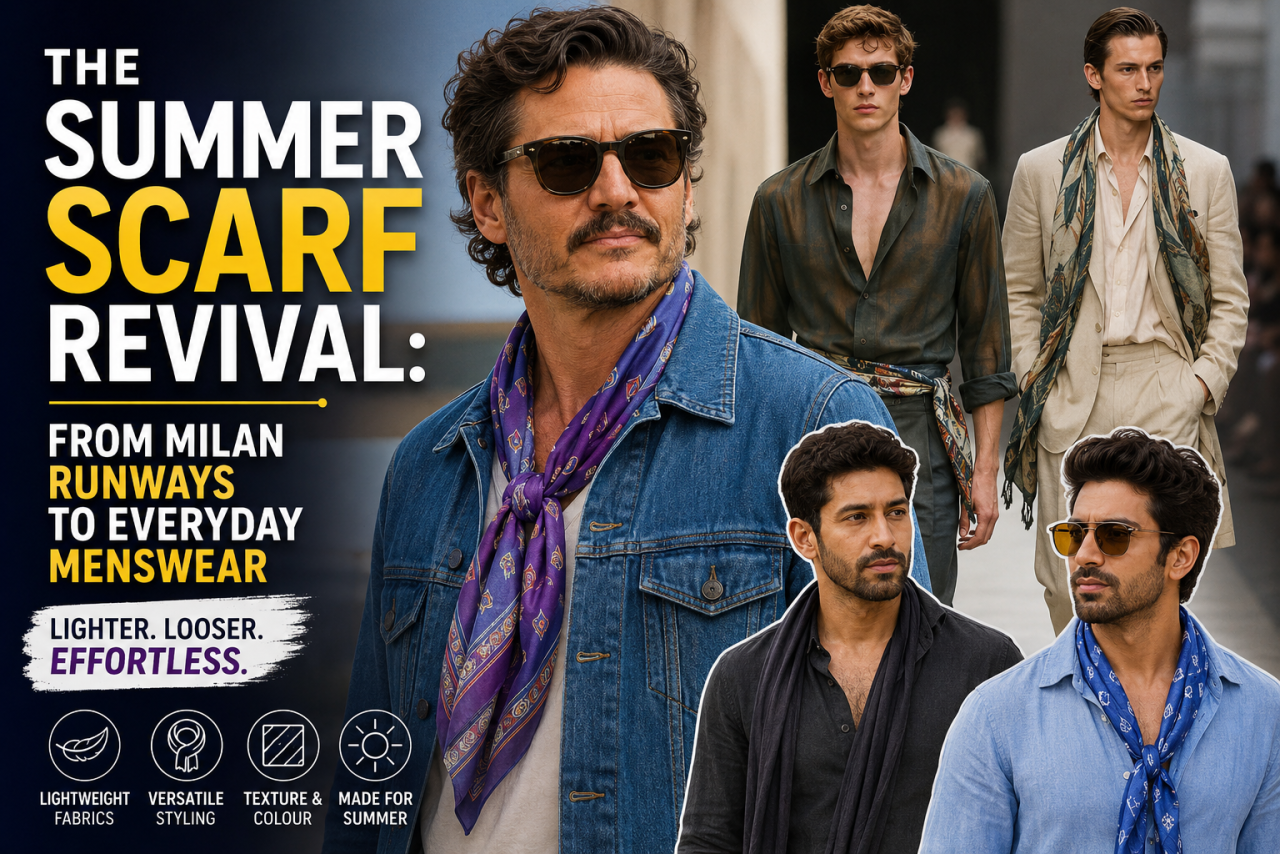
The scarf, long treated as a winter essential, has found a new season. Across the Spring/Summer 2027 menswear runways and red carpets, the accessory is reappearing in silk, linen and cotton—worn loosely around the neck, draped over the shoulder or tied at the waist rather than wrapped tightly for warmth.
Actor Pedro Pascal became one of the most visible faces of the trend after appearing at a Los Angeles film premiere in a printed purple silk scarf paired with a simple denim jacket. The look quickly moved beyond fashion pages into mainstream style conversations, with other public figures embracing the accessory in recent appearances. Actors Vikrant Massey and Saqib Saleem have also incorporated scarves into casual dressing—one opting for a charcoal black piece, the other pairing a fitted blue silk scarf with an understated outfit for a refined finish.
On the runway, the revival is even more pronounced. Prada and Ralph Lauren both made scarves a defining styling element in their Spring/Summer 2027 menswear collections. Prada transformed printed silk scarves into cummerbunds, replacing the conventional necktie with something softer and more relaxed. Ralph Lauren styled scarves around the waist and hips, lending tailored looks a sense of vintage, off-duty glamour.
Elsewhere in Milan, Saint Laurent, Anthony Vaccarello and Dior Men also embraced the accessory, layering narrow silk scarves over lightweight suits and formal coats to add texture without overwhelming the silhouette.
Costume designer Sia Seth, who has worked across Indian film and television, believes the resurgence reflects a broader shift in menswear. According to her, public figures confidently pairing scarves with contemporary clothing are helping dismantle the hesitation that once surrounded the accessory for men. In her view, the trend reflects a wider understanding that masculinity need not be confined to rigid ideas of dressing.
That shift is visible in India as well, though in a distinctly local form. Scarves have always existed in Indian wardrobes, even if they have not traditionally been described that way. The dupatta worn with traditional attire, the stole paired with kurtas and the gamchha used across regions all serve similar purposes. What is changing, Seth says, is the styling. These familiar pieces are increasingly being worn casually—draped around the neck, tied loosely at the waist like a cummerbund or layered over jackets rather than remaining fixed to traditional outfits.
For those looking to embrace the trend this summer, stylist Vikram Seth Sharma recommends keeping the approach understated. Cotton and linen scarves are ideal for daytime because they remain breathable in warmer weather, while lightweight silk works well for evening occasions. A loosely tied scarf over an open-collar shirt or paired with a blazer creates an effortless finish without appearing overstyled.
He also suggests choosing tonal shades or understated prints for everyday wear, while using brighter scarves to add colour to darker outfits. With linen or cotton shirts, a scarf can provide visual interest without the need for an additional jacket.
The rest of the styling, Sharma says, should remain restrained. Avoiding chunky jewellery and excessive layering allows the scarf to remain the focal point rather than competing with other accessories.
From Los Angeles red carpets to Milan runways and India's longstanding textile traditions, the scarf has moved well beyond its role as a winter necessity. In its lighter summer form, it has become one of menswear's most versatile accessories—bringing colour, texture and personality to warm-weather dressing with effortless ease.
The scarf, long treated as a winter essential, has found a new season. Across the Spring/Summer 2027 menswear runways and red carpets, the accessory is reappearing in silk, linen and cotton—worn loosely around the neck, draped over the shoulder or tied at the waist rather than wrapped tightly for warmth.
Actor Pedro Pascal became one of the most visible faces of the trend after appearing at a Los Angeles film premiere in a printed purple silk scarf paired with a simple denim jacket. The look quickly moved beyond fashion pages into mainstream style conversations, with other public figures embracing the accessory in recent appearances. Actors Vikrant Massey and Saqib Saleem have also incorporated scarves into casual dressing—one opting for a charcoal black piece, the other pairing a fitted blue silk scarf with an understated outfit for a refined finish.
On the runway, the revival is even more pronounced. Prada and Ralph Lauren both made scarves a defining styling element in their Spring/Summer 2027 menswear collections. Prada transformed printed silk scarves into cummerbunds, replacing the conventional necktie with something softer and more relaxed. Ralph Lauren styled scarves around the waist and hips, lending tailored looks a sense of vintage, off-duty glamour.
Elsewhere in Milan, Saint Laurent, Anthony Vaccarello and Dior Men also embraced the accessory, layering narrow silk scarves over lightweight suits and formal coats to add texture without overwhelming the silhouette.
Costume designer Sia Seth, who has worked across Indian film and television, believes the resurgence reflects a broader shift in menswear. According to her, public figures confidently pairing scarves with contemporary clothing are helping dismantle the hesitation that once surrounded the accessory for men. In her view, the trend reflects a wider understanding that masculinity need not be confined to rigid ideas of dressing.
That shift is visible in India as well, though in a distinctly local form. Scarves have always existed in Indian wardrobes, even if they have not traditionally been described that way. The dupatta worn with traditional attire, the stole paired with kurtas and the gamchha used across regions all serve similar purposes. What is changing, Seth says, is the styling. These familiar pieces are increasingly being worn casually—draped around the neck, tied loosely at the waist like a cummerbund or layered over jackets rather than remaining fixed to traditional outfits.
For those looking to embrace the trend this summer, stylist Vikram Seth Sharma recommends keeping the approach understated. Cotton and linen scarves are ideal for daytime because they remain breathable in warmer weather, while lightweight silk works well for evening occasions. A loosely tied scarf over an open-collar shirt or paired with a blazer creates an effortless finish without appearing overstyled.
He also suggests choosing tonal shades or understated prints for everyday wear, while using brighter scarves to add colour to darker outfits. With linen or cotton shirts, a scarf can provide visual interest without the need for an additional jacket.
The rest of the styling, Sharma says, should remain restrained. Avoiding chunky jewellery and excessive layering allows the scarf to remain the focal point rather than competing with other accessories.
From Los Angeles red carpets to Milan runways and India's longstanding textile traditions, the scarf has moved well beyond its role as a winter necessity. In its lighter summer form, it has become one of menswear's most versatile accessories—bringing colour, texture and personality to warm-weather dressing with effortless ease.

























Leave a Comment