
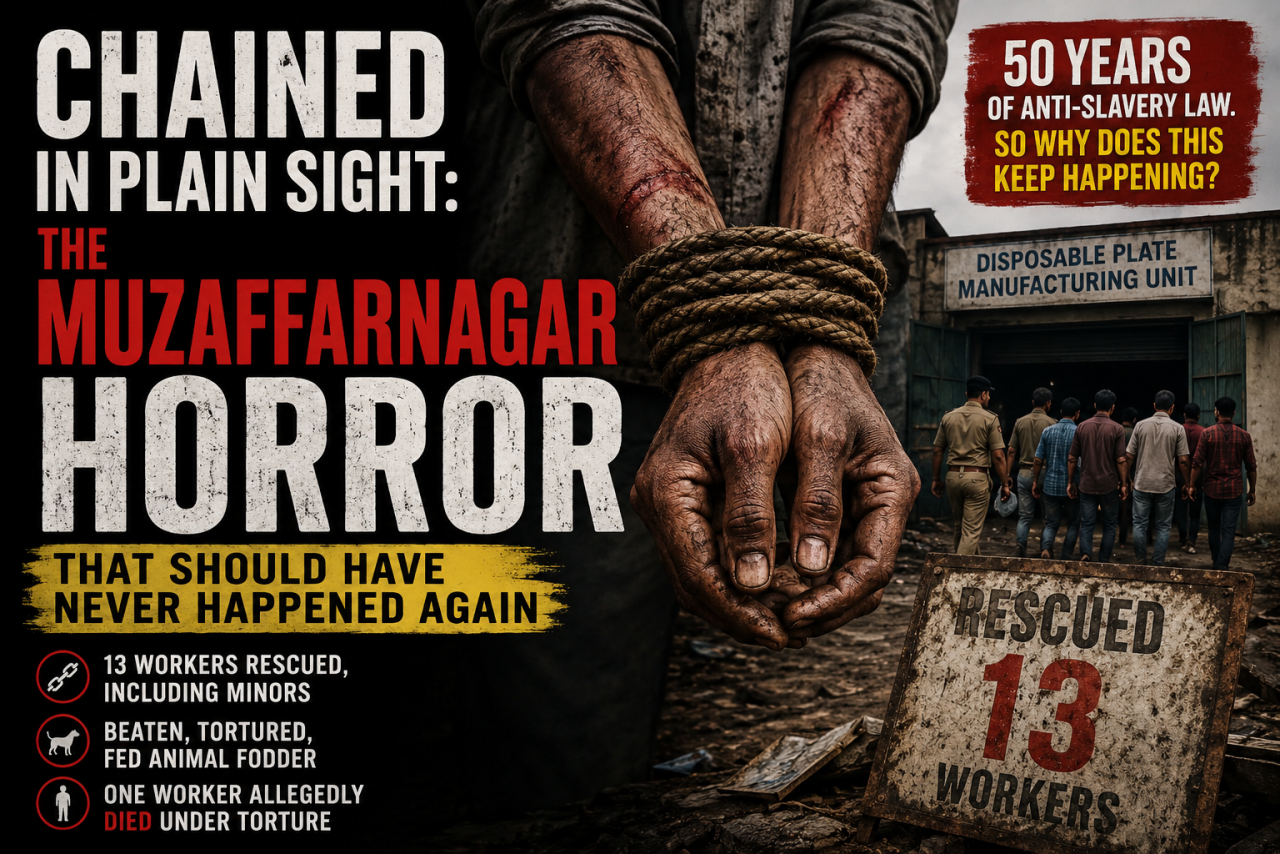
A factory in western Uttar Pradesh held men captive for months, beating them with belts, setting dogs on them and feeding them animal fodder. One worker allegedly died under torture. India's bonded labour law has been on the books for fifty years.
On the morning of June 22, a labourer from Sitapur climbed over the boundary wall of a disposable plate manufacturing unit in Mandi village, Muzaffarnagar, and ran. He ran to the Titawi police station. What he told officers there set in motion a rescue that would expose one of the most disturbing cases of forced labour to emerge from Uttar Pradesh in recent years — and reignite a conversation that India has been avoiding for half a century.
When police and the Labour Department raided the factory later that day, they freed thirteen workers — including at least two minors, aged 16 and 17 — who had allegedly been held against their will for months, some for nearly two years. They came from across the country: Haryana, Punjab, Rajasthan, Jharkhand, Bihar, Uttarakhand and Nepal. Their stories, told to investigators through tears and visible wounds, followed a pattern that should by now be etched into public memory as a warning — except that it never quite has been.
How a Job Promise Became a Prison
The workers say they were recruited at bus stands and railway stations, the oldest hunting grounds for labour traffickers in India. They were promised regular wages, decent food and fair treatment. What they found instead was a factory that had been converted, by design or by cruelty, into something indistinguishable from a detention facility.
Their phones were taken. Their Aadhaar cards were seized. Without identity documents or the ability to contact their families, they were, in effect, invisible. The outside world had no way of knowing they existed inside those walls. Two pitbull dogs were reportedly stationed at the premises, a calculated deterrent against escape attempts.
For those who tried anyway — or who simply asked to go home — punishment was swift and violent. Workers told investigators they were beaten with belts, stabbed with spears, attacked by the dogs and, in what stands as one of the most chilling details of the case, fed fodder meant for animals. Jagdish, a resident of Sitapur who spent eleven months inside the factory, described asking to leave over and over again, and being beaten each time in response.
Then came the most alarming allegation of all. Senior Superintendent of Police Sanjay Kumar confirmed on Thursday that a worker named Arjun had allegedly died in November 2025 following torture at the factory. His body, police allege, was packed into a bag and disposed of. A man died. And no one on the outside knew.
Police have arrested Pradeep Balyan and Shiva Tyagi in connection with the case. The factory owner, Ankit Balyan, remains absconding. Cases have been registered under the Bharatiya Nyaya Sanhita, the Bonded Labour System (Abolition) Act and the Child Labour (Prohibition and Regulation) Act.
Fifty Years of a Law Nobody Enforces
The Bonded Labour System (Abolition) Act was passed by Parliament in 1976. It did not merely prohibit bonded labour — it declared the entire system illegal in one sweeping stroke, mandating that every bonded labourer stands freed from any obligation to render forced work, with immediate effect.
That was fifty years ago.
India committed at the United Nations in 2016 to identify, release and rehabilitate 18.4 million people trapped in bonded labour by the year 2030 — roughly 1.3 million workers per year. The reality, revealed through Right to Information requests, is a number so far removed from that target that it is difficult to characterise it as anything other than institutional indifference. Between April 2024 and January 2025, just 246 bonded labourers were rescued and rehabilitated across the entire country. Not thousands. Not hundreds of thousands. Two hundred and forty-six.
At that rate, as one analysis calculated, India will fulfil approximately two per cent of its self-declared goal. The Parliamentary Standing Committee on Labour, Textiles and Skill Development described the figures as a stark illustration that the scourge of bonded labour is "spreading its tentacles" — words from legislators sitting in the same Parliament that passed the 1976 law, describing a crisis as though it had arrived from outside rather than festered within.
The Faces of Bonded Labour
The face of bonded labour in India is not random. An analysis of National Crime Records Bureau data shows that 96 per cent of cases registered under the Bonded Labour Act in 2019 involved crimes against Scheduled Castes and Scheduled Tribes. Separate research estimates that between 80 and 98 per cent of bonded labourers in India are Dalits or members of indigenous communities — people for whom the social order has historically substituted exploitation for employment.
The ILO's India Employment Report notes that approximately 90 per cent of India's workers are informally employed, with no social security. In this vast, unregistered economy, the mechanisms of bondage thrive: a wage advance here, a fabricated debt there, documents confiscated, movement restricted and violence normalised. The Muzaffarnagar workers are not an exception. They are an illustration.
Migrant workers are among the most vulnerable. Recruited through middlemen with promises of stable work, they arrive in unfamiliar cities with no local support networks, little knowledge of their legal rights and no one to call when things go wrong. Their phones, in the Mandi village case, were allegedly taken away specifically to ensure that last point held.
The System That Looks Away
The Muzaffarnagar case exposes not one failure but a cascade of them. A factory reportedly operating in this manner for close to two years — allegedly killing one worker — in a village under the jurisdiction of a functioning police station. Labour inspectors whose mandate includes proactive monitoring of workplaces. A district administration with legal responsibility to identify and rehabilitate bonded workers. All of it, somehow, not enough for Arjun to come home alive.
The NHRC and the ILO have repeatedly flagged poor identification of bonded labour cases at the ground level, weak rehabilitation efforts once workers are rescued and slow disbursement of rehabilitation funds meant to help them rebuild their lives. The Central Sector Scheme for Rehabilitation of Bonded Labourers, updated in 2021, promises up to ₹3 lakh to freed workers. In practice, administrative gaps mean many never receive it.
The law exists. The money exists, at least on paper. What is missing is the political will to treat the eradication of bonded labour as something more than a line item in a government commitment document.
A Democracy's Open Secret
Congress leader Rahul Gandhi, responding to the Muzaffarnagar rescue, described the treatment of the workers as an "assault on human dignity." He is right. But the assault did not begin on the day these men walked through the factory gates. It began in the structural conditions that made them recruitable — the poverty, the lack of formal employment, the absence of social security and the desperation that makes a stranger's promise of wages worth following into an unknown city.
India's Constitution, under Articles 21 and 23, explicitly prohibits forced labour and guarantees the right to life and personal liberty. These are not aspirational clauses. They are fundamental rights, enforceable in court and theoretically protected by the full weight of the state. The men in Mandi village had those rights on the day they arrived. They had them every day of their captivity. Arjun had them the day he allegedly died.
The horror of the Muzaffarnagar case is not that the law failed. It is that the law was never truly activated on behalf of the people it was written to protect. That is a governance failure. It is also a democratic one — a measure of how deeply the voices of the vulnerable fail to penetrate systems built, at least in theory, to hear them.
One worker climbed a wall and ran to a police station. Thirteen people came out. One did not.
India cannot keep waiting for the one who runs.
On the morning of June 22, a labourer from Sitapur climbed over the boundary wall of a disposable plate manufacturing unit in Mandi village, Muzaffarnagar, and ran. He ran to the Titawi police station. What he told officers there set in motion a rescue that would expose one of the most disturbing cases of forced labour to emerge from Uttar Pradesh in recent years — and reignite a conversation that India has been avoiding for half a century.
When police and the Labour Department raided the factory later that day, they freed thirteen workers — including at least two minors, aged 16 and 17 — who had allegedly been held against their will for months, some for nearly two years. They came from across the country: Haryana, Punjab, Rajasthan, Jharkhand, Bihar, Uttarakhand and Nepal. Their stories, told to investigators through tears and visible wounds, followed a pattern that should by now be etched into public memory as a warning — except that it never quite has been.
How a Job Promise Became a Prison
The workers say they were recruited at bus stands and railway stations, the oldest hunting grounds for labour traffickers in India. They were promised regular wages, decent food and fair treatment. What they found instead was a factory that had been converted, by design or by cruelty, into something indistinguishable from a detention facility.
Their phones were taken. Their Aadhaar cards were seized. Without identity documents or the ability to contact their families, they were, in effect, invisible. The outside world had no way of knowing they existed inside those walls. Two pitbull dogs were reportedly stationed at the premises, a calculated deterrent against escape attempts.
For those who tried anyway — or who simply asked to go home — punishment was swift and violent. Workers told investigators they were beaten with belts, stabbed with spears, attacked by the dogs and, in what stands as one of the most chilling details of the case, fed fodder meant for animals. Jagdish, a resident of Sitapur who spent eleven months inside the factory, described asking to leave over and over again, and being beaten each time in response.
Then came the most alarming allegation of all. Senior Superintendent of Police Sanjay Kumar confirmed on Thursday that a worker named Arjun had allegedly died in November 2025 following torture at the factory. His body, police allege, was packed into a bag and disposed of. A man died. And no one on the outside knew.
Police have arrested Pradeep Balyan and Shiva Tyagi in connection with the case. The factory owner, Ankit Balyan, remains absconding. Cases have been registered under the Bharatiya Nyaya Sanhita, the Bonded Labour System (Abolition) Act and the Child Labour (Prohibition and Regulation) Act.
Fifty Years of a Law Nobody Enforces
The Bonded Labour System (Abolition) Act was passed by Parliament in 1976. It did not merely prohibit bonded labour — it declared the entire system illegal in one sweeping stroke, mandating that every bonded labourer stands freed from any obligation to render forced work, with immediate effect.
That was fifty years ago.
India committed at the United Nations in 2016 to identify, release and rehabilitate 18.4 million people trapped in bonded labour by the year 2030 — roughly 1.3 million workers per year. The reality, revealed through Right to Information requests, is a number so far removed from that target that it is difficult to characterise it as anything other than institutional indifference. Between April 2024 and January 2025, just 246 bonded labourers were rescued and rehabilitated across the entire country. Not thousands. Not hundreds of thousands. Two hundred and forty-six.
At that rate, as one analysis calculated, India will fulfil approximately two per cent of its self-declared goal. The Parliamentary Standing Committee on Labour, Textiles and Skill Development described the figures as a stark illustration that the scourge of bonded labour is "spreading its tentacles" — words from legislators sitting in the same Parliament that passed the 1976 law, describing a crisis as though it had arrived from outside rather than festered within.
The Faces of Bonded Labour
The face of bonded labour in India is not random. An analysis of National Crime Records Bureau data shows that 96 per cent of cases registered under the Bonded Labour Act in 2019 involved crimes against Scheduled Castes and Scheduled Tribes. Separate research estimates that between 80 and 98 per cent of bonded labourers in India are Dalits or members of indigenous communities — people for whom the social order has historically substituted exploitation for employment.
The ILO's India Employment Report notes that approximately 90 per cent of India's workers are informally employed, with no social security. In this vast, unregistered economy, the mechanisms of bondage thrive: a wage advance here, a fabricated debt there, documents confiscated, movement restricted and violence normalised. The Muzaffarnagar workers are not an exception. They are an illustration.
Migrant workers are among the most vulnerable. Recruited through middlemen with promises of stable work, they arrive in unfamiliar cities with no local support networks, little knowledge of their legal rights and no one to call when things go wrong. Their phones, in the Mandi village case, were allegedly taken away specifically to ensure that last point held.
The System That Looks Away
The Muzaffarnagar case exposes not one failure but a cascade of them. A factory reportedly operating in this manner for close to two years — allegedly killing one worker — in a village under the jurisdiction of a functioning police station. Labour inspectors whose mandate includes proactive monitoring of workplaces. A district administration with legal responsibility to identify and rehabilitate bonded workers. All of it, somehow, not enough for Arjun to come home alive.
The NHRC and the ILO have repeatedly flagged poor identification of bonded labour cases at the ground level, weak rehabilitation efforts once workers are rescued and slow disbursement of rehabilitation funds meant to help them rebuild their lives. The Central Sector Scheme for Rehabilitation of Bonded Labourers, updated in 2021, promises up to ₹3 lakh to freed workers. In practice, administrative gaps mean many never receive it.
The law exists. The money exists, at least on paper. What is missing is the political will to treat the eradication of bonded labour as something more than a line item in a government commitment document.
A Democracy's Open Secret
Congress leader Rahul Gandhi, responding to the Muzaffarnagar rescue, described the treatment of the workers as an "assault on human dignity." He is right. But the assault did not begin on the day these men walked through the factory gates. It began in the structural conditions that made them recruitable — the poverty, the lack of formal employment, the absence of social security and the desperation that makes a stranger's promise of wages worth following into an unknown city.
India's Constitution, under Articles 21 and 23, explicitly prohibits forced labour and guarantees the right to life and personal liberty. These are not aspirational clauses. They are fundamental rights, enforceable in court and theoretically protected by the full weight of the state. The men in Mandi village had those rights on the day they arrived. They had them every day of their captivity. Arjun had them the day he allegedly died.
The horror of the Muzaffarnagar case is not that the law failed. It is that the law was never truly activated on behalf of the people it was written to protect. That is a governance failure. It is also a democratic one — a measure of how deeply the voices of the vulnerable fail to penetrate systems built, at least in theory, to hear them.
One worker climbed a wall and ran to a police station. Thirteen people came out. One did not.
India cannot keep waiting for the one who runs.



























Leave a Comment