
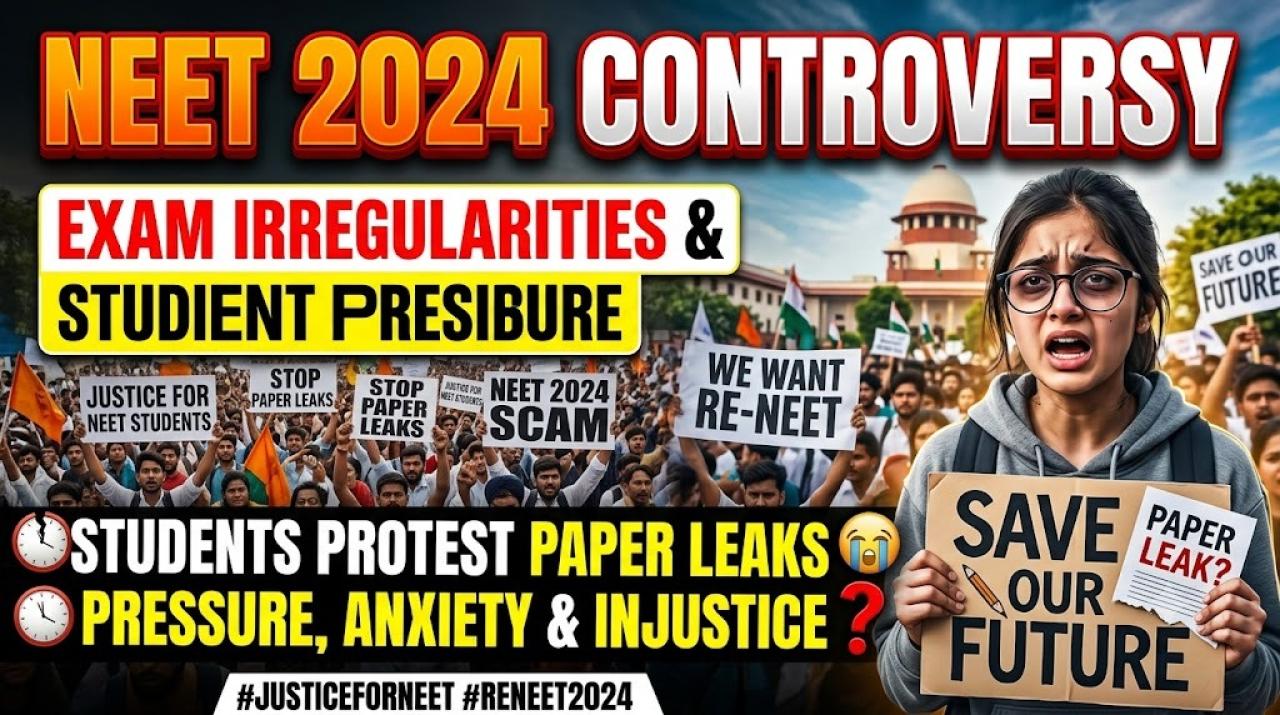
NEET-UG 2024 raised serious questions about grace marks, perfect scores and exam fairness, exposing the pressure students face in India's race for medical seats.
India offers thousands of career options to students completing Class 12, yet a lack of career counselling and proper guidance pushes lakhs of young people towards a single competitive examination. More than 20 lakh students appear for the National Eligibility cum Entrance Test (NEET) every year to compete for a limited number of medical seats. As a result, many students begin their professional journeys feeling like failures before they have had a fair chance to explore their potential.
If this trend continues, India's ambition to transform its education system and become a Vishwa Guru (world teacher) will remain difficult to achieve. An education system should help students discover their abilities and build meaningful careers, not make success appear dependent on clearing a single examination.
NEET-UG 2024 and the Controversy Over Results
The National Testing Agency (NTA) conducted the NEET-UG 2024 examination on May 5, 2024, across 571 cities, at 4,750 centres in India and 14 centres abroad. The results were originally scheduled to be announced on June 14, but were declared on June 4, ten days earlier than expected.
The results soon became controversial. A total of 67 candidates were initially reported to have scored a perfect 720 out of 720 marks. Even more surprising was the claim that six top-scoring candidates had appeared at the same examination centre in Jhajjar, Haryana.
The unusually high number of perfect scores raised questions among students, parents and educators. Many aspirants wondered whether the examination had been conducted and evaluated fairly, particularly when even a single mark could affect admission to a preferred medical college.
Grace Marks Add to Students' Confusion
The NTA explained that grace marks had been awarded to candidates who lost examination time because of administrative issues. Some students had reportedly faced problems involving the distribution of OMR answer sheets, which affected the time available to complete the examination.
The decision to award compensatory marks became another source of controversy. While the intention was to compensate candidates for lost time, the adjustment affected the final scores and rankings, making an already competitive examination more complicated for students trying to understand their admission prospects.
Reports of alleged question-paper leaks in different locations added to the concerns surrounding the examination. Another controversy arose over a question for which two answers were reportedly accepted, further confusing candidates who expected a single correct answer in a multiple-choice examination.
These developments raised serious questions about examination management, transparency and the process used to determine merit.
Questions Over the Unusually High Number of Toppers
The concentration of high scores at certain examination centres attracted particular attention. Physics Wallah founder Alakh Pandey questioned the results and the statistical likelihood of so many candidates receiving perfect scores in the same examination.
Pandey also referred to the performance of one of his students, who had reportedly been scoring around 680 out of 720 in the institute's regular tests but appeared among the top performers in the NEET results.
The controversy demonstrated how even a highly competitive examination can lose students' confidence when its results are accompanied by unexplained anomalies or inadequate communication. At the same time, unusual score patterns alone cannot establish wrongdoing; such concerns require a transparent investigation based on examination records and evidence.
For students and their families, the central issue was not simply the number of toppers. It was whether the examination process had treated every candidate fairly and whether the resulting rankings could be trusted.
Legal Intervention and the Human Cost of Pressure
Candidates approached the courts over the alleged irregularities, seeking explanations and corrective action. The controversy also brought renewed attention to the immense psychological pressure faced by students preparing for competitive examinations.
For many families, clearing NEET becomes a defining ambition. Students may spend years preparing, attend expensive coaching classes and sacrifice other interests in the belief that a medical career is their only acceptable future. When results do not meet expectations, some struggle to cope with disappointment and uncertainty.
Reports of student suicides have repeatedly highlighted the need to take academic pressure seriously. No single examination result should determine a young person's sense of self-worth or their prospects for a fulfilling life.
Parents, teachers and educational institutions must therefore help students understand that medicine is only one of many possible career paths. Engineering, law, economics, design, journalism, research, teaching, public policy, entrepreneurship and numerous vocational fields can also offer rewarding professional opportunities.
Career counselling should begin well before students complete Class 12. Guidance based on aptitude, interests, financial circumstances and long-term goals can help young people make informed choices instead of following the crowd.
NEET Retest: What Happened Next?
The controversy continued after the initial results. Following judicial intervention, the NTA offered a retest to 1,563 candidates who had received grace marks because of reported time losses at six examination centres.
The retest was conducted on June 23, 2024, and its results were declared on July 1. Of the 1,563 eligible candidates, 813 appeared for the retest. None scored a perfect 720 in the re-examination.
The revised results brought further attention to the original scoring controversy, although the absence of perfect scores in the retest did not, by itself, establish that the original results were fraudulent.
Meanwhile, another group of candidates approached the Supreme Court seeking the cancellation of the examination and a halt to the counselling process through which students are allotted seats in medical colleges. The Court declined to grant the requested interim relief at that stage and scheduled a further hearing for July 8, 2024.
The episode highlighted the importance of reliable examination procedures, timely communication and clear rules for compensating candidates who experience administrative difficulties.
India Needs Better Career Guidance and Fairer Examinations
The NEET controversy should prompt a broader discussion about India's approach to education and career development. Competitive examinations can help establish merit-based admission, but they must be conducted with fairness, transparency and accountability.
The government and examination authorities need to strengthen question-paper security, improve examination-centre management, establish clear procedures for compensatory marks and communicate decisions promptly. When irregularities are reported, candidates deserve credible explanations and timely corrective action.
Equally important is the need to reduce the excessive social pressure attached to a handful of prestigious professions. Students should be encouraged to explore their strengths rather than measure their worth against examination ranks alone.
India's educational ambitions cannot be fulfilled merely by expanding institutions or increasing the number of competitive examinations. They require a system that recognises diverse talents, supports informed career choices and protects students' dignity.
NEET should serve as a fair gateway to medical education, not become a source of despair for young people whose abilities and aspirations extend far beyond one examination.



















Leave a Comment