
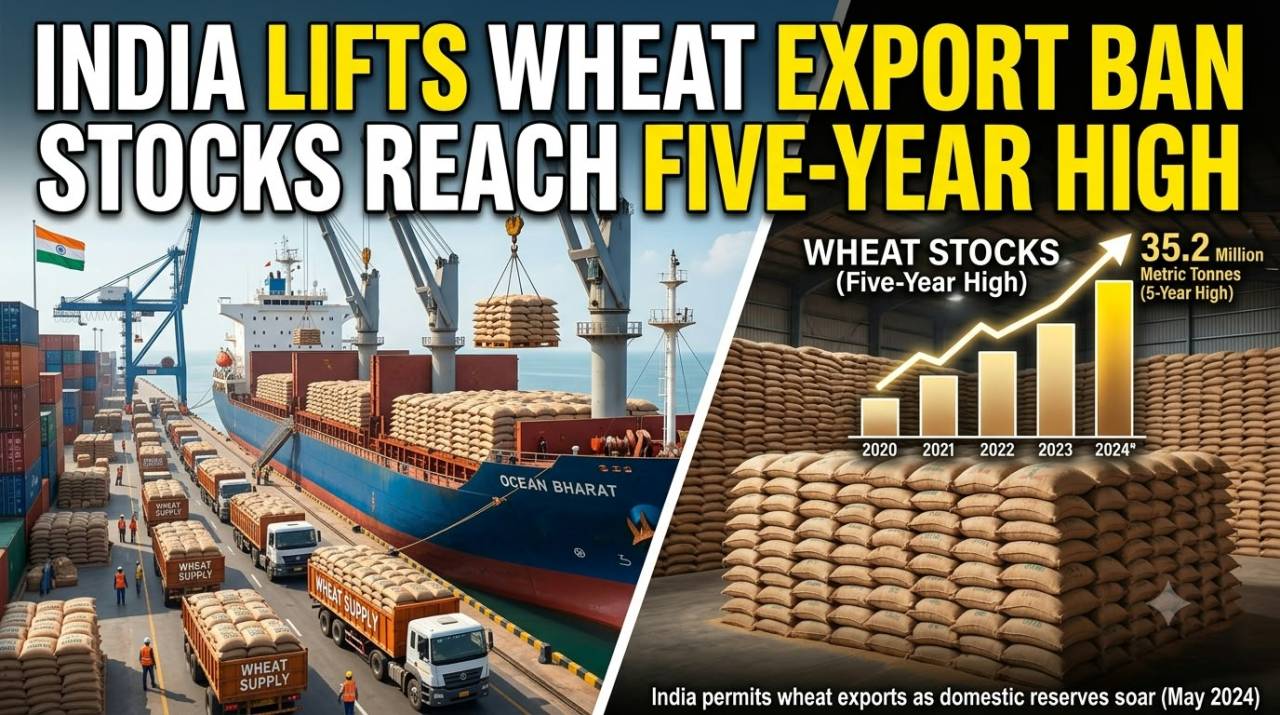
India has lifted the wheat export ban. But abundant stocks alone may not be enough to make Indian wheat a global bargain.
India has lifted restrictions on wheat exports, opening the door for traders to ship grain without quantitative limits. On August 24, the Directorate General of Foreign Trade changed the export status of durum wheat and other wheat from “Prohibited” to “Free.” A separate notification also allowed exports of wheat flour and products such as atta, maida and semolina.
The move marks a significant change after months of tightly controlled exports. But while India now has the freedom to sell wheat abroad, the economics may prevent a major export surge.
Comfortable Stocks Give Government Room to Act
India’s earlier export policy was driven largely by concerns over domestic food security. In February, the government allowed a wheat export quota of 2.5 million tonnes and later added another 2.5 million tonnes, taking the total permitted volume to 5 million tonnes.
The supply situation has since improved substantially.
Wheat stocks held by the Food Corporation of India stood at 50.5 million tonnes on August 1, nearly 46 percent higher than a year earlier and the highest level in five years. Procurement during the 2026-27 marketing season also reached about 35.76 million tonnes, exceeding the revised target of 34.6 million tonnes.
With government reserves comfortable and no immediate domestic shortage in sight, policymakers appear to have concluded that strict export controls are no longer necessary.
The decision, therefore, is less about pushing exports aggressively and more about restoring flexibility to the market.
Global Wheat Prices Are Rising
The timing of the decision is notable.
Global grain markets are facing fresh uncertainty as attacks on Russian and Ukrainian grain infrastructure disrupt parts of the Black Sea supply chain. Chicago wheat futures have risen more than 17 percent since early July.
On paper, this should create an opportunity for Indian exporters.
When global supplies are disrupted and international prices rise, countries with surplus grain can potentially step in to fill the gap. India has large stocks and now has regulatory permission to export.
But there is a problem.
Indian wheat remains expensive compared with competing supplies.
The Price Problem
At an exchange rate of ₹95.7 to the US dollar, Black Sea wheat priced at about $270 a tonne translates to roughly ₹2,580 per 100 kg before freight.
Once shipping costs to Southeast Asia are included, the delivered price rises to around $310 to $315 a tonne, equivalent to approximately ₹2,970 to ₹3,015 per 100 kg.
Indian exporters loading wheat at Kandla, one of Gujarat’s major commercial ports, would need prices close to ₹2,600 per 100 kg simply to break even. Domestic prices, however, are currently around ₹2,700 per 100 kg.
That leaves Indian wheat at a disadvantage.
For an overseas buyer, the decision is ultimately about landed cost. If wheat from another origin arrives more cheaply, regulatory permission alone will not make Indian grain competitive.
This is why the lifting of the export ban may not immediately translate into large shipments.
Previous Quotas Never Came Close to Being Filled
Trade data underline the challenge.
Actual exports under the earlier quotas remained modest, at around 60,000 tonnes of wheat products, apart from limited flour shipments to Bangladesh. Industry sources have also pointed out that the earlier quotas never translated into anything close to the volumes the government had technically permitted.
The reason was not simply the availability of wheat.
It was the price.
That same equation is likely to remain relevant after the restrictions have been removed. Exporters may now have greater freedom, but they still need overseas buyers willing to pay a competitive price.
What Does the Decision Mean for Farmers?
For farmers, the immediate impact is likely to be limited.
Increased export demand could eventually support farm-gate prices. But that can happen only if Indian wheat becomes competitive in international markets.
At present, the price differential works against that possibility.
If global wheat prices remain elevated for a sustained period, however, the equation could change. A sufficiently large rise in international prices could make Indian wheat more attractive and encourage exporters to buy more grain domestically.
Until then, the benefit to farmers is likely to remain more potential than immediate.
Millers and Traders Gain More Flexibility
The policy change does offer a clear advantage to millers and traders.
They can now explore overseas markets for wheat, flour and related products without waiting for government quota allocations. This reduces an important administrative hurdle and gives businesses greater flexibility to respond to international demand.
Yet processed wheat products face the same basic challenge as raw grain.
If the underlying wheat is expensive, flour and other products also become less competitive once freight and other export costs are added.
A sudden explosion in exports, therefore, appears unlikely.
Food Security Remains the Safety Net
Domestic food security will remain the government's most important consideration.
The government has indicated that wheat stocks are adequate and that there is no immediate risk to domestic supplies. Lifting the export restrictions does not compel India to sell its reserves abroad. It simply restores the option.
That distinction matters.
If international wheat prices rise sharply, or if currency movements narrow the price gap, exporters could increase shipments. Conversely, if domestic stocks begin to tighten, policymakers retain the ability to impose fresh restrictions.
The current decision is therefore better understood as a sign of confidence in India's supply position than as a sudden move towards aggressive export promotion.
The Larger Economic Impact Depends on Price
The long-term economic effect will depend on whether Indian wheat can actually find buyers.
A sustained increase in global wheat prices could eventually bring Indian grain into international markets. Higher exports would generate foreign-exchange earnings and could create stronger incentives for investment in storage, handling and port logistics.
But these benefits remain conditional.
As long as Indian wheat costs more than competing supplies after freight, the practical impact of the policy change will remain limited for farmers, traders and the broader economy.
The government has removed the regulatory barrier. The market now has to overcome the price barrier.
Permission to Export Is Not the Same as the Ability to Export
India has restored free exports of wheat and wheat products at a time when domestic stocks are comfortable and global supplies face disruption.
The decision removes an administrative restriction that had already produced relatively limited export volumes. But it does not guarantee a surge in shipments.
For farmers, the potential benefit will depend on whether exporters can offer competitive prices. For traders and millers, the change provides greater freedom to seek international markets. For consumers and policymakers, comfortable stocks provide a buffer against any sudden increase in exports.
Ultimately, the success of the policy will be determined less by the legal permission to export and more by the arithmetic of price, currency and freight.
India can now export more wheat. The bigger question is whether the world can afford to buy it.
India has lifted restrictions on wheat exports, opening the door for traders to ship grain without quantitative limits. On August 24, the Directorate General of Foreign Trade changed the export status of durum wheat and other wheat from “Prohibited” to “Free.” A separate notification also allowed exports of wheat flour and products such as atta, maida and semolina.
The move marks a significant change after months of tightly controlled exports. But while India now has the freedom to sell wheat abroad, the economics may prevent a major export surge.
Comfortable Stocks Give Government Room to Act
India’s earlier export policy was driven largely by concerns over domestic food security. In February, the government allowed a wheat export quota of 2.5 million tonnes and later added another 2.5 million tonnes, taking the total permitted volume to 5 million tonnes.
The supply situation has since improved substantially.
Wheat stocks held by the Food Corporation of India stood at 50.5 million tonnes on August 1, nearly 46 percent higher than a year earlier and the highest level in five years. Procurement during the 2026-27 marketing season also reached about 35.76 million tonnes, exceeding the revised target of 34.6 million tonnes.
With government reserves comfortable and no immediate domestic shortage in sight, policymakers appear to have concluded that strict export controls are no longer necessary.
The decision, therefore, is less about pushing exports aggressively and more about restoring flexibility to the market.
Global Wheat Prices Are Rising
The timing of the decision is notable.
Global grain markets are facing fresh uncertainty as attacks on Russian and Ukrainian grain infrastructure disrupt parts of the Black Sea supply chain. Chicago wheat futures have risen more than 17 percent since early July.
On paper, this should create an opportunity for Indian exporters.
When global supplies are disrupted and international prices rise, countries with surplus grain can potentially step in to fill the gap. India has large stocks and now has regulatory permission to export.
But there is a problem.
Indian wheat remains expensive compared with competing supplies.
The Price Problem
At an exchange rate of ₹95.7 to the US dollar, Black Sea wheat priced at about $270 a tonne translates to roughly ₹2,580 per 100 kg before freight.
Once shipping costs to Southeast Asia are included, the delivered price rises to around $310 to $315 a tonne, equivalent to approximately ₹2,970 to ₹3,015 per 100 kg.
Indian exporters loading wheat at Kandla, one of Gujarat’s major commercial ports, would need prices close to ₹2,600 per 100 kg simply to break even. Domestic prices, however, are currently around ₹2,700 per 100 kg.
That leaves Indian wheat at a disadvantage.
For an overseas buyer, the decision is ultimately about landed cost. If wheat from another origin arrives more cheaply, regulatory permission alone will not make Indian grain competitive.
This is why the lifting of the export ban may not immediately translate into large shipments.
Previous Quotas Never Came Close to Being Filled
Trade data underline the challenge.
Actual exports under the earlier quotas remained modest, at around 60,000 tonnes of wheat products, apart from limited flour shipments to Bangladesh. Industry sources have also pointed out that the earlier quotas never translated into anything close to the volumes the government had technically permitted.
The reason was not simply the availability of wheat.
It was the price.
That same equation is likely to remain relevant after the restrictions have been removed. Exporters may now have greater freedom, but they still need overseas buyers willing to pay a competitive price.
What Does the Decision Mean for Farmers?
For farmers, the immediate impact is likely to be limited.
Increased export demand could eventually support farm-gate prices. But that can happen only if Indian wheat becomes competitive in international markets.
At present, the price differential works against that possibility.
If global wheat prices remain elevated for a sustained period, however, the equation could change. A sufficiently large rise in international prices could make Indian wheat more attractive and encourage exporters to buy more grain domestically.
Until then, the benefit to farmers is likely to remain more potential than immediate.
Millers and Traders Gain More Flexibility
The policy change does offer a clear advantage to millers and traders.
They can now explore overseas markets for wheat, flour and related products without waiting for government quota allocations. This reduces an important administrative hurdle and gives businesses greater flexibility to respond to international demand.
Yet processed wheat products face the same basic challenge as raw grain.
If the underlying wheat is expensive, flour and other products also become less competitive once freight and other export costs are added.
A sudden explosion in exports, therefore, appears unlikely.
Food Security Remains the Safety Net
Domestic food security will remain the government's most important consideration.
The government has indicated that wheat stocks are adequate and that there is no immediate risk to domestic supplies. Lifting the export restrictions does not compel India to sell its reserves abroad. It simply restores the option.
That distinction matters.
If international wheat prices rise sharply, or if currency movements narrow the price gap, exporters could increase shipments. Conversely, if domestic stocks begin to tighten, policymakers retain the ability to impose fresh restrictions.
The current decision is therefore better understood as a sign of confidence in India's supply position than as a sudden move towards aggressive export promotion.
The Larger Economic Impact Depends on Price
The long-term economic effect will depend on whether Indian wheat can actually find buyers.
A sustained increase in global wheat prices could eventually bring Indian grain into international markets. Higher exports would generate foreign-exchange earnings and could create stronger incentives for investment in storage, handling and port logistics.
But these benefits remain conditional.
As long as Indian wheat costs more than competing supplies after freight, the practical impact of the policy change will remain limited for farmers, traders and the broader economy.
The government has removed the regulatory barrier. The market now has to overcome the price barrier.
Permission to Export Is Not the Same as the Ability to Export
India has restored free exports of wheat and wheat products at a time when domestic stocks are comfortable and global supplies face disruption.
The decision removes an administrative restriction that had already produced relatively limited export volumes. But it does not guarantee a surge in shipments.
For farmers, the potential benefit will depend on whether exporters can offer competitive prices. For traders and millers, the change provides greater freedom to seek international markets. For consumers and policymakers, comfortable stocks provide a buffer against any sudden increase in exports.
Ultimately, the success of the policy will be determined less by the legal permission to export and more by the arithmetic of price, currency and freight.
India can now export more wheat. The bigger question is whether the world can afford to buy it.






















Leave a Comment