
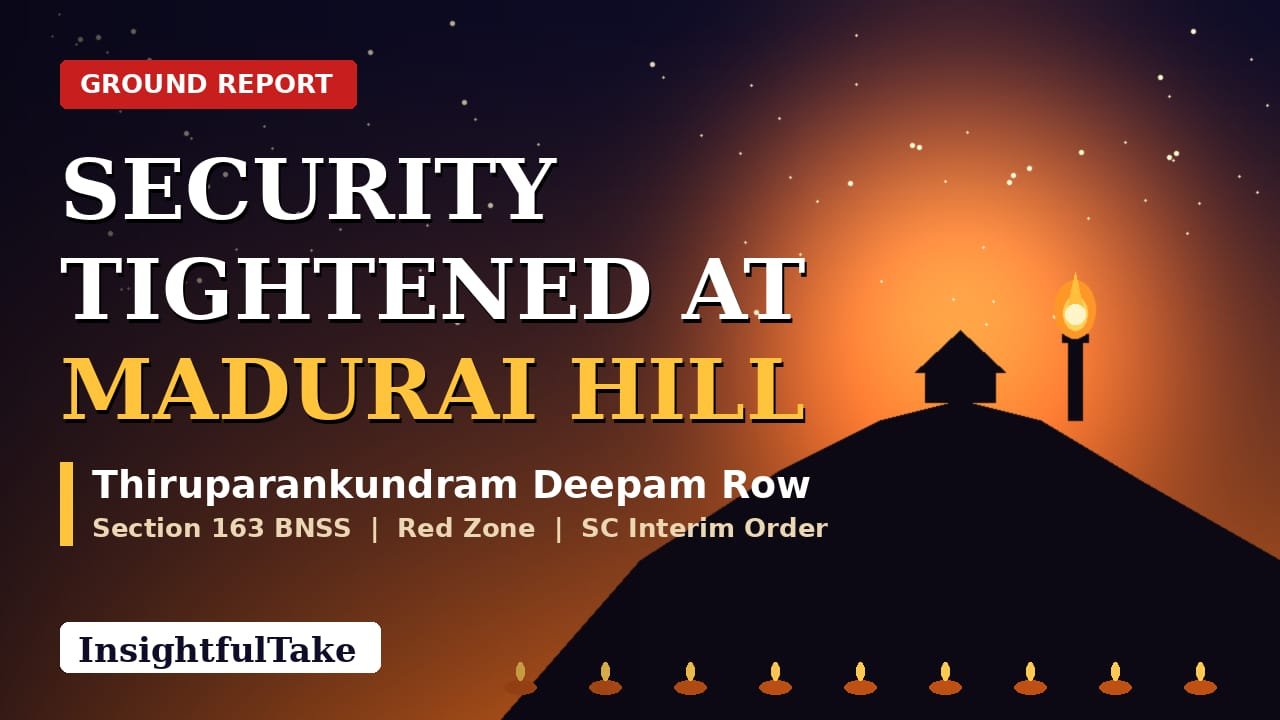
A disputed lamp at Thiruparankundram has brought religious tradition, judicial authority and Tamil Nadu's political rivalries into a sharp public confrontation.
On the night of Karthigai Deepam, thousands of Tamil homes glow with rows of traditional clay lamps. This year, however, one lamp has become the centre of a statewide controversy. The dispute concerns the lighting of a lamp on the Deepathoon, a stone pillar atop Thiruparankundram hill in Madurai district.
The hill is home to the Arulmigu Subramaniya Swamy Temple, while a dargah stands close to the disputed pillar. What would ordinarily be a religious observance has turned into a sensitive contest involving religious customs, judicial authority, political interests and public order.
A Hill Under Security Watch
On Monday, police personnel were deployed in large numbers across the temple premises and surrounding areas. Madurai District Collector Nishanth Krishna imposed prohibitory orders under Section 163 of the Bharatiya Nagarik Suraksha Sanhita (BNSS) across the district.
According to ANI, the order followed police intelligence inputs warning of a possible breach of public tranquillity. It remains in force from 9 pm on Monday until 10 am on November 25, unless withdrawn earlier.
Madurai city police have also designated Thiruparankundram hill a "Red Zone", prohibiting drones and other unmanned aerial vehicles in the area.
The administration has taken additional precautions amid the political and religious mobilisation surrounding the dispute. Police denied permission to the Viduthalai Chiruthaigal Katchi (VCK) for a proposed procession in the area on Tuesday, a decision confirmed by party president Thol. Thirumavalavan.
How the Dispute Reached the Supreme Court
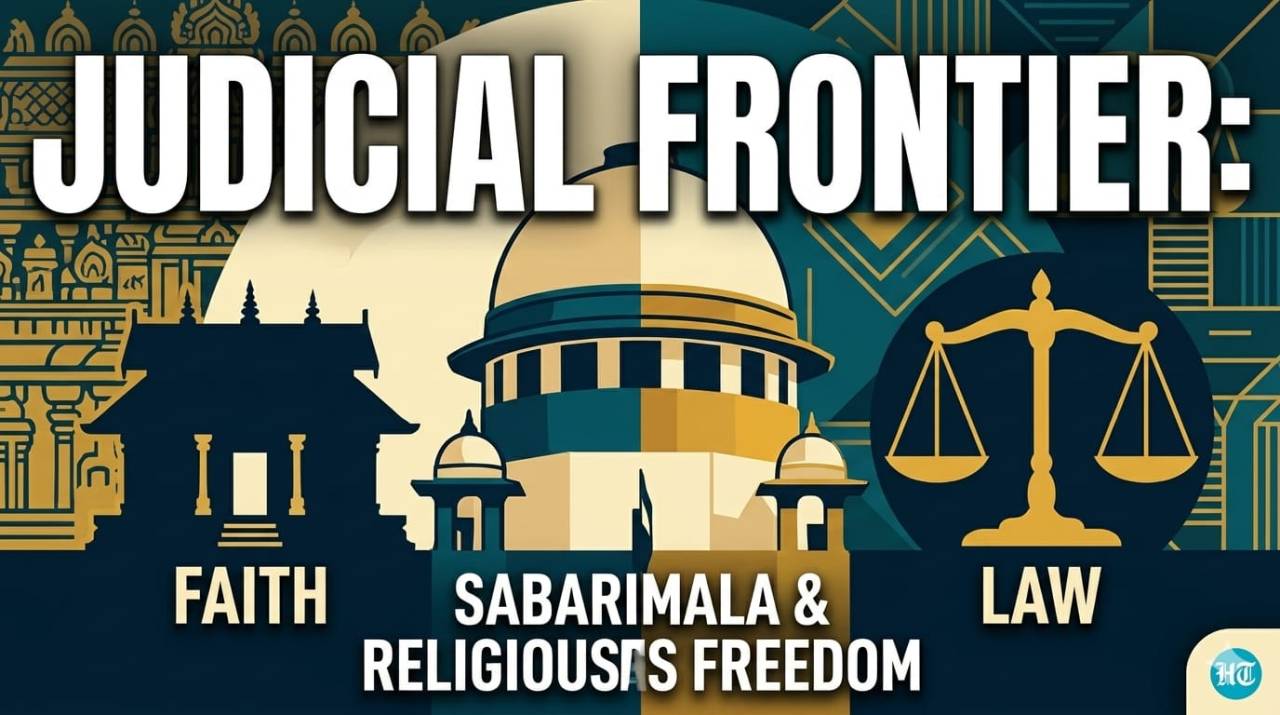
At the centre of the controversy is a straightforward but legally complicated question: can devotees light the Karthigai Deepam at the Deepathoon?
Devotees approached the Madurai Bench of the Madras High Court, seeking permission to restore the practice of lighting the traditional lamp at the ancient stone pillar. A single-judge bench allowed the request, and a division bench subsequently upheld that order.
The Tamil Nadu government challenged the High Court's decision in the Supreme Court.
On November 20, the Supreme Court permitted the lighting of the lamp at the Deepathoon on November 24, allowing the ritual on a one-time basis. The interim order came with specific conditions and important legal qualifications.
The Court clarified that its permission should not be interpreted as a final recognition of the claimed customary right. It also stayed the relevant portions of the High Court judgment directing restoration of the practice.
Consequently, the interim permission does not settle whether devotees possess a legally established customary right to perform the ritual at the location in subsequent years.
The distinction is important. The Supreme Court has allowed the ceremony for this year's observance without finally deciding the underlying dispute.
The Tamil Nadu government subsequently approached the Supreme Court seeking a review of its order. Representatives of the dargah have also indicated their intention to file a review petition.
A Political Flashpoint Across Party Lines
The judicial proceedings have triggered sharp political exchanges in Tamil Nadu, with parties interpreting the controversy through competing religious, electoral and governance arguments.
BJP: Tamil Nadu BJP president Nainar Nagenthran accused the ruling Tamilaga Vettri Kazhagam (TVK) of adopting an "anti-Hindu" position. He questioned whether Chief Minister C. Joseph Vijay would go to such lengths for vote-bank politics.
DMK: Leader of the Opposition Udhayanidhi Stalin criticised the government's handling of the legal proceedings. He argued that the Chief Minister must explain why the case was not argued effectively and pointed out that two days had passed since party president M.K. Stalin raised the issue without a response from the Chief Minister.
AIADMK: Party spokesperson Kovai Sathyan alleged that there was little difference between the DMK and TVK. He condemned what he described as the government's attempt to appease one section of society.
Congress: MP Manickam Tagore defended the government's position, arguing that its intention was to protect communal harmony and maintain goodwill in the state.
The review petition has therefore acquired a political dimension beyond its legal implications. Critics see the government's move as political calculation, while its supporters describe it as a precautionary step to prevent tensions and preserve public order.
Three Developments That Will Shape the Outcome
The November 24 ceremony is only one stage in a dispute whose legal and political consequences are likely to extend beyond this year's festival.
1. Maintaining Peace at Thiruparankundram
The extensive police deployment and prohibitory orders reflect the administration's concern about possible tensions. A peaceful observance would demonstrate that competing religious claims can be managed without confrontation, even in a politically charged atmosphere.
2. The Review Petitions
The Tamil Nadu government's review plea and the proposed petition from the dargah side could significantly influence the next stage of the dispute. The Supreme Court's response will be important in determining the legal position ahead of future Karthigai Deepam celebrations.
3. The Final Judicial Determination
The Supreme Court's interim permission does not establish a permanent customary right. The underlying question of whether the Deepathoon is an established and legally protected location for the ritual remains unresolved.
The eventual judicial determination will have implications for the administration of religious practices at historically sensitive shared sites.
The Larger Question: Faith, Heritage and Public Order
Karthigai Deepam is fundamentally a festival celebrating light, devotion and the triumph of good over evil. At Thiruparankundram, however, this year's observance has become entangled with competing claims over religious tradition, the interpretation of law and the responsibilities of an elected government.
The presence of a dargah near the disputed pillar adds another dimension to the issue. Religious heritage sites require sensitive administration, particularly when questions of customary worship intersect with the rights and concerns of different communities.
The state has a responsibility to uphold lawful religious practices while ensuring that no community feels threatened or excluded. Political parties, too, have a responsibility to avoid turning religious observances into instruments of electoral mobilisation.
The Supreme Court's interim order has provided a temporary legal arrangement, not a final resolution. The review proceedings and eventual judgment will determine the legal position.
For the people of Madurai, the immediate priority remains a peaceful Karthigai Deepam. The longer challenge is to ensure that faith, historical traditions and constitutional principles can coexist without turning a place of worship into a permanent political battleground.











Leave a Comment