
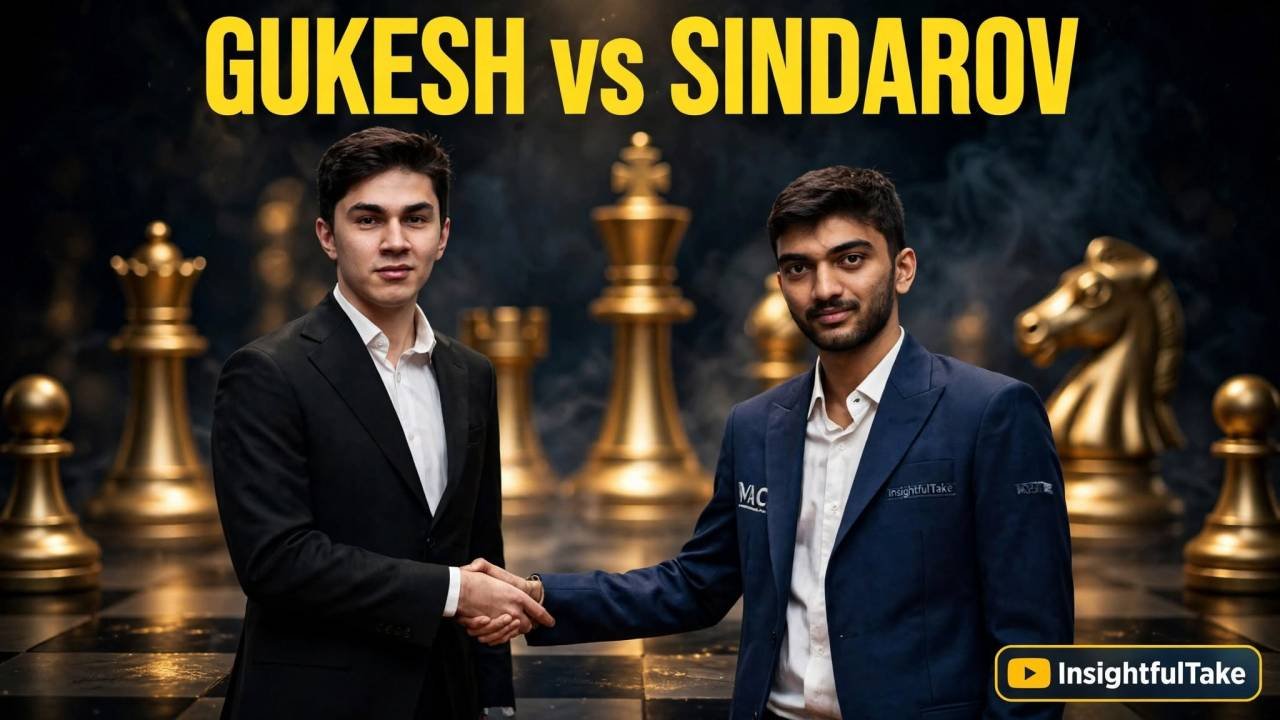
India’s reigning world champion D Gukesh enters the Geneva showdown with the burden of defending his crown, while Uzbekistan’s Javokhir Sindarov arrives riding a remarkable run of form.
Chess rarely produces a championship match with such a compelling storyline even before the first move. Geneva has one. From November 24 to December 12, India's reigning world champion D Gukesh will face Uzbekistan's Javokhir Sindarov, a challenger whose 2026 season has arguably been stronger.
One man holds the crown. The other holds the momentum. The contest will test whether experience, resilience and championship temperament can overcome the confidence of a challenger at the peak of his form.
Two Prodigies, One Shared Past
The pairing feels less like a clash between strangers and more like a meeting of contemporaries who grew up in the same competitive environment. Both emerged from the junior chess circuit, earned grandmaster titles at remarkably young ages and established themselves as extraordinary talents before reaching adulthood.
Their careers are also curiously intertwined. Sindarov once held the distinction of being among the youngest grandmasters in chess history, ahead of India's R Praggnanandhaa. Gukesh subsequently surpassed that achievement a year later.
Their shared history removes much of the uncertainty surrounding the contest. Neither player will be unfamiliar with the other's temperament or playing style. Both have followed each other's progress from promising young talents to contenders for the highest honour in chess.
The Case for Sindarov: A Year That Belonged to Him
If recent form were the only measure, Sindarov would enter Geneva as the favourite. By most assessments, 2026 has been his season. He has also emerged as an important figure in Uzbekistan's remarkable chess rise, a national success story highlighted by Olympiad gold and the country's growing influence in international competition.
His playing style makes him particularly dangerous. Observers describe him as dynamic and fearless, comfortable navigating positions that appear chaotic to opponents. Rather than relying exclusively on patient positional manoeuvres, he often seeks to seize the initiative through aggressive play, tactical complications and speed.
Praggnanandhaa, who has studied and competed against him, has also highlighted his engaging and aggressive approach to the game.
There is a psychological advantage as well. A player who has enjoyed a successful season arrives without the same burden of expectations carried by a defending champion. Sindarov can approach the contest with confidence, knowing that much of the pressure rests on his opponent.
The Case for Gukesh: Calculation, Resilience and a Champion’s Calm
Gukesh's 2026 campaign has been more difficult, and his recent results have attracted criticism. His position on the rating list has also reflected a period of inconsistency.
Yet his greatest strength has never been an uninterrupted run of victories. It is his ability to recover.
His career has featured several demanding comebacks. He has navigated difficult positions, absorbed painful defeats and returned with renewed preparation and determination. Those who have followed his development often point to his extraordinary calculating ability and his capacity to work through difficult situations without losing his competitive focus.
That resilience becomes particularly valuable in a long championship contest. A single defeat can unsettle a player, while a sequence of difficult games can quickly change the psychological balance of a match. Gukesh has demonstrated an ability to withstand such pressure.
His aggressive approach, however, also carries risks. Players who calculate deeply and frequently seek complications can sometimes spend too much time navigating possibilities. One concern in his recent performances has been his occasional tendency to lose the thread of a position before paying the price.
In Geneva, consistency will be essential. Gukesh needs to bring back the composure and precision that carried him to the world championship.
Ratings Versus Reality
The numbers tell one story, but the chessboard can tell another. Ratings measure past performance, and their influence becomes less decisive in a championship match where preparation, psychological strength and the ability to adapt can quickly change the balance.
Modern chess is increasingly shaped by computer engines, extensive opening preparation and rapidly evolving strategic ideas. The difference between a player's rating and their practical strength can become less meaningful over a relatively short period.
Both camps understand that Elo ratings offer an indication of strength, not a guarantee of results.
The decisive factors will be opening preparation, accuracy under pressure and the ability to respond when an opponent introduces an unexpected idea. Each player is likely to arrive with carefully prepared variations and tactical surprises.
The first player forced to navigate unfamiliar territory without adequate preparation could find himself at a serious disadvantage.
The First Games Will Set the Tone
Praggnanandhaa, who has played against both competitors, believes the opening couple of games could play a decisive role in shaping the psychology of the contest.
A strong start can give a player confidence and momentum, while an early setback can force the opponent into a difficult position. In a 14-game format, there is limited room to recover from a poor beginning.
The opening rounds may therefore feature cautious and calculated chess rather than immediate aggression. Both players are likely to test each other's preparation and temperament before committing to more ambitious plans.
As the match progresses, physical and mental fatigue could become increasingly important. Concentration may weaken, calculation errors may emerge and opportunities for the more alert tactician could become decisive.
What the Match Means for India
For Indian chess followers, the stakes extend beyond Gukesh's individual championship defence.
A victory would strengthen his position among the world's leading players and reinforce India's growing influence in international chess. A defeat would be disappointing, but it would not diminish the larger transformation taking place in Indian chess.
The country now produces elite players in remarkable numbers, from world champions and Olympiad winners to a younger generation breaking records in their early teens.
India's chess boom has fundamentally changed the significance of a world championship match. A decade ago, an Indian player defending the highest title in chess would have appeared an extraordinary possibility. Today, it reflects the country's emergence as a major force in the sport.
That progress also brings greater expectations. Gukesh carries not only the responsibility of defending his title but also the hopes of a generation that increasingly sees Indian players competing at the highest level.
A Match That Could Define an Era
Chess has often defined its greatest periods through memorable rivalries. Garry Kasparov and Anatoly Karpov shaped one era, while Viswanathan Anand and Vladimir Kramnik represented another important chapter in the sport's evolution. Magnus Carlsen's prolonged dominance subsequently established a different benchmark.
The sport is now witnessing another generational transition. Gukesh and Sindarov, both remarkably young by championship standards, represent the growing influence of a new generation of players.
Their contest reflects several broader developments in modern chess: younger champions, increasingly sophisticated computer-assisted preparation and a more geographically diverse distribution of elite talent.
Asia, particularly South and Central Asia, has become central to this transformation. The Geneva contest could offer an important indication of how that shift will shape the sport in the years ahead.
Final Take
Predicting the outcome of a chess championship is always difficult, particularly when two players bring such different strengths to the board.
Sindarov has recent form, confidence and the freedom of a challenger. Gukesh has the experience of a reigning champion and the resilience required to survive a demanding contest.
An early breakthrough for Sindarov could shift the psychological balance in his favour. If Gukesh withstands the opening pressure and settles into his rhythm, his ability to recover from difficult positions could become a decisive advantage.
Geneva promises more than a contest for the world title. It brings together two exceptional young players whose careers have developed alongside each other, but whose paths now converge at the highest level of competitive chess.
The crown belongs to Gukesh. The momentum belongs to Sindarov. The next move belongs to the board.


























Leave a Comment