
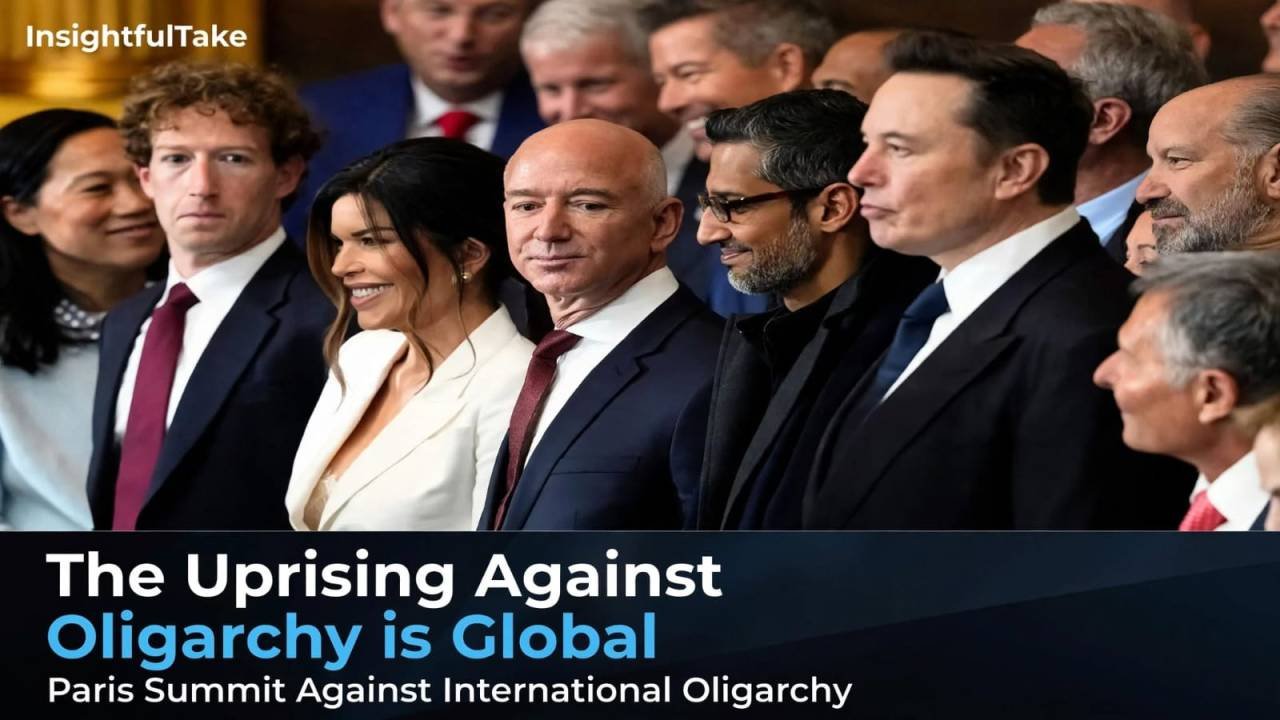
The Paris Manifesto challenges the concentration of wealth and political influence in the hands of a few, calling for global action on taxation, media independence and democratic control of artificial intelligence.
The greatest threat to democracy may not always come from authoritarian governments or political extremists. Increasingly, it may emerge from an economic system in which a handful of extraordinarily wealthy individuals possess enough financial power to influence elections, shape public opinion, control technology and determine the direction of public policy.
This uncomfortable question came to the centre of an international gathering in Paris, where economists, philosophers, journalists, political leaders and trade union representatives assembled for the First Paris Summit Against International Oligarchy. Their concern was not simply that the rich were becoming richer. It was that extreme wealth was gradually translating into a form of political power that democratic institutions were finding increasingly difficult to challenge.
The summit, convened by economist Gabriel Zucman and the International Tax Observatory, brought together prominent thinkers including Nobel laureate Joseph Stiglitz, Esther Duflo, Thomas Piketty, Jayati Ghosh, Lea Ypi and Isabella Weber. Their discussions revolved around a fundamental concern: when private fortunes become powerful enough to influence the institutions governing society, the principle of political equality begins to lose its meaning.
The Paris Manifesto, endorsed by more than 100 researchers and public intellectuals, attempts to turn this concern into a political and economic programme.
When wealth becomes political power
One of the manifesto's most striking arguments concerns the extraordinary concentration of global wealth.
According to the figures presented in the document, the richest 0.0001 per cent of the world's population controlled wealth equivalent to approximately 3 per cent of global GDP in 1987. By 2026, this share had increased to 17 per cent.
The numbers illustrate a remarkable shift in the distribution of economic power. A tiny section of humanity now commands financial resources that can influence decisions extending far beyond individual businesses or national economies.
Wealth itself is not necessarily incompatible with democracy. Entrepreneurs can create employment, investors can finance innovation and businesses can contribute significantly to economic development. The problem begins when economic influence becomes so concentrated that wealthy individuals acquire disproportionate access to political institutions and public discourse.
A billionaire who controls major corporations, finances political campaigns, owns influential media platforms and invests in emerging technologies exercises influence that extends well beyond ordinary commercial activity.
The relationship between money and political power can also become self-reinforcing. Financial resources provide access to policymakers and opportunities to influence public opinion. Political influence, in turn, can help preserve favourable tax arrangements, regulatory conditions and business privileges.
Democracy promises equal political rights to citizens, but concentrated economic power can make those rights increasingly unequal in practice.
The billionaire influence over media and public debate
The manifesto identifies media ownership as one of the central challenges to democratic accountability.
Independent journalism is essential because it questions governments, investigates corporate conduct and gives citizens information with which to make informed decisions. But when influential newspapers, television networks and digital platforms are controlled by a small number of wealthy individuals, editorial independence can become vulnerable to private interests.
The concern is not that every billionaire media owner necessarily interferes with journalism. It is that the ownership structure creates the possibility of interference, particularly when editorial positions conflict with the owner's commercial or political interests.
The growing influence of technology entrepreneurs makes this problem more complicated. Social media platforms have become important spaces for political communication, public debate and the circulation of news. Their ownership gives a small number of individuals considerable influence over the infrastructure through which millions of people encounter information.
The debate surrounding Elon Musk's acquisition of Twitter, now X, illustrates this wider concern. Decisions taken by the owner of a major communication platform can influence content moderation, political visibility and the boundaries of public debate across national borders.
The Paris initiative therefore calls for stronger legal protection for newsrooms and journalists against censorship and interference by owners.
The underlying argument is straightforward: media institutions cannot perform their democratic responsibilities if their editorial freedom depends entirely on the preferences of those who finance or own them.
Artificial intelligence: Who owns humanity's collective knowledge?
The third major concern is artificial intelligence, perhaps the most consequential of the three battles.
AI systems are being developed using enormous collections of human knowledge, language, literature, research, images and creative expression accumulated over centuries. Much of this knowledge represents the collective intellectual contribution of humanity.
Yet the infrastructure, computing resources and commercial platforms through which advanced AI is developed are increasingly concentrated among a relatively small group of technology corporations.
This raises an important question about ownership. If artificial intelligence depends on accumulated human knowledge, should its benefits and governance remain exclusively in private hands?
The issue extends beyond commercial competition. AI is likely to influence education, employment, healthcare, public administration, scientific research and the future of creative professions. Decisions about how these systems are designed, trained and deployed will have consequences for entire societies.
There is also an environmental dimension. Large-scale data centres require substantial electricity and water resources. Their expansion raises questions about who bears the environmental costs of technological development and who ultimately receives its economic benefits.
The Paris Manifesto proposes a non-profit, democratically governed and internationally coordinated model for artificial intelligence. Its objective is to ensure that a technology with profound consequences for humanity is not governed exclusively by the commercial priorities of a handful of corporations.
The taxation question and the 2 per cent proposal
The manifesto's most concrete economic proposal is a minimum annual tax of 2 per cent on fortunes exceeding $100 million.
The proposal seeks to address a fundamental weakness in international taxation. The wealth of billionaires is often held in company shares, investments and other assets rather than conventional income. As a result, the tax burden on their actual economic capacity can differ substantially from the rates paid by ordinary wage earners.
Large fortunes can also be protected through complex ownership structures, international financial arrangements and jurisdictions offering favourable tax treatment.
Gabriel Zucman's research has contributed significantly to the debate over taxing extreme wealth. His broader argument challenges the assumption that governments are powerless to address the growing concentration of private fortunes.
A coordinated international minimum tax would attempt to prevent the ultra-rich from avoiding meaningful taxation simply by shifting assets or financial arrangements across borders.
However, implementing such a proposal would require political cooperation, transparency in financial ownership and effective mechanisms to recover unpaid taxes. Governments would also need to address legitimate concerns about valuation, capital movement and the enforcement of international rules.
The proposal is ambitious, but its underlying principle is difficult to dismiss: those who benefit enormously from the institutions, infrastructure and collective resources of society should contribute fairly to maintaining them.
Why the debate matters to India
For India, the Paris Manifesto raises questions that deserve serious domestic attention.
India has experienced the emergence of globally competitive business groups, a rapidly expanding technology sector and extraordinary growth in private wealth. Entrepreneurship and investment are essential to economic development. However, economic growth must also be accompanied by institutional accountability and fair competition.
The concentration of wealth becomes a democratic concern when business influence, political access and control over information begin reinforcing one another.
Media ownership and editorial independence deserve particular scrutiny. A healthy democracy requires news organisations capable of questioning both political authorities and powerful corporate interests. Their independence should not depend entirely on the willingness of owners to tolerate uncomfortable reporting.
India must also confront the implications of artificial intelligence. The country has a vast pool of engineers, researchers, writers and creative professionals, alongside millions of people whose languages and cultural knowledge remain underrepresented in global technology systems.
The question of who controls AI infrastructure, training data and the economic benefits of automation will have direct consequences for India's employment landscape and technological sovereignty.
Equally important is the taxation debate. India's challenge is not simply to collect more revenue from wealthy individuals or corporations. It is to ensure that the tax system is transparent, predictable and fair, while preventing economic privilege from becoming a source of political privilege.
The Paris proposals need not be adopted wholesale to stimulate a meaningful Indian debate. Their underlying concerns are relevant to any democracy experiencing growing economic concentration.
Democracy needs more than elections
The significance of the Paris Summit lies in its attempt to connect three issues that are often discussed separately: taxation, media ownership and artificial intelligence.
They are, in reality, different expressions of the same struggle over power.
The concentration of wealth can influence political decisions. Media ownership can shape the information citizens receive. Private control over artificial intelligence can determine who benefits from one of the most transformative technologies of the century.
The manifesto's call for an international democratic movement reflects the belief that national governments acting independently may struggle to challenge a global economic network.
Its proposals will undoubtedly face resistance. International tax agreements are difficult to negotiate, media independence requires strong legal institutions, and democratic governance of AI presents complicated questions of regulation, ownership and accountability.
But dismissing these ideas as impractical would mean accepting that the existing distribution of power is beyond democratic scrutiny.
Democracy cannot be measured only by the frequency of elections or the existence of political parties. It also depends on whether ordinary citizens have a meaningful voice in decisions affecting their economic opportunities, access to information and technological future.
The central message emerging from Paris is that extreme wealth is no longer just an economic question. It is a question about the distribution of power in modern society.
A world in which a handful of individuals can influence governments, dominate public communication and control technologies shaping humanity's future faces a serious democratic challenge.
The answer is not hostility towards wealth creation or entrepreneurship. It is the creation of institutions strong enough to ensure that economic success does not become an unlimited licence to exercise political and social power.
The future of democracy will depend, in considerable measure, on whether societies can establish that distinction before concentrated wealth becomes too powerful to challenge.














Leave a Comment