
America's economic figures face growing scrutiny as political attacks, shrinking agency resources and declining public confidence test the credibility of official data.
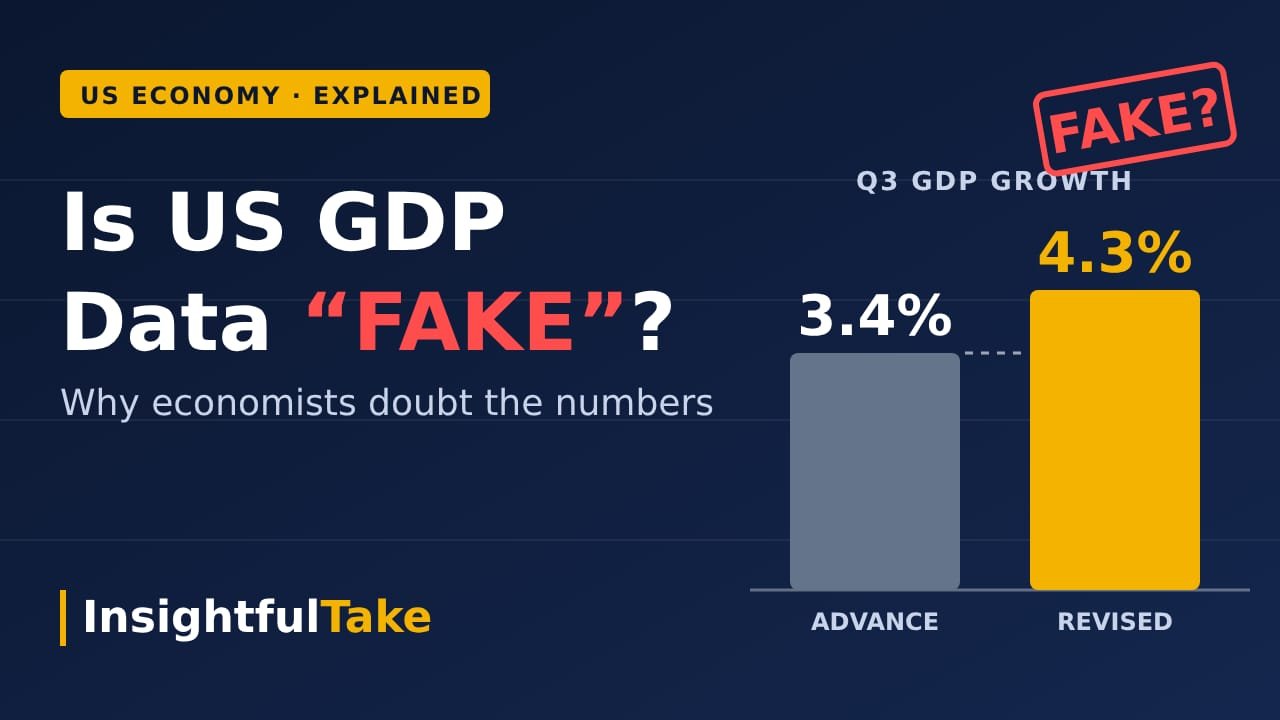
When Donald Trump called America's latest economic growth figures "FAKE" and demanded an "immediate investigation", he turned a statistical revision into a political confrontation. The Bureau of Economic Analysis (BEA) had revised third-quarter GDP growth to an annualised 4.3%, up from its earlier estimate of 3.4%. Trump alleged that the previous figure was deliberately wrong, describing it as a "purposeful" error. He offered no evidence to support the charge.
GDP estimates are routinely revised as more complete information becomes available. That is how economic statistics are supposed to work. Yet the timing of the revision, less than a week before the midterm elections, gave the president an opportunity to question the credibility of the figures.
There is, however, a more consequential story beneath the political exchange. Economists have been raising concerns about the quality of American economic data for some time. Their unease has little to do with Trump's election-related allegations. It centres on the growing difficulties faced by the government agencies responsible for measuring the world's largest economy.
Revisions Are Part of the Process
The BEA releases GDP estimates in three stages: advance, second and third. For the quarter in question, the first estimate appeared on 29 October, the second on 25 November, and the final scheduled estimate is due on 23 December.
The latest upward revision reflected stronger investment, particularly in software, as well as higher consumer spending. As additional information enters the system, earlier calculations change. The same process applies to employment figures and other major economic indicators.
American economic history offers several examples of substantial revisions. During Trump's first presidency, second-quarter 2020 GDP growth was revised upwards by 1.2 percentage points. A May analysis co-authored by BEA Director Vipin Arora found that quarterly GDP estimates had been revised by nearly a full percentage point or more at least four times over 25 years.
The revisions are not always favourable. Fourth-quarter 2025 growth, for instance, was revised downwards by 0.7 percentage point to 0.7%.
The latest change is therefore significant, but it is not unprecedented. Nor does the size of a revision establish that officials deliberately altered the figures. That would require evidence of interference, not simply a difference between two estimates.
The Statistical System Is Under Pressure
Economists have more substantial reasons to question the reliability of America's economic statistics. One of the most persistent is the declining willingness of households and businesses to participate in government surveys.
These surveys provide much of the information used to calculate employment, inflation and other economic indicators. When fewer people respond, statistical agencies have to work with smaller pools of information. The difficulty becomes greater when non-participation is concentrated among particular sections of the population, potentially distorting the picture produced by the survey.
A Reuters poll of 100 economists found that 89 were concerned about the quality of official US economic data. Forty-one described themselves as very concerned. These are not minor reservations about an occasional revision. They point to wider questions about the reliability of the information on which economic decisions are based.
The agencies collecting this information are also dealing with staff and budget pressures. According to reports, the Bureau of Labor Statistics (BLS) lost 20% of its workforce in a single fiscal year, while the BEA has shed 25% of its staff since 2019. The American Statistical Association has reported that the BLS's purchasing power has declined by 14% since fiscal 2009.
In the Reuters survey, 70% of economists believed government agencies did not have adequate resources to maintain high-quality data.
Collecting economic information across a country as large and diverse as the United States is a demanding exercise. It requires trained researchers, functioning survey systems, reliable technology and the capacity to check and process enormous amounts of information. Staff reductions and declining budgets do not automatically make published figures inaccurate, but they leave agencies with less room to address problems.
Political Independence Is Becoming a Concern
The controversy over economic data has also acquired an institutional dimension. In August 2025, Trump dismissed BLS Commissioner Erika McEntarfer. The move was followed by public allegations that employment figures had been manipulated.
Such episodes inevitably raise questions about the independence of government statistical agencies. Their credibility depends on the belief that figures are produced according to established methods, not adjusted to suit the political interests of the administration in power.
A Brookings analysis published in April 2026 identified falling survey response rates, budget and staffing reductions, declining public confidence and political interference among the major threats to official statistics.
The damage from political pressure need not involve direct manipulation of a particular figure. Even the perception that statistical agencies are vulnerable to pressure can undermine confidence in their work. Economists, investors and businesses need to know that an inconvenient employment report or disappointing growth estimate will be published with the same professional independence as a favourable one.
The October-November 2025 government shutdown added another complication by forcing the BEA to reschedule economic data releases. Delayed publications and changes to reporting schedules make it harder for those following the economy to work with consistent information.
A June 2026 Government Accountability Office review of the employment report also noted that, although stakeholders were generally satisfied with the process, occasional large revisions reduced the usefulness of figures for timely decisions. Declining survey participation remained a concern.
Attacking the Numbers Can Make Matters Worse
There is an irony in the growing political assault on official statistics. Government agencies already struggle to persuade enough households and businesses to respond to their surveys. When political leaders repeatedly dismiss their work as worthless or fabricated, public willingness to cooperate may decline further.
A household that believes government statistics are politically manufactured has little reason to spend time answering a survey. A business that distrusts the agency collecting its information may be equally reluctant. The result could be less representative data and greater uncertainty in subsequent estimates.
The administration's wider approach to government spending also invites scrutiny. If accurate economic information is a priority, agencies responsible for producing it need the resources and professional independence to do their jobs. Cutting staff and budgets while demanding greater accuracy is a difficult position to defend.
Statistical agencies are not infallible. Their methods should be examined, their errors acknowledged and their revisions explained. But public criticism must be supported by evidence, particularly when allegations concern the integrity of the people responsible for producing national economic figures.
Why the Debate Matters Beyond Washington
For India, the reliability of American economic data is not an academic concern. The United States is a major trading partner, an important source of investment and a key destination for Indian professionals and remittances. Its economic performance influences global markets, the movement of capital and decisions taken by the Federal Reserve.
Indian exporters watch American consumption and employment figures to assess demand for their products. Investors follow US growth and inflation data for clues about interest rates, the dollar and international financial flows. Policymakers also rely on these indicators when assessing the risks facing India's external sector.
A preliminary GDP estimate should never be treated as the final word on an economy. Businesses and investors are better served by examining several quarters of data alongside employment, consumption, investment and inflation trends. Subsequent revisions are part of that assessment.
Trump's allegation that the latest figures were deliberately falsified remains unsupported by the evidence presented publicly. But the concerns surrounding America's statistical system cannot be dismissed simply because the president's accusation lacks proof.
The United States needs economic statistics that command confidence across political administrations. That confidence is built through professional independence, adequate funding, transparent methods and a willingness to explain mistakes. Once the institutions measuring the economy become objects of political suspicion, restoring public trust becomes considerably harder than revising a GDP estimate.
























Leave a Comment