
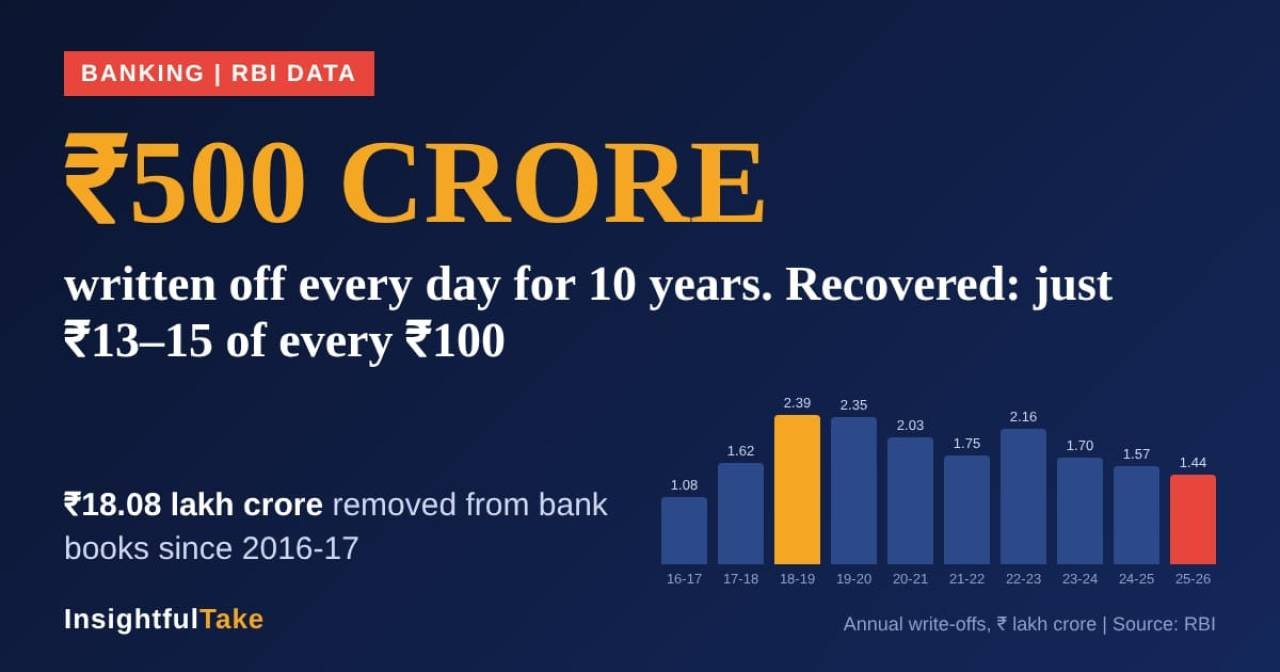
Indian banks wrote off nearly ₹500 crore every day for a decade, but recovered only a fraction. The real cost extends far beyond their balance sheets.
India's banks have written off ₹18.08 lakh crore in loans over ten years. While bad-loan ratios have fallen and balance sheets look healthier, recoveries remain painfully low. The gap raises serious questions about accountability, public money and unequal treatment of borrowers.
Indian banks have written off nearly ₹500 crore worth of loans every day over the past decade. According to Reserve Bank of India (RBI) data released in response to a Right to Information (RTI) application, scheduled commercial banks wrote off a staggering ₹18.08 lakh crore between 2016-17 and 2025-26.
The latest figures offer some relief on the surface. Bank write-offs declined by 8.2 per cent in 2025-26 to ₹1.44 lakh crore, compared with ₹1.57 lakh crore in 2024-25 and ₹1.70 lakh crore in 2023-24.
But a declining annual figure does not automatically mean that India's bad-loan problem has been resolved. The more consequential measure is how much of the money written off has actually been recovered.
The distinction matters because writing off a loan and recovering it are two entirely different things. One improves the appearance of a bank's balance sheet. The other restores money to the banking system.
What a Bank Loan Write-Off Actually Means
A loan write-off is primarily an accounting exercise. When a bank considers a loan unlikely to be recovered, it makes provisions against the expected loss and removes the loan amount from its balance sheet.
However, the borrower's repayment obligation does not disappear. Banks retain the legal right to pursue recovery through appropriate channels.
A written-off loan also stops appearing in the bank's reported non-performing asset (NPA) figures. Consequently, the reported level of stressed assets can decline even when the money has not been recovered.
This distinction is essential to understanding the improvement in India's banking sector.
Gross NPAs of scheduled commercial banks declined to ₹3.86 lakh crore, or 1.73 per cent of total advances, in 2025-26. In 2024-25, the figure stood at ₹4.32 lakh crore.
The improvement is substantial when compared with the 2017-18 peak, when gross NPAs reached ₹10.40 lakh crore, equivalent to 11.18 per cent of advances.
The banking system has undoubtedly strengthened its reported asset quality. However, the reduction in NPAs must be viewed alongside write-offs, recoveries and the actual financial losses absorbed by banks.
A cleaner balance sheet does not necessarily mean a recovered loan.
The Recovery Gap Is the Bigger Concern
The most troubling aspect of the RBI figures is not simply the enormous volume of loans written off. It is the limited amount that has returned.
According to the reported data, banks recovered only around 13 to 15 per cent of the loans written off over the last five years, amounting to approximately ₹1.32 lakh crore.
In practical terms, for every ₹100 written off, banks recovered barely ₹13 to ₹15.
The remaining amount represents money that has not returned through recovery efforts, leaving banks to absorb the financial consequences through provisions and capital.
The scale becomes clearer when looking at individual years. Write-offs in 2022-23 alone amounted to ₹2.16 lakh crore, substantially exceeding the total recoveries reported across the five-year period.
This recovery gap exposes the limitations of treating declining write-off figures as evidence of a healthier lending environment.
A lower annual write-off may indicate fewer fresh bad loans, but it may also reflect changes in the timing and recognition of stressed accounts. Without transparent recovery figures, the broader picture remains incomplete.
Public Sector Banks Carry a Heavy Burden
The concentration of write-offs among a handful of major lenders raises further concerns.
The top ten banks accounted for approximately ₹11.73 lakh crore, nearly two-thirds of the total write-offs during the decade.
The State Bank of India (SBI) topped the list with write-offs of ₹3.03 lakh crore. Punjab National Bank followed with ₹1.31 lakh crore, while Bank of Baroda accounted for ₹1.15 lakh crore.
Union Bank of India and Canara Bank recorded write-offs of ₹1.13 lakh crore and ₹1.04 lakh crore, respectively.
Together, these five public sector banks wrote off approximately ₹7.66 lakh crore.
Private sector lenders, including ICICI Bank, Axis Bank and HDFC Bank, also featured among the ten largest banks in terms of write-offs. Nevertheless, government-owned banks accounted for nearly 63 per cent of the overall amount.
This concentration has implications beyond banking.
Public sector banks are government-owned institutions. When accumulated losses weaken their capital position, the government has repeatedly stepped in with financial support to maintain their lending capacity.
Such capital support ultimately comes from public resources. Money committed to recapitalising banks competes with other demands on government finances, including infrastructure, healthcare, education and social welfare.
Therefore, large-scale loan write-offs are not merely internal banking decisions. They also raise questions about the responsible use of public money.
Large Borrowers and Small Borrowers: An Unequal Experience
The distribution of loan write-offs also raises concerns about fairness in the banking system.
A former RBI Deputy Governor has observed that smaller loans are rarely written off and that a substantial proportion of the total write-off amount relates to large loans.
The contrast is familiar to ordinary borrowers.
A person who misses instalments on a personal loan, two-wheeler loan or home loan can quickly face recovery calls, reminders, legal notices and damage to their credit score. Even a relatively small default can affect their ability to access future credit.
Large corporate defaults, on the other hand, often involve prolonged negotiations, legal proceedings, insolvency processes and restructuring arrangements.
There are legitimate differences between individual and corporate lending. Large business loans involve complex financial structures, multiple creditors and assets that may take years to liquidate. Writing off unrecoverable amounts is also a recognised accounting practice.
However, these explanations cannot substitute for accountability.
When large borrowers account for substantial losses, the public deserves greater transparency about the circumstances of default, the recovery efforts undertaken and the responsibility of those who sanctioned and monitored the loans.
The credibility of the banking system depends not only on its ability to recover money but also on whether lending discipline applies consistently across borrower categories.
What India Needs to Do Next
The scale of write-offs calls for stronger disclosure and institutional accountability.
First, banks should publish standardised annual figures showing recoveries from previously written-off accounts alongside fresh write-offs. This would help policymakers, depositors and taxpayers understand whether the recovery process is producing meaningful results.
Second, banks should provide clearer information about recovery proceedings, including the duration of legal action and the progress of major default cases, subject to legitimate confidentiality requirements.
Third, lending decisions involving exceptionally large accounts need closer scrutiny. Credit appraisal, collateral assessment, risk monitoring and early identification of financial distress should receive greater institutional attention.
Finally, accountability should not end with the borrower. Where negligence, procedural violations or deliberate misconduct are established, the responsibility of bank officials and other concerned parties must also be examined.
A Cleaner Balance Sheet Is Not the Same as a Repaired Banking System
The 8.2 per cent decline in annual write-offs and the improvement in gross NPAs are genuine positives for India's banking sector. Stronger balance sheets help banks expand credit, support businesses and contribute to economic growth.
But the larger financial picture cannot be understood through declining NPA ratios alone.
Over ten years, nearly ₹18.08 lakh crore has been written off. Recoveries have represented only a fraction of the amounts involved. The concentration of losses among major lenders, particularly public sector banks, makes the issue even more significant.
India needs a banking system that does more than remove bad loans from its balance sheets. It needs institutions that lend responsibly, recover public money effectively and apply accountability without favour or exception.
A write-off may clean up a bank's books, but it does not erase the economic cost. Until recovery improves and accountability becomes more transparent, the decline in write-offs should be seen as progress in financial reporting, not necessarily proof that the underlying problem has been repaired.























Leave a Comment