
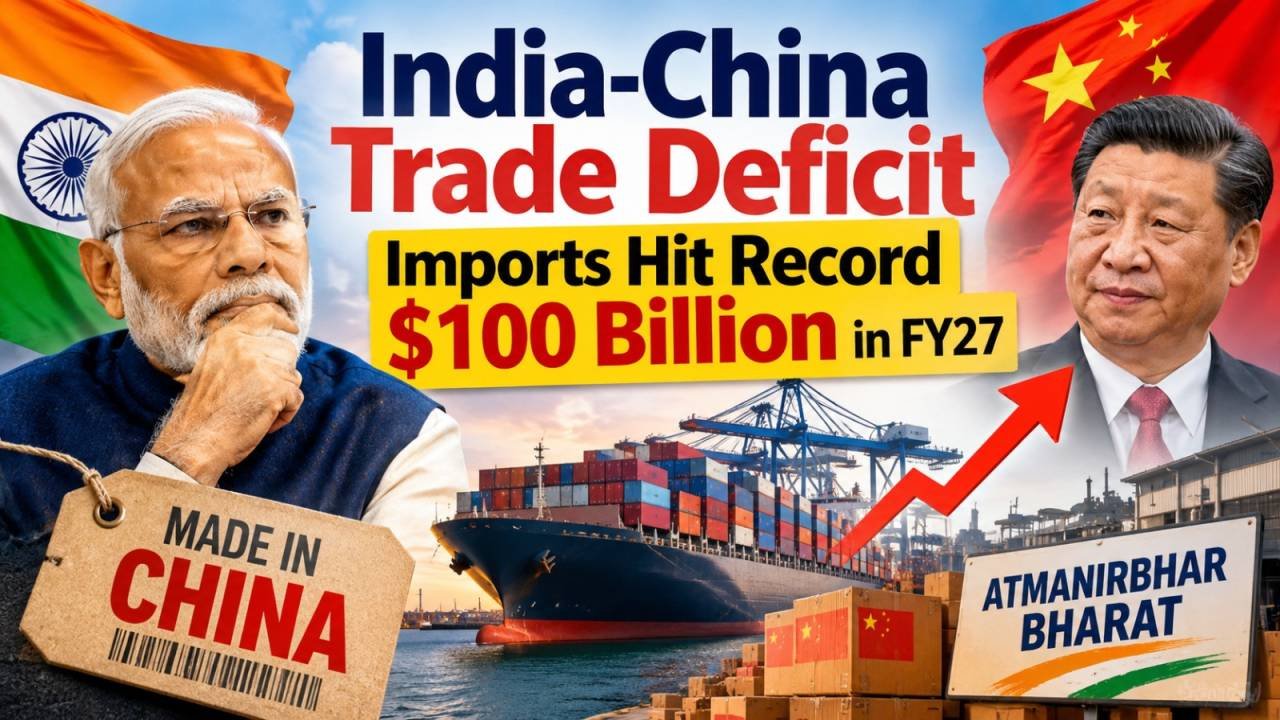
India's record Chinese imports expose a widening gap between its self-reliance ambitions and the realities of domestic manufacturing.
India's merchandise imports from China hit $96.61 billion in just seven months of FY27, up 30.6% over the corresponding period last year. At this pace, the $100-billion mark could be crossed in November, four months ahead of schedule, while the full-year record of $131.62 billion set in FY26 is likely to be comfortably surpassed. China's share of India's total imports has climbed from 13.76% in FY23 to 18.3% this year.
For a government that has built much of its economic identity around self-reliance, these numbers present an uncomfortable reality.
The rhetoric has remained consistent since the 2020 Galwan clash. Chinese apps were banned, investments from China were placed under stricter scrutiny, and Atmanirbhar Bharat became a central national mission. Yet India's trade deficit with China increased from $85.08 billion in FY24 to a record $112.16 billion in FY26. Business Standard estimates suggest it could approach $150 billion in FY27.
The political messaging has hardened, but India's economic dependence has continued to deepen.
China's Components Are Inside India's Manufacturing Story
The popular image of Chinese imports, cheap toys, decorative lights and low-cost consumer goods, is outdated. India's dependence now extends deep into its industrial and manufacturing ecosystem.
In April-September, electronic components worth $9.37 billion, telecom instruments worth $7.27 billion and industrial machinery worth $4.58 billion featured among the leading imports. Organic chemicals, batteries and plastics also accounted for substantial purchases. India even imports bulk drugs from China to manufacture medicines that it subsequently exports.
This changes the nature of the debate. China is no longer simply competing with Indian manufacturers. It has become an important part of their production process.
A mobile phone assembled in Noida, a solar module, a generic medicine or an engineering product manufactured in India may contain components sourced from China. India's $70.89 billion in engineering exports and $31.97 billion in electronics exports depend, to varying degrees, on imported inputs.
This is a more difficult form of dependence to address because it operates upstream, often beyond the visibility of consumers. Analysts estimate that around 80% of India's imports from China fall within four major product groups where finding immediate alternatives remains difficult.
Replacing a finished consumer product is relatively straightforward. Replacing an entire network of industrial suppliers, component manufacturers and technology providers is a much longer exercise.
Where India's Policy Met Economic Reality
India's Press Note 3 of 2020 introduced stricter scrutiny of investments from countries sharing land borders with India, effectively restricting Chinese capital flows. The measure reflected genuine national security concerns following the Galwan confrontation.
However, restricting investments did not automatically reduce imports.
A Carnegie India analysis observed that the restrictions succeeded in keeping Chinese capital out but did little to stem the flow of Chinese goods into the country. Indian manufacturers continued purchasing machinery, components and industrial inputs because domestic alternatives were either unavailable or insufficiently competitive.
In March 2026, the Union Cabinet acknowledged the need for a more pragmatic approach by easing restrictions on non-controlling Chinese investments of up to 10% without prior government approval.
The decision reflected economic necessity rather than a fundamental change in India's strategic position. It also exposed the gap between political messaging and industrial requirements.
By the first half of FY27, China had overtaken the United States as India's largest trading partner, according to trade data. The economic relationship has therefore continued to expand despite persistent diplomatic and security tensions.
The Government Has an Economic Argument Too
A fair assessment must consider the government's position. India's growing imports from China do not automatically indicate the failure of its manufacturing ambitions.
The government's broader approach can be understood as economic de-risking rather than complete decoupling. Strategic sectors require safeguards, but factories must retain access to competitively priced machinery and components to remain productive.
Japan, South Korea and Vietnam also experienced import-heavy phases during their industrial development. Imported capital goods and intermediate products helped them build manufacturing capacity and eventually strengthen exports.
India's exports to China have also increased by 38% so far this year, although the value remains relatively modest at around $14 billion.
Moreover, a trade deficit is not necessarily evidence of economic weakness. Imports of machinery, technology and industrial inputs can support domestic production, generate employment and strengthen export capacity.
The distinction lies in whether these imports help build domestic capabilities or create permanent dependence on external suppliers.
Self-Reliance Needs More Than Political Messaging
The central contradiction in India's China policy is not that the country continues to trade with its strategic rival. International trade rarely follows the neat boundaries of political relationships. The contradiction lies in presenting economic independence as an established achievement while critical manufacturing sectors remain heavily dependent on Chinese supply chains.
A genuinely self-reliant economy should have the capacity to diversify suppliers without disrupting its factories. By that measure, India's dependence on China remains a serious structural vulnerability.
Boycott campaigns and app bans may deliver immediate political messaging, but industrial independence requires much harder work. India needs competitive component ecosystems, reliable electricity, efficient logistics, affordable credit, skilled labour and predictable regulatory policies. It also needs consistent anti-dumping measures that protect domestic manufacturers without making essential industrial inputs prohibitively expensive.
New Delhi faces a choice. It can acknowledge that Chinese inputs remain necessary during India's industrial expansion and manage the associated strategic risks transparently. Alternatively, it can commit the investment, infrastructure and regulatory reforms required to make Indian manufacturing a credible alternative.
These approaches are not mutually exclusive, but both require economic realism.
The dragon is no longer standing outside India's industrial gates. It is already inside the warehouse, embedded in the machinery, components and supply chains that keep Indian factories running.
India's ambition to become a global manufacturing power will ultimately be judged not by the strength of its slogans, but by how successfully it reduces this dependence.






















Leave a Comment