
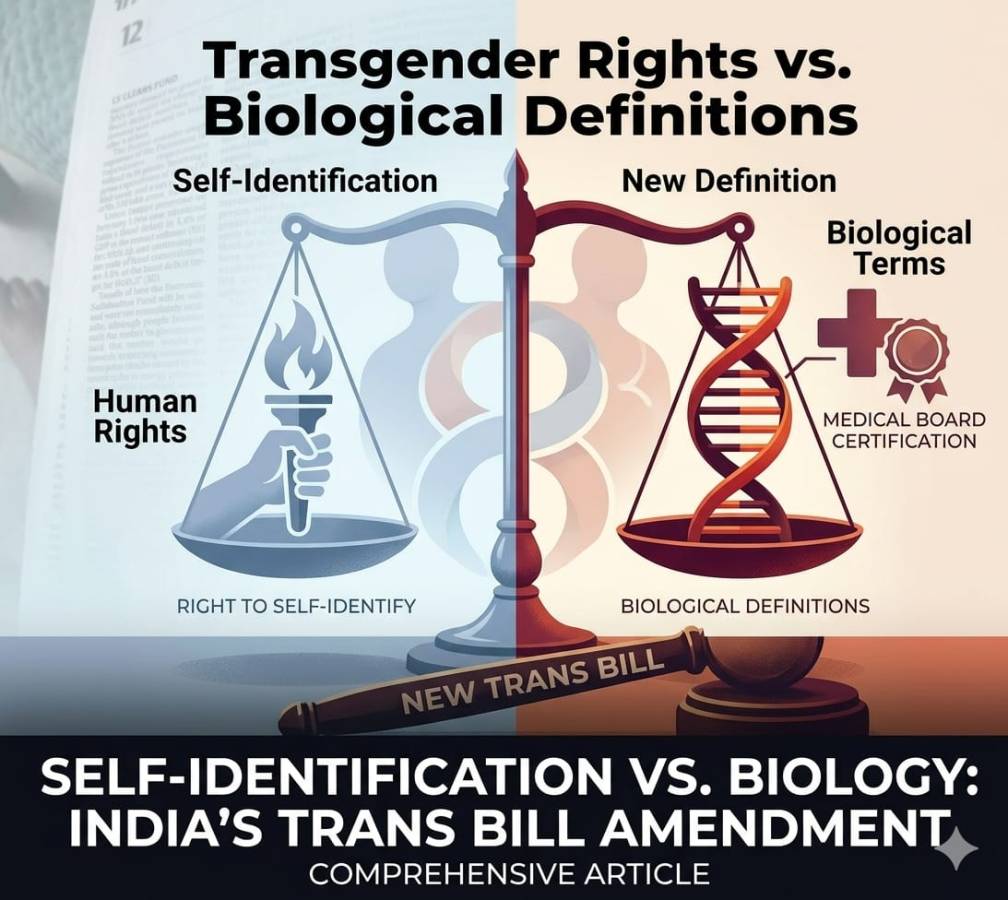
Is gender identity a personal truth or a medical classification? India’s proposed Transgender Persons (Protection of Rights) Amendment Bill, 2026 has ignited a national debate by shifting the recognition of transgender identity from self-identification to biological and institutional certification—raising profound questions about rights, dignity, and state authority.
In a move that has sparked intense debate across the country, the Union government recently introduced the Transgender Persons (Protection of Rights) Amendment Bill, 2026 in the Lok Sabha. Presented by Social Justice Minister Virendra Kumar, the bill proposes significant changes to how the Indian state defines and recognises transgender individuals.
While the government frames these changes as necessary for clarity and protection, rights activists and members of the LGBTQ+ community warn that the legislation represents a substantial step backward for human rights in India.
A Drastic Shift in Definition
The most striking feature of the 2026 amendment is the narrowing of the term “transgender person.”
Under the Transgender Persons (Protection of Rights) Act, 2019, the definition was relatively broad and inclusive. It covered individuals whose gender identity differed from the gender assigned to them at birth, including trans-men, trans-women, and genderqueer persons.
The new bill replaces this inclusive definition with one rooted primarily in biological characteristics and traditional socio-cultural identities.
Under the proposed amendment, a transgender person would be defined as:
- A person with specific intersex variations, meaning biological or congenital conditions related to sex characteristics.
- A person belonging to traditional socio-cultural identities such as Kinner, Hijra, Aravani, Jogta, or Eunuch.
Crucially, the bill includes a proviso explicitly excluding individuals with “different sexual orientations and self-perceived sexual identities.”
This means that individuals who identify as transgender based on their internal sense of gender — without falling into one of the specified biological or traditional categories — may no longer receive legal recognition under the law.
The End of Self-Identification
For years, India’s transgender community fought for the right to self-identify their gender — a principle firmly established in the landmark NALSA v. Union of India judgment delivered by the Supreme Court of India in 2014.
The 2019 Act recognised this right. However, the 2026 Amendment Bill seeks to remove it.
Instead of allowing individuals to declare their own gender identity, the proposed law introduces a medicalised certification process:
- Medical Boards: A designated medical board will serve as the certifying authority for determining transgender status.
- District Magistrate Oversight: The District Magistrate (DM) will remain the authority responsible for issuing identity certificates but must now act based on recommendations made by the medical board.
- Mandatory Reporting: Medical institutions performing gender-affirming surgeries will be required to report such procedures to the District Magistrate and relevant medical authorities.
In effect, the bill transfers the power of identity determination from the individual to medical experts and government officials.
Stricter Penalties and a Graded Justice System
The amendment also proposes a major overhaul of the legal framework governing offences against transgender persons.
Under the 2019 Act, crimes against transgender individuals carry a uniform punishment ranging from six months to two years of imprisonment.
The new bill introduces a graded system of penalties, including much harsher punishments for certain offences:
- Extreme Crimes: Forcing a child into emasculation, castration, or amputation with the intent of compelling a transgender identity will be punishable with rigorous imprisonment for life, along with a minimum fine of ₹5 lakh.
- Forced Labour and Begging: Forcing a person to present as transgender for the purposes of begging or bonded labour could lead to 10–14 years of imprisonment for offences against children, and 5–10 years for offences against adults.
- Existing Offences: Crimes such as forced labour, denial of access to public spaces, and physical or sexual abuse continue to attract six months to two years of imprisonment.
The government argues that these provisions aim to protect vulnerable individuals from exploitation and coercion.
Why Activists Are Opposing the Bill
Despite the introduction of stricter punishments, activists and legal experts say the bill overlooks the lived realities of many transgender people in India.
1. Medicalisation vs. Rights
Senior advocate Jayna Kothari and several rights activists argue that the amendment “turns back the clock.”
By requiring medical certification, critics say the law effectively treats gender identity as a medical condition, rather than recognising it as a fundamental aspect of personal liberty and dignity.
2. Exclusion of a Large Population
Activists also warn that narrowing the definition to biological variations and traditional communities like Hijras risks leaving trans-men and trans-women outside these traditional identities without legal protection.
Rituparna Neog, a member of the National Council for Transgender Persons, has pointed out that highlighting only socio-cultural identities could exclude a large number of people who fall under the broader transgender umbrella.
3. Safety and Privacy Concerns
Members of the transgender community also fear that the involvement of medical boards and mandatory reporting requirements may increase bureaucratic hurdles, stigma, and privacy concerns, discouraging individuals from coming forward or seeking support.
Final Take
The Transgender Persons (Protection of Rights) Amendment Bill, 2026 marks a pivotal — and deeply controversial — moment in India’s evolving legal framework on gender identity.
On one hand, the legislation seeks to curb extreme and exploitative practices by introducing harsher criminal penalties. On the other, it appears to roll back the hard-won right to self-perceived gender identity, shifting the authority to define identity from individuals to medical boards and administrative institutions.
As the bill moves through Parliament, a fundamental question lies at the heart of the debate:
Should identity be defined by the person living it — or by the institutions that seek to regulate it?


























Leave a Comment