
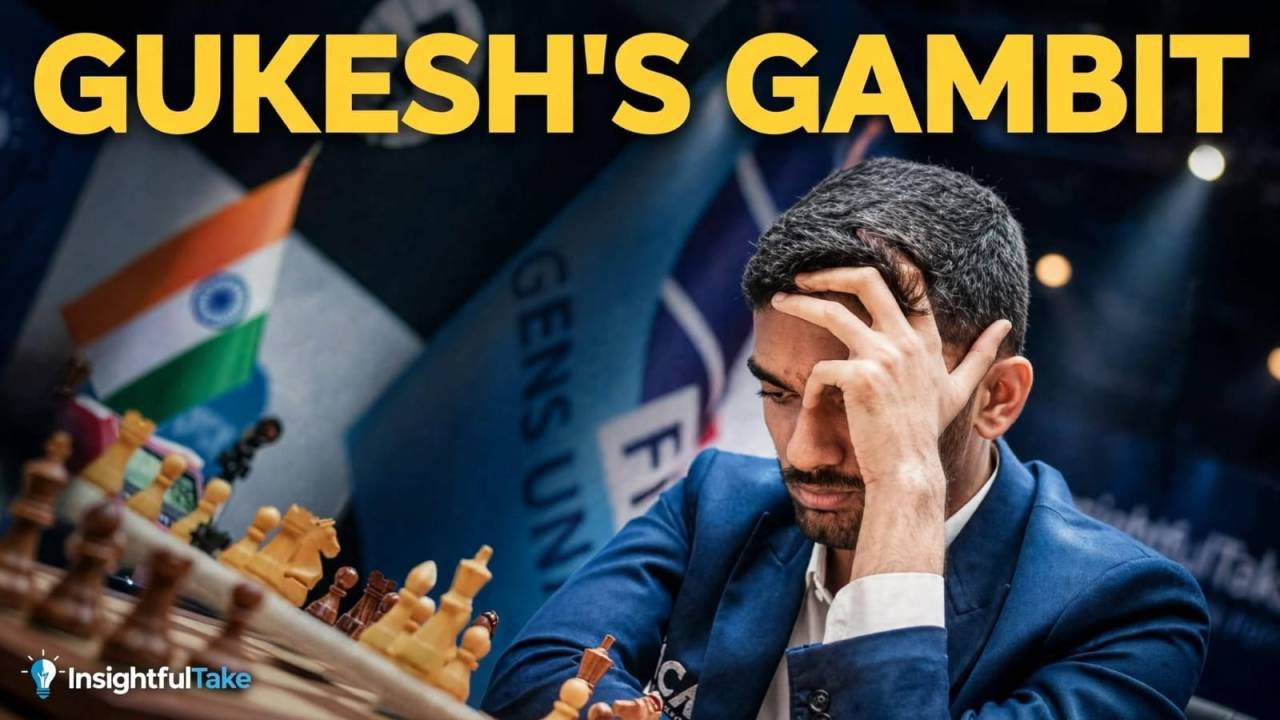
Gukesh's opening surprise failed to trouble Sindarov as the challenger comfortably held a 20-move draw to keep the World Championship level at 1-1.
D Gukesh's attempt to surprise Javokhir Sindarov with the London System produced little excitement on the board as Game 2 of the World Chess Championship ended in a draw after just 20 moves. Playing White for the first time in the match, the defending champion failed to create any meaningful pressure, allowing Sindarov to neutralise his opening ideas comfortably.
The result leaves the match level at 1-1, with 12 classical games still remaining.
Gukesh's Opening Surprise Fails to Deliver
After a tense opening encounter in Game 1, where Gukesh defended with the Berlin Defence as Black, the Indian grandmaster opted for a different approach in the second game.
The London System, often regarded as a solid but relatively unambitious opening, was Gukesh's choice with White. Its strength lies in a reliable pawn structure and limited early risks. Despite its reputation as a conservative opening, it has featured prominently on the biggest stage. Ding Liren, for instance, used it to score a victory against Ian Nepomniachtchi during the 2023 World Chess Championship.
Gukesh appeared to be banking on an element of surprise. Sindarov, however, was well prepared.
The Uzbek challenger brought his queen into play as early as the seventh move, exchanged a knight on the eighth and returned his queen to its original square by move 11. The resulting position offered neither player a meaningful advantage.
Gukesh also faced a growing time disadvantage, having spent considerably longer thinking over his moves. He was approximately 40 minutes behind Sindarov on the clock.
With no clear opening advantage and little scope to put his opponent under pressure, the defending champion agreed to a draw by repetition on the 20th move.
Gukesh Admits His Preparation Fell Short
Speaking after the game, Gukesh offered an unusually candid assessment of his opening choice.
He described the London System as a "nice little surprise", explaining that he had played it frequently during the pandemic lockdown. A sense of nostalgia may also have influenced his decision to return to the opening.
However, the champion acknowledged that he could not recall all the preparation he had intended to use.
Describing the encounter as "soft" compared with the first game, Gukesh credited Sindarov for his preparation and understanding of the position.
He also recognised that failing to secure an advantage from the opening is hardly unusual at the highest level of professional chess.
Sindarov, meanwhile, said he had not particularly expected the London System but had previously studied the variation. Consequently, Gukesh's choice did not catch him completely off guard.
The challenger appeared relaxed about the match score, saying it was too early to focus on the overall result. He also indicated that he was feeling energetic.
Cards, Coaches and the Mental Game
Away from the chessboard, the atmosphere in Geneva appears relatively relaxed despite the enormous pressure associated with a World Championship match.
Sindarov was seen speaking with his second, Nikita Vitiugov, before the game. However, the challenger described their conversation as more of a motivational exchange than a last-minute discussion about opening preparation.
His coach, Roman Vidonyak, is also accompanying him in Geneva.
Both Gukesh and Sindarov are 20 years old and experiencing a World Championship match for the first time. Sindarov acknowledged that adjusting to the intensity and expectations of the occasion remains part of the learning process.
Interestingly, the players also revealed that their preparation camps are not entirely consumed by chess. Card games sometimes provide a welcome break from the relentless concentration required at the board.
Such moments of relaxation can be important during a championship that demands sustained mental discipline over several weeks.
World Championship Remains Wide Open
With two games completed, neither player has established a clear advantage.
Gukesh arguably gained some psychological confidence from Game 1, having defended a difficult position to secure a draw. Game 2, however, demonstrated that Sindarov's preparation is deep enough to withstand unexpected opening choices.
The challenger has also shown that he is comfortable handling the pressure of facing the reigning world champion.
Nevertheless, a short draw with White does not offer sufficient evidence to judge the direction of a 14-game classical contest. Early encounters in championship matches frequently involve testing preparation, assessing an opponent's playing style and avoiding unnecessary risks.
The real battle often develops gradually as both players attempt to identify weaknesses in the other's preparation and decision-making.
What's Next: Gukesh Takes Black in Game 3
The contest moves into Game 3 with the colours reversed. Gukesh will play Black, giving Sindarov the opportunity to take the initiative with White.
The next encounter could provide a clearer indication of whether either player is prepared to take greater risks.
For Gukesh, the immediate challenge will be to recover from an opening experiment that failed to produce an advantage. Sindarov, meanwhile, will look to build on his comfortable handling of the London System.
At 1-1, the championship remains evenly poised. The opening games have revealed two well-prepared opponents, but the decisive strategic battle is still ahead.

























Leave a Comment