
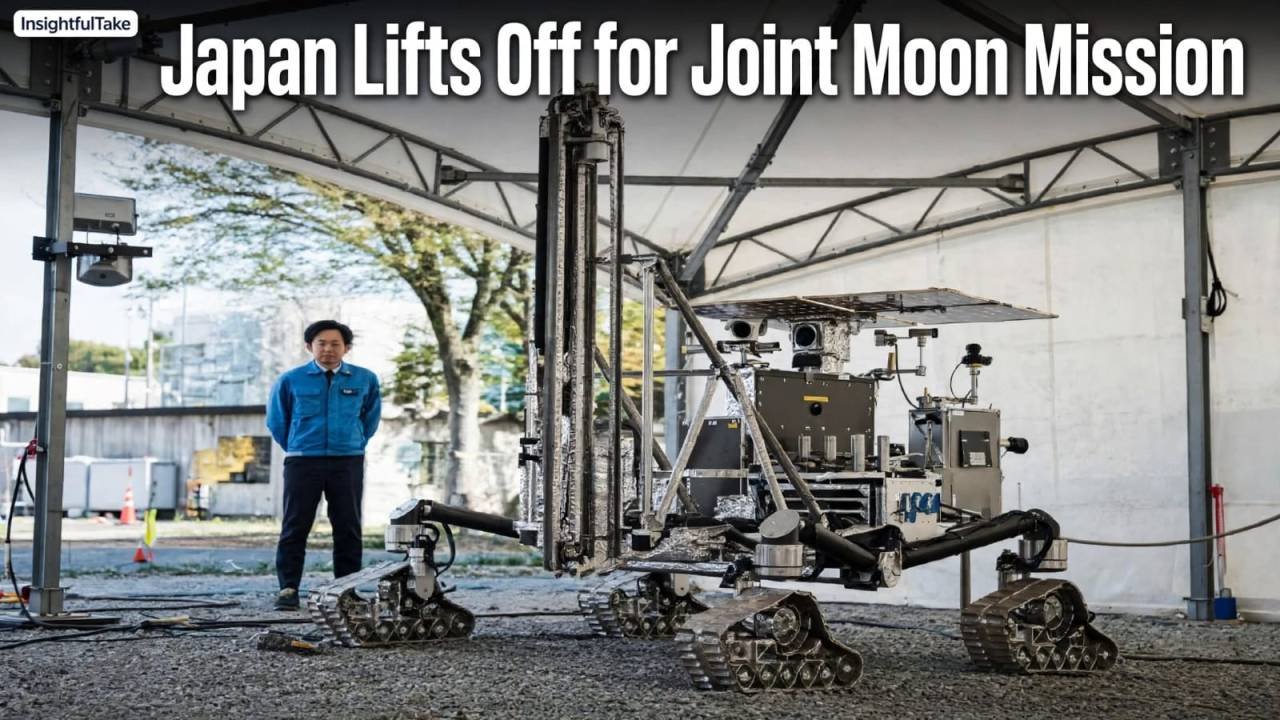
India and Japan are preparing to explore the Moon’s south pole in 2028, searching for water ice that could eventually turn the lunar surface into a refuelling station for future space missions.
Japan’s space agency JAXA has unveiled a test model of the rover it is developing for one of the most ambitious lunar exploration missions of the decade. At its Chofu Aerospace Center in Tokyo, the agency demonstrated the vehicle’s driving capabilities before reporters.
The rover will eventually travel to the Moon’s south pole as part of the Lunar Polar Exploration (LUPEX) mission, a joint initiative between India and Japan. Its primary objective is to investigate water resource on moon surface.
The mission could mark an important shift in lunar exploration, moving beyond the pursuit of landing achievements towards understanding whether the Moon can support sustained human activity.
Why Water Is the Real Prize
The Moon’s polar regions contain craters whose floors have remained untouched by direct sunlight for billions of years. Known as permanently shadowed regions, these locations are among the coldest environments in the solar system.
Scientists believe that water ice may be trapped inside these craters. However, its actual quantity, distribution, purity and accessibility remain uncertain.
Finding water would have implications far beyond drinking supplies. Through a process called electrolysis, water can be separated into hydrogen and oxygen, both of which can be used as rocket propellants.
LUPEX project manager Takeshi Hoshino has indicated that the long-term ambition is to explore the possibility of using lunar water as rocket fuel. Such a development could significantly reduce the cost of future space missions.
Even the International Space Station, where more than 90 per cent of water is recycled, cannot recover water once it has been converted into propellant and consumed during a rocket's operation.
Transporting large quantities of water from Earth is expensive and technically challenging. If usable water can be extracted from the Moon, future missions could potentially refuel there instead of carrying all their supplies from Earth.
This could eventually support return journeys, extended lunar operations and even missions to Mars.
India and Japan’s Division of Responsibilities
LUPEX, also known as Chandrayaan-5 in India, represents a substantial collaboration between two major Asian space powers.
The responsibilities are divided between the two countries.
- Japan’s JAXA: Developing the lunar rover, its scientific instruments and the H3 launch vehicle.
- India’s ISRO: Developing the lander that will transport the rover to the lunar surface.
The rover is expected to weigh approximately 350 kg and is designed to operate on the Moon for more than 100 days, according to published mission details.
The collaboration also extends beyond India and Japan. NASA is expected to contribute a neutron spectrometer, while the European Space Agency is providing another scientific instrument.
The project has progressed through important institutional milestones. ISRO received government approval in early 2025, followed by the signing of an implementing arrangement between India and Japan in August 2025.
The launch is currently targeted for fiscal year 2028.
What LUPEX Means for India
For India, LUPEX is a logical progression from Chandrayaan-3, which achieved a historic lunar landing in August 2023. India became the first country to land near the Moon’s south polar region, demonstrating its ability to navigate and operate in challenging lunar terrain.
However, LUPEX involves a considerably more complex undertaking.
Landing a heavier rover, deploying it safely and conducting scientific investigations in extreme conditions will demand more advanced engineering capabilities. The mission will also test India's ability to participate in sophisticated international space projects as an equal technical partner.
There is a strategic dimension to this partnership as well.
The Moon’s south pole is emerging as an important area of international space exploration. Countries that develop the ability to explore, map and utilise its resources could gain significant technological and diplomatic advantages in the coming decades.
Working with Japan gives India access to complementary expertise, shared research capabilities and an opportunity to strengthen its position in the evolving international space ecosystem.
The Challenges Ahead
The lunar south pole is among the most difficult environments for robotic exploration.
Extreme temperatures, prolonged darkness, steep slopes, loose soil and rugged terrain present serious engineering challenges. Equipment must withstand severe temperature variations while maintaining reliable communication, navigation and power systems.
The LUPEX rover will need to navigate the terrain, investigate the lunar soil and analyse samples to establish the presence, quantity and characteristics of water ice.
The test model demonstrated in Tokyo represents an important stage in preparing for these conditions. Engineers must establish that the rover can function reliably long before the actual spacecraft begins its journey.
Even a successful mission will not immediately make lunar fuel commercially or operationally viable. LUPEX is primarily a scientific and technological prospecting mission, not an attempt to establish a lunar fuel production facility.
Its findings will help determine whether the Moon possesses sufficient accessible water to justify future extraction technologies and infrastructure.
The Moon as Humanity’s Next Supply Station
For much of the space age, the Moon has been viewed primarily as a destination for scientific exploration and national achievement. LUPEX points towards a potentially different future.
If water ice can be located, extracted and processed economically, the Moon could eventually become a supply station for deeper space exploration.
The implications would extend beyond lunar missions. Refuelling infrastructure on the Moon could reduce dependence on Earth-based launches and make long-distance space travel more sustainable.
The distance between Earth and the Moon is approximately 384,000 kilometres. Yet the discovery of a usable water reserve inside a permanently shadowed crater could have consequences reaching millions of kilometres further into space.
For India and Japan, LUPEX is therefore more than another lunar mission. It is an investment in the technologies, partnerships and scientific knowledge that could shape humanity’s next phase of space exploration.




















Leave a Comment