
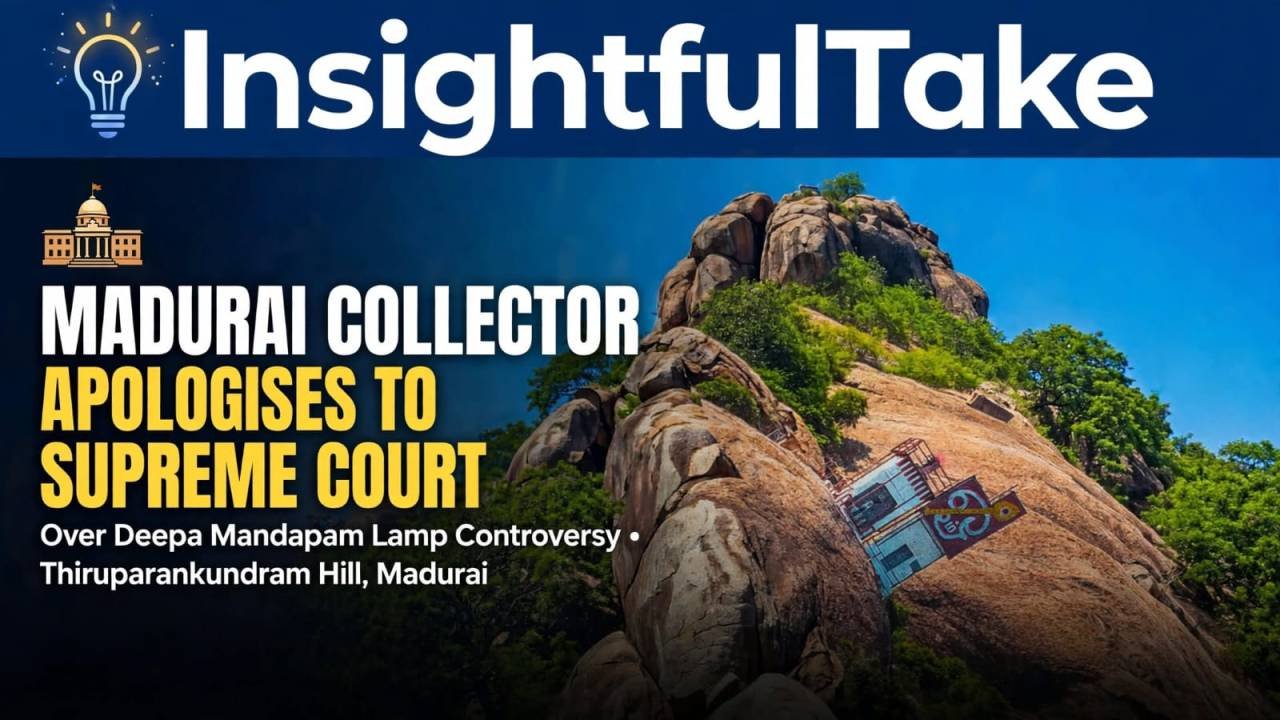
A missed ritual, a court order and a political confrontation have turned Thiruparankundram's Deepathoon into a test of institutional accountability.
The dispute over lighting the ceremonial lamp at Thiruparankundram hill has escalated into a legal and political confrontation, involving a Supreme Court order, a contempt petition and a query from the Tamil Nadu Governor to the Chief Minister.
Madurai District Collector Nishant Krishna has apologised to the Supreme Court for the administration's failure to ensure that the Karthigai Deepam lamp was lit at the Deepathoon, a stone pillar on Thiruparankundram hill, despite the court's permission on November 20. However, while expressing regret, the collector attributed the failure to the temple's Devasthanam and its Board of Trustees, saying the administration had completed the necessary preparations but did not receive the required authorisation.
The controversy has since moved beyond the immediate question of a religious ceremony. It now involves allegations of disobedience of a judicial order, a pending contempt petition, intervention by the Governor and a widening political confrontation in Tamil Nadu.
What the Supreme Court Had Ordered
On November 20, a Supreme Court bench comprising Justices Aravind Kumar and VM Pancholi permitted the lighting of the ceremonial lamp at the stone pillar, locally known as the Deepathoon, on the occasion of Karthigai Deepam. The permission was described as a restricted, one-time arrangement.
The festival was observed on November 24. However, the lamp was lit only at the customary location, the Uchi Pillaiyar Mandapam of the Uchchipillaiyar Temple on the same hill. The Deepathoon remained unlit.
The decision immediately triggered criticism from the BJP, which accused the ruling Tamilaga Vettri Kazhagam (TVK) government of failing to comply with the Supreme Court's directions.
Collector Attributes Failure to Temple Authorities
In his status report submitted to the Supreme Court, Collector Nishant Krishna maintained that the district administration had taken the necessary steps to implement the order.
According to his account, between November 21 and 24, the administration repeatedly sought authorisation from the temple's Devasthanam to nominate a team for lighting the lamp at the Deepathoon. He said all arrangements had been completed, but the temple authorities did not approve the names of the proposed team members.
The collector further stated that the temple's Board of Trustees passed a resolution on November 24 to light the ceremonial lamp at the customary location instead. The Devasthanam, he added, never informed the district administration that anyone had been authorised to conduct the ceremony at the Deepathoon.
Krishna also referred to an email reminder sent to the temple's executive officer at 3.47 pm on Tuesday. He said he appeared before the Madras High Court twice that day and assured it that the Supreme Court's directions would be followed.
According to the collector, the executive officer communicated the Board of Trustees' decision only after the lamp had been lit at approximately 8.30 pm.
Krishna has assured the Supreme Court that he will submit an additional status report supported by relevant documents.
The location of the Deepathoon adds another layer of sensitivity to the dispute. The stone pillar is situated approximately 50 metres from the Sikkandar Badusha Dargah, making the site a longstanding point of religious and community sensitivities.
Petitioners Seek Enforcement of the Order
During Wednesday's hearing, the petitioners argued that the Supreme Court's November 20 order should still be implemented, notwithstanding the fact that the festival date had passed.
They submitted an interlocutory application arguing that the question of substantive justice and compliance with the court's directions should be considered independently of any separate contempt proceedings.
A review petition filed by the Tamil Nadu government against the earlier order is also pending before the Supreme Court.
Justice Aravind Kumar said the registry would verify the relevant details and that the application would be listed within a day or two.
The bench, however, declined to initiate contempt proceedings on its own. It indicated that the concerned parties would have to file an appropriate petition.
Contempt Petition Names Three Officials
The legal confrontation has taken another turn with the Hindu Dharma Parishad, represented by KK Ramesh, filing a contempt petition against three senior officials:
- Dr T G Vinay, Commissioner of the Hindu Religious and Charitable Endowments Department.
- Nishant Krishna, Madurai District Collector.
- S Rajendiran, Madurai Police Commissioner.
The petition alleges wilful disobedience of the Supreme Court's directions and invokes Sections 12 and 23 of the Contempt of Courts Act, read with Article 129 of the Constitution.
It also alleges violations of Articles 14 and 16, which concern equality before the law and equality of opportunity in public employment, respectively.
These remain allegations made by the petitioners. The Supreme Court has not yet determined whether any official is guilty of contempt.
Governor Seeks Explanation From Chief Minister
The controversy has also reached the Governor's office.
Governor Rajendra Arlekar has reportedly sought an explanation from Chief Minister C Joseph Vijay over the failure to light the ceremonial lamp at the Deepathoon in accordance with the Supreme Court's order.
According to people familiar with the matter, the Governor invoked Article 167(b) of the Constitution, which requires the Chief Minister to furnish information concerning the administration of state affairs when requested by the Governor.
An official confirmed the Governor's communication on condition of anonymity.
The intervention adds a constitutional dimension to an already contentious dispute, bringing the offices of the Governor and the elected state government into the unfolding controversy.
A Judicial Order Caught Between Administration and Politics
The developments expose three important dimensions of the dispute.
First, the case highlights the practical difficulties of implementing judicial directions when administrative responsibility is divided among multiple authorities. The district administration maintains that it was waiting for the temple's authorisation, while the temple's Board of Trustees chose to retain the customary location. The result was that the Supreme Court's permission was not acted upon.
Such institutional divisions cannot automatically absolve public officials of responsibility. The court will have to examine whether the administration took adequate and timely steps to ensure compliance with its directions.
Second, the collector's apology and the contempt proceedings are legally distinct matters. An expression of regret does not, by itself, establish whether contempt has occurred. The court will need to assess the sequence of events, the status report, the correspondence between the administration and temple authorities, and the reasons the order remained unimplemented.
Third, the controversy has acquired a political dimension that could complicate an already sensitive religious issue. The BJP's criticism of the TVK government, the Governor's intervention and the petitioners' legal challenge have brought the dispute into the centre of Tamil Nadu's political debate.
The immediate facts remain straightforward. The Supreme Court permitted the lighting of the lamp at the Deepathoon on November 20. The lamp was not lit there on November 24. The district collector has apologised and attributed the failure to the temple authorities. A contempt petition has been filed, and the Governor has sought an explanation from the Chief Minister.
The next hearing will be significant in determining how the Supreme Court interprets the failure to implement its order and whether responsibility can be fixed on the officials and institutions involved.
For now, the Deepathoon controversy has become a test of institutional accountability, judicial authority and the relationship between religious administration and the state.













Leave a Comment