

India's fertiliser subsidy burden is approaching record levels as rising global input costs, geopolitical disruptions and currency fluctuations push government spending far beyond the budgeted allocation.
India's fertiliser subsidy bill for 2026-27 could reach approximately ₹2.5 lakh crore, nearly 46 per cent higher than the ₹1.71 lakh crore allocated in the Union Budget. The estimate, released by the Fertiliser Association of India (FAI) on Monday, points to an additional financial burden of nearly ₹79,000 crore on the Centre.
If the projection holds, fertiliser subsidy expenditure will approach the record ₹2.55 lakh crore spent in 2022-23, when the Russia-Ukraine war triggered a sharp surge in international fertiliser prices.
The latest increase reflects a combination of rising raw material costs, supply chain disruptions, expensive freight and currency fluctuations. Unlike the 2022-23 crisis, the present pressure is emerging from several interconnected factors rather than a single geopolitical shock.
Rising Global Input Costs Push Up Subsidy Requirements
Fertiliser production depends on several imported raw materials, including natural gas, ammonia, phosphoric acid, rock phosphate and sulphur. Prices of these essential inputs have increased, raising production and import costs for manufacturers.
According to FAI, geopolitical disruptions and uncertainty in international supply chains have contributed significantly to the price escalation. Higher transportation costs and fluctuations in the rupee have added to the financial pressure.
Data for April-October 2026 indicate the extent of the increase. The price of one key input nearly doubled from ₹47,320 per tonne to ₹94,210 per tonne. Phosphorus prices increased by 25 per cent, rising from ₹52,760 to ₹66,110 per tonne. Meanwhile, the government's subsidy on sulphur more than tripled, from ₹3,160 to ₹10,420 per tonne.
The Centre has already responded by revising Nutrient Based Subsidy (NBS) rates for the ongoing rabi season.
Under the NBS mechanism, the government determines subsidy rates for individual nutrients, allowing fertiliser companies to sell products at prices farmers can afford despite fluctuations in international markets.
FAI chairman S Sankarasubramanian has indicated that the subsidy requirement for nitrogen, phosphatic and potassic fertilisers alone could reach approximately ₹1 lakh crore during the current financial year.
Fertiliser Sales Decline Despite Rising Costs
The growing subsidy burden comes at a time when fertiliser consumption is showing signs of weakness.
FAI data for April-October 2026 indicate a decline in sales across most major fertiliser categories. Complex fertilisers, which combine nitrogen, phosphorus and potassium, have experienced the sharpest contraction.
Sales of NP/NPK fertilisers declined 25.5 per cent year-on-year to 6.65 million tonnes. Urea sales also fell by 3.7 per cent to 20.85 million tonnes.
The industry expects the slowdown to continue through the financial year. Total fertiliser consumption could fall to between 65 million and 67 million tonnes in 2026-27, compared with approximately 70 million tonnes in the previous year.
Lower rainfall is among the factors affecting demand. FAI has also highlighted the potential influence of the El Niño weather pattern. Inadequate rainfall can discourage farmers from using higher quantities of fertilisers, particularly when uncertain crop prospects make additional input expenditure financially risky.
This creates a difficult situation for the fertiliser industry, which is facing higher production costs alongside weaker domestic demand.
The Fiscal Challenge for the Government
The widening gap between budgeted expenditure and projected subsidy requirements presents a significant challenge for the Centre.
An additional ₹79,000 crore would have to be accommodated through supplementary demands for grants or adjustments in other areas of government expenditure. Either approach could put pressure on the government's broader fiscal management.
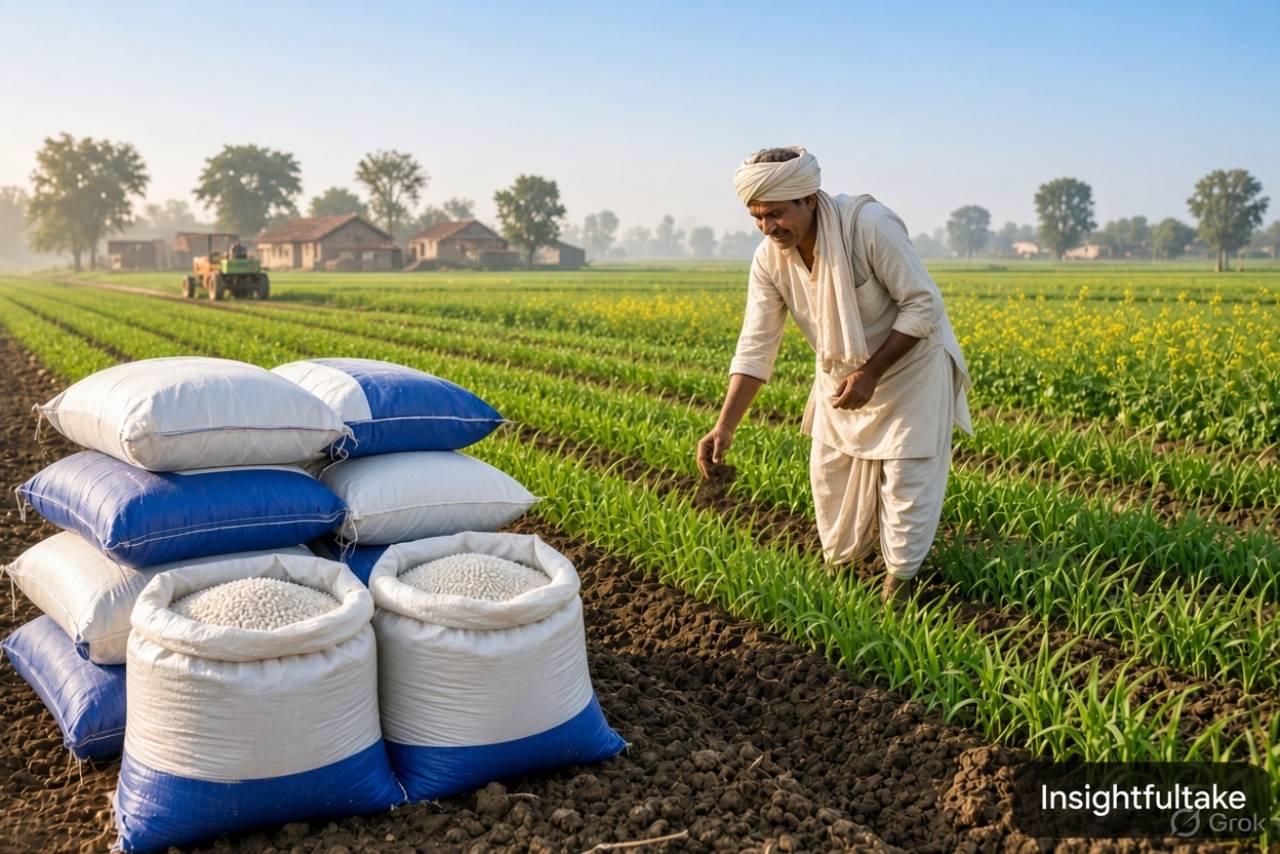
For farmers, however, fertiliser subsidies remain essential to protecting agricultural production costs from international price volatility.
Urea, in particular, is sold at a government-controlled retail price. The subsidy compensates manufacturers for the difference between the notified selling price and the actual cost of production and distribution.
Without this support, farmers could face substantially higher input costs, potentially affecting crop economics and agricultural productivity.
The present situation also exposes India's continuing dependence on international markets for phosphatic and potassic fertilisers and several critical raw materials. Domestic agricultural policy remains vulnerable to developments in global energy markets, shipping costs, currency movements and geopolitical tensions.
India's Fertiliser Policy Faces a Difficult Balancing Act
The projected subsidy expenditure highlights a structural weakness in India's agricultural input economy. The government must protect farmers from international price shocks while managing an increasingly unpredictable fiscal burden.
The combination of expensive raw materials and declining fertiliser consumption makes the situation particularly complicated. A weaker monsoon could affect agricultural output and demand, while persistent international price pressures could keep subsidy requirements elevated even if domestic sales remain subdued.
The coming months will test the Centre's ability to balance farmer affordability, fertiliser availability and fiscal discipline. Any further revision of NBS rates ahead of the next sowing season will also influence how the additional financial burden is distributed across the government, fertiliser manufacturers and agricultural consumers.
For India, the challenge goes beyond managing a ₹2.5 lakh crore subsidy bill. It is about reducing the vulnerability of agricultural production to global supply disruptions while ensuring that the cost of food security does not become an increasingly difficult burden on public finances.






















Leave a Comment