
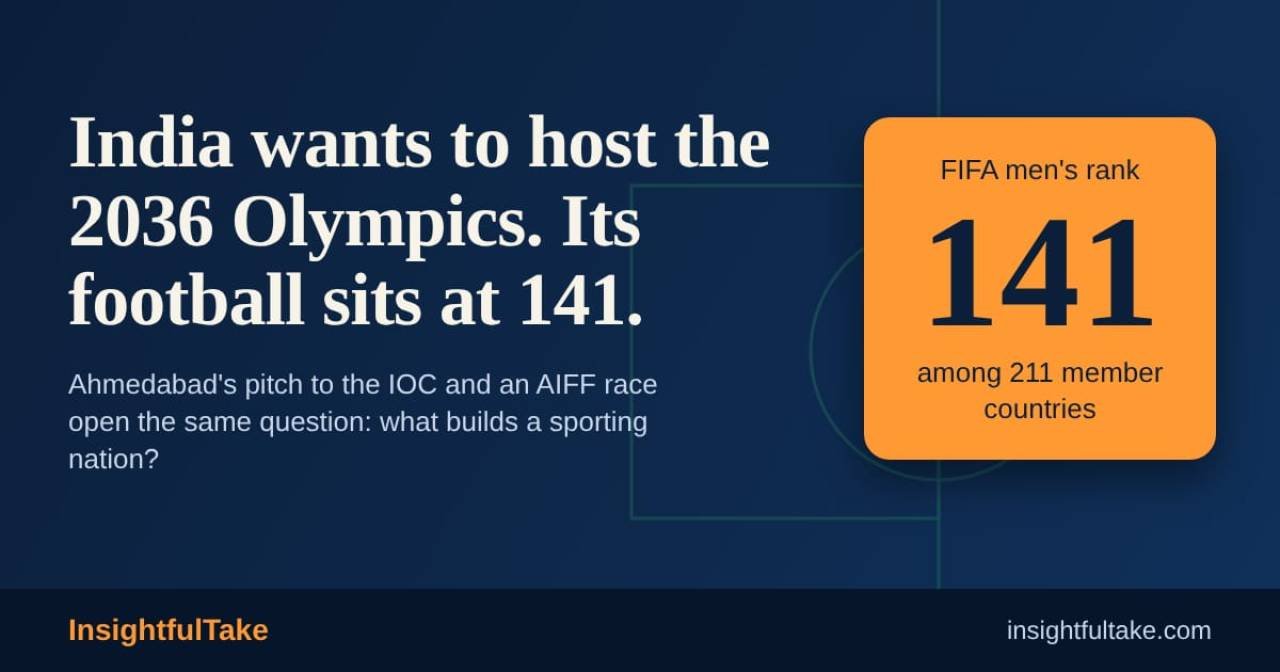
India's Olympic ambition is growing, but its football struggles expose a deeper challenge. Building world-class venues is one thing; creating a sporting system that produces world-class athletes is quite another.
India wants to host the 2036 Olympic Games. It has presented its case to the International Olympic Committee (IOC), showcasing Ahmedabad's infrastructure, funding plans and preparations for a major international sporting event.
In the same week, a football administrator from Uttar Pradesh highlighted an uncomfortable statistic. India stands 141st among FIFA's 211 member associations in men's football.
The two developments may appear unrelated, but they raise the same question: can India become a serious sporting nation beyond its ability to organise major events?
India's 2036 Olympic pitch reaches the IOC
The Indian delegation met the IOC's Future Host Commission virtually for a presentation lasting approximately 35 minutes. The discussion covered Ahmedabad's preparedness, the proposed financing arrangements and the long-term legacy of hosting the Games.
The delegation was led by Indian Olympic Association (IOA) president PT Usha and chief executive Raghuram Iyer. Sports Minister Mansukh Mandaviya, Gujarat Deputy Chief Minister Harsh Sanghavi, IOC member Nita Ambani and PV Sindhu, chairperson of the IOA Athletes' Commission, also participated.
Ahmedabad's preparations for the 2030 Commonwealth Games form an important part of India's Olympic argument. Officials see the event as an opportunity to develop venues and supporting infrastructure that could subsequently serve the Olympics.
Iyer described the interaction as a "positive meeting". According to him, the commission raised broad questions about the city's readiness, financial arrangements and the legacy India hopes to create.
The discussion also extended beyond infrastructure. The IOC wanted to understand India's approach to athlete development, including grassroots participation, training facilities and the pathway from emerging talent to elite competition.
The distinction matters. Hosting the Olympics requires more than impressive stadiums and efficient event management. It requires a sporting ecosystem capable of supporting athletes long before they reach the international stage.
Doping and athlete development remain critical concerns
India's anti-doping record was another important subject during the presentation. Indian officials reportedly raised the issue themselves, acknowledging an area that has repeatedly damaged the country's sporting credibility.
India has frequently figured among countries reporting high numbers of doping violations. The delegation highlighted increased testing, athlete education initiatives and the introduction of the 'Know Your Medicine' app as part of its response.
World Anti-Doping Agency president Witold Banka visited India in April to discuss stronger anti-doping measures.
The presentation also highlighted India's progress in para-sports. Officials referred to the World Para Athletics Championships held in October 2025 and plans to improve accessibility at Sports Authority of India (SAI) training centres.
These initiatives strengthen India's case, but they also underline the scale of the work ahead. A credible Olympic ambition must include clean competition, accessible facilities and a reliable system for identifying and developing talent.
India is currently among seven countries in the IOC's continuous dialogue phase for the 2036 Games. The others are Germany, Hungary, Qatar, South Korea, South Africa and Türkiye.
The next stage, expected to begin in March 2027, could narrow the field. India has therefore made an important presentation, but the process remains far from a final decision.
Football administrator challenges the system behind India's 141st rank
While India makes its Olympic pitch, a different sporting debate is taking shape within Indian football.
Arvind Menon, 58, president of the Uttar Pradesh Football Sangh, has announced his intention to contest the presidency of the All India Football Federation (AIFF). The election is scheduled for December 20. He has been nominated as one of Uttar Pradesh's two representatives in the electoral college.
Menon's central argument is straightforward. India's population, growing stadium infrastructure and sporting potential have not translated into meaningful progress in international football.
A country of India's size, he argues, should not remain 141st in the FIFA men's rankings. The problem, in his assessment, lies less in the availability of talent than in the system responsible for identifying, training and supporting it.
He believes occasional tournament successes cannot substitute for sustained development. A young footballer in a village should have a clearly defined route through school competitions, district teams and state-level selection before reaching the national stage.
His proposed solution is a nationwide scouting and player development network supported by structured coaching and talent identification beyond major urban centres.
Menon cited cricket as an example of a sport that regularly discovers promising players from smaller towns. He also promised to give players' concerns greater attention, declaring, "Without the players, we are nothing."
A proposal that still needs a blueprint
Menon's argument identifies a genuine challenge, but his proposed solution requires greater clarity.
He has not explained how his national scouting network would operate, how it would be funded or how it would differ from existing AIFF programmes.
The federation's website already describes talent identification through age-group leagues, national championships, school and district competitions, and trials conducted through state associations.
The real question, therefore, is not whether India needs scouting. It is why existing mechanisms have failed to produce a stronger and more consistent national team.
Menon's political background may also become part of the election debate. He served as a BJP general secretary in Madhya Pradesh until 2016 and is currently joint in-charge of the party's Uttarakhand unit. He has connected his football ambitions with India's broader objective of becoming a global sporting power by 2047.
The presidential contest could become more competitive. Incumbent Kalyan Chaubey, who has held the position since 2022, has not ruled out seeking another term. Former AIFF president Praful Patel recently posted on X highlighting achievements during his tenure, prompting speculation about a possible return.
Neither has formally announced a candidacy.
Stadiums can be built. Sporting cultures take longer.
India's Olympic ambition and its football administration debate ultimately converge on a fundamental issue: the difference between sporting infrastructure and sporting capability.
An Olympic host is judged on much more than the number of stadiums it can build. The IOC's interest in grassroots programmes, athlete development and anti-doping measures reflects the importance of the systems operating behind the venues.
Football presents an equally important test. India cannot expect its international ranking to improve simply by constructing more stadiums or announcing new development programmes. It needs qualified coaches, competitive school and district leagues, transparent selection processes and sustained investment in young players.
The 2036 Olympic bid offers India an opportunity to demonstrate its organisational and financial capabilities. The AIFF election offers a chance to examine whether Indian football can move beyond administrative promises.
The country has political backing, financial resources and growing sporting infrastructure. But a global sporting power cannot be created in the boardroom alone.
Its real foundations are laid on school grounds, village fields and local training centres, where a young athlete first gets the opportunity to compete.
India wants the world to come for the Olympics in 2036. The bigger challenge is ensuring that, by then, it has also developed athletes capable of making the country proud on the field.


















Leave a Comment