
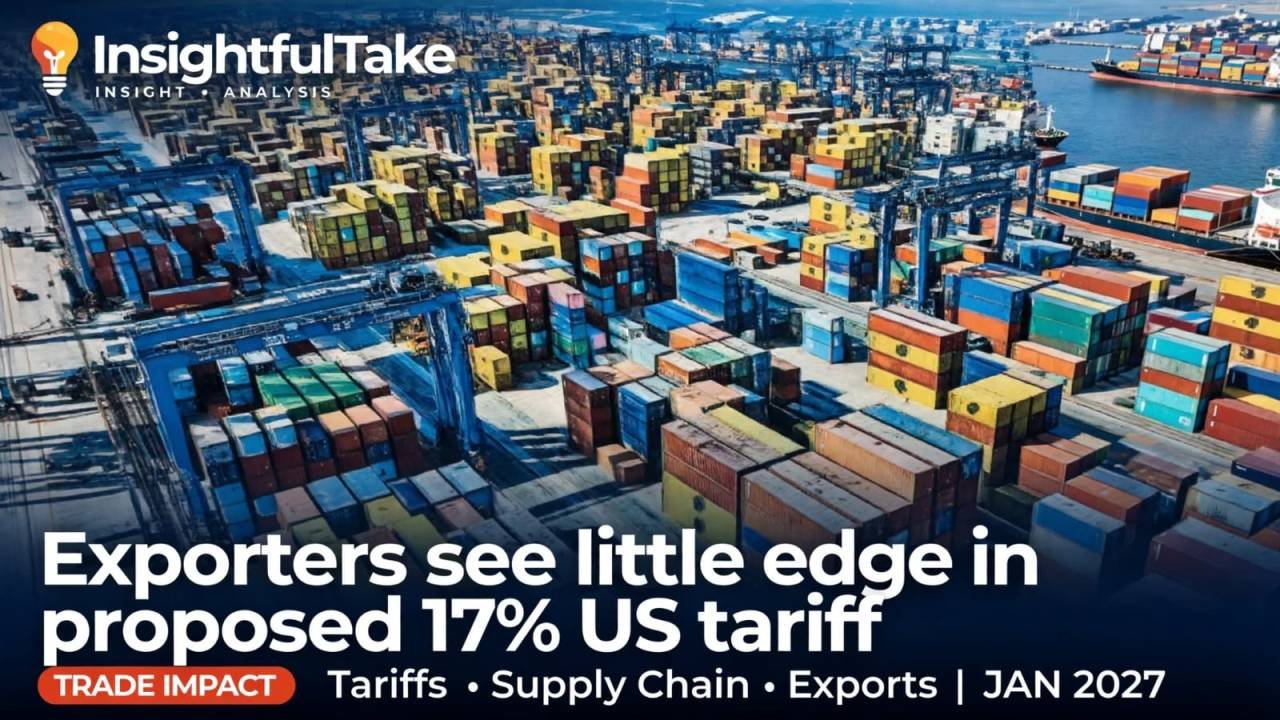
A 17% US tariff may look like relief, but India's exporters see little competitive advantage when rival Asian economies face nearly the same duties.
A lower tariff rate on paper does not make India more competitive when its regional rivals face almost the same duties. Indian exporters want a meaningful advantage, not marginal relief.
When Washington put a number on the tariff India could face, many expected relief. The proposal offers a 17% duty on Indian goods if a trade deal is signed, compared with 25% if no agreement is reached. Yet exporters are far from celebrating. Their concern is not just how much India will pay, but how the proposed rate compares with the duties imposed on competing countries.
The difference could determine whether Indian manufacturers gain new orders or continue losing ground to exporters across Asia.
The competitiveness problem
Industry leaders say the proposed rate gives India no meaningful advantage over Bangladesh, Indonesia, Malaysia and Thailand, which are reportedly facing tariffs of around 18%. A one-percentage-point difference offers little protection in sectors where international orders can shift on marginal cost differences.
Pankaj Chadha, chairman of the Engineering Export Promotion Council of India, said India's stated objective in the negotiations has been to secure a clear advantage over its neighbours and competitors. He remains unconvinced that a 17% tariff would deliver that benefit.
The stakes are particularly high for engineering exporters, as engineering goods constitute India's largest merchandise export category. Chadha described the situation as fluid, with India and the US continuing negotiations on an interim bilateral trade agreement.
A calendar to watch
The timeline for the next phase of the process is becoming clearer. The Office of the US Trade Representative (USTR) will accept public comments until January 5, 2027, followed by public hearings beginning January 25.
The final tariff structure is expected by the end of January, leaving Indian exporters with roughly two months of uncertainty over the terms that will govern their access to the American market.
For businesses planning production, pricing and shipment schedules, this uncertainty is itself a commercial challenge.
The 'excess capacity' dispute
The Federation of Indian Export Organisations (FIEO) has challenged the USTR's Section 301 finding that India's manufacturing sector suffers from excess capacity.
FIEO president SC Ralhan said India does not have structural overcapacity in any sector. He argued that any agreement must be balanced and reciprocal, allowing Indian businesses to compete on a level playing field.
Ralhan also acknowledged exporters' concerns over the uncertainty surrounding the negotiations, while maintaining that the industry was not panicking.
The dispute matters because the excess-capacity assessment could influence Washington's broader trade position towards Indian manufacturing. For New Delhi, challenging the finding is as important as negotiating the headline tariff rate.
Export numbers offer some comfort
There are encouraging signs in India's latest trade figures. An Emkay Global report suggests that India has handled the tariff and geopolitical turbulence of 2025 relatively well, partly by diversifying its export markets.
India's merchandise exports increased by more than 45% year-on-year to $49.47 billion in October. Madhavi Arora, lead economist at Emkay Global, expects export growth to exceed 15% in FY27.
One factor supporting this outlook is the possibility of exporters accelerating shipments to the US before new tariffs take effect.
However, this frontloading could also distort the immediate picture. Buyers placing advance orders and importing additional inventory today may reduce their purchases later. Consequently, strong export figures in the current months may not necessarily translate into equally strong growth throughout the next financial year.
A 'deliberate bait'?
Not everyone views the proposed tariff structure as a favourable outcome for India.
Ajay Srivastava, founder of the Global Trade Research Initiative (GTRI), has described the proposed rates as "manipulated" and "a deliberate bait" intended to extract one-sided concessions from India.
He has also drawn attention to a separate concern that the 17% proposal does not resolve: the threat of tariffs of up to 100% under the Graham Act linked to purchases of Russian oil.
Srivastava has argued that India should not accept the proposed arrangement without adequately examining the allegations against its manufacturing sectors. Instead, he favours responding to the US concerns on a sector-by-sector basis.
His position reflects a larger concern within sections of the Indian trade community: a lower headline tariff should not come at the cost of concessions that weaken India's negotiating position.
Could the political equation change?
The Emkay report also points to domestic economic pressures within the United States that could influence Washington's tariff policy.
Higher import duties risk increasing costs for American businesses and consumers, potentially adding to inflationary pressures. Sustained inflation could also complicate the Federal Reserve's interest-rate decisions.
The report suggests that the Republicans' heavy losses in the midterm elections could soften the administration's approach to tariffs. Political pressure over the domestic economic consequences may eventually encourage a more flexible trade position.
However, Indian exporters cannot base their business decisions on the possibility of a political reversal in Washington.
What it means for India
For India's negotiators, the objective cannot simply be to bring the proposed tariff down from 25% to 17%. The more important test is whether the final agreement gives Indian goods a competitive position against products coming from Dhaka, Jakarta, Kuala Lumpur and Bangkok.
If competing countries face tariffs close to 18%, India's one-percentage-point advantage is unlikely to change purchasing decisions significantly. Production costs, logistics, product quality, delivery schedules and supply-chain reliability will continue to influence where American buyers place their orders.
The coming weeks will therefore be important for India's trade strategy. Between the January hearings and the expected final announcement, New Delhi has an opportunity to push for tariff rates and trade terms that recognise India's manufacturing potential and strategic importance.
For exporters, the immediate message is one of caution. The current rise in shipments offers encouragement, but it should not be mistaken for a durable competitive advantage. A trade agreement will be meaningful only when it delivers better market access, predictable conditions and a measurable edge over competing economies.

























Leave a Comment