
West Asia's conflict is bringing destination weddings back to India, but rising demand for luxury venues, entertainment and décor is making celebrations increasingly expensive.
A couple from Chennai had a plan for their wedding this year. They wanted to exchange vows in the UAE, fly in their guests and build the celebration around a foreign skyline. Then the conflict in West Asia made that plan feel like a gamble. They moved the entire wedding to Jaisalmer.
Devanshi Patel, founder of Mumbai-based Shreem Events, handled the switch. Her experience reflects a much wider shift in India's luxury wedding market. As Mint reported this week, families that once considered an overseas destination wedding the ultimate celebration are increasingly looking at venues closer to home.
The return of demand, however, is creating a problem of its own. India's premium wedding destinations are witnessing rising bookings, but the cost of hosting a grand celebration is climbing almost as quickly.
The Overseas Dream Gets Rebooked
Monil Shah, founder and chief executive of Kkings Events, says international weddings have almost disappeared from his calendar this year.
"Weddings in India are back," he told.
For the hospitality industry, the shift sounds like welcome news. Wedding season fills palace hotels, keeps caterers busy, creates temporary employment and brings substantial business to local vendors. But the sudden concentration of demand has exposed a limitation: India has only a finite number of properties capable of hosting several hundred guests across multiple days.
Such weddings require more than an attractive backdrop. Families need sufficient accommodation, expansive lawns, banquet facilities, catering capacity and trained staff. When several families compete for the same properties, venue owners gain considerable pricing power.
The result is a destination wedding market where returning demand is translating into higher bills.
What a Night Costs Now
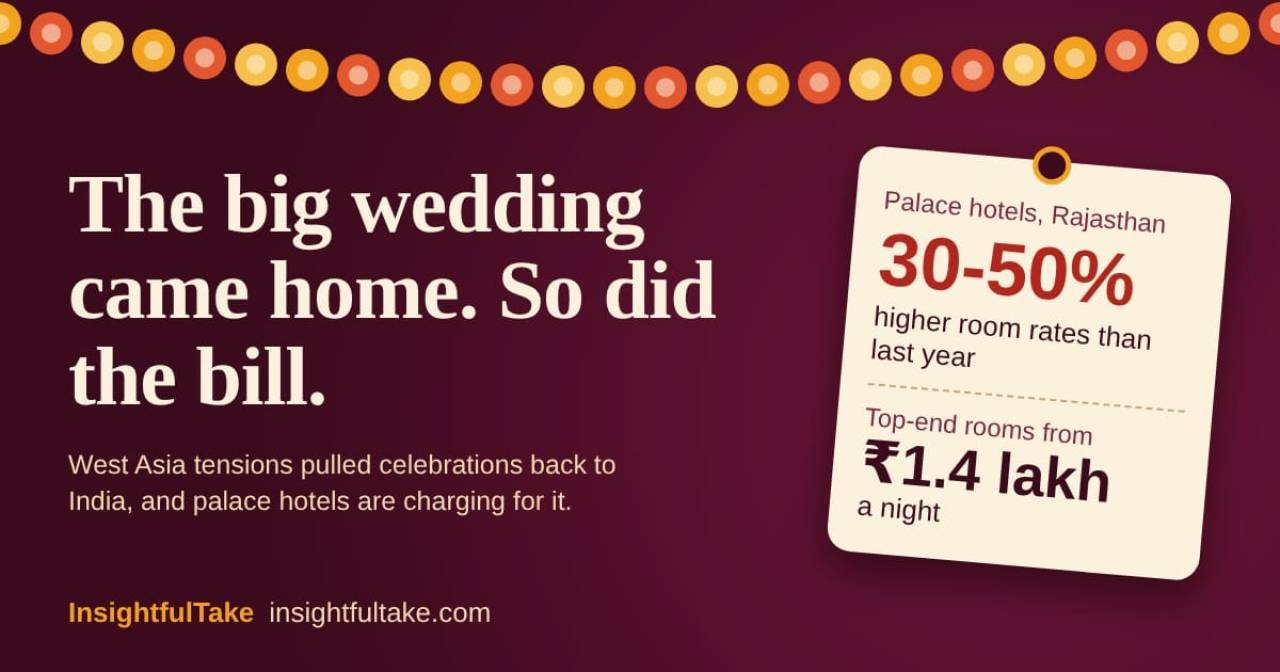
At the luxury end, some hotels are quoting room rates of up to ₹1.4 lakh per night. And accommodation is only one component of the overall expenditure.
The increases extend well beyond Rajasthan's palace properties. Rahool Macarius of Wyndham Hotels & Resorts says room tariffs have increased by 10-15%, while food and beverage costs have risen by 10-14%.
Parthip Thyagarajan, CEO of WeddingSutra, says room rates during the auspicious wedding season are at least 10-16% higher than last year. The steepest increases are being reported at Rajasthan's palace hotels and five-star properties in major metropolitan cities.
Rajasthan has emerged as both the biggest beneficiary and a major pressure point in this changing market. Udaipur and smaller destinations such as Alsisar are attracting strong demand. Wedding planners say room rates at some properties in the state have increased by 30-50%.
For guests expected to arrange their own accommodation, these increases can make an invitation considerably more expensive than anticipated.
The Hidden Line Item: Entertainment
Hotel tariffs may dominate conversations about wedding expenses, but entertainment is another major source of budget escalation.
A celebrity performance, elaborate stage production and high-end musical entertainment have become important elements of India's luxury wedding experience. Their costs, however, are rising sharply.
Shah says fees charged by top and mid-tier artists have roughly doubled over the past year or so.
The artist's fee is only the starting point. Travel and accommodation for performers and their crews, sound and lighting equipment, make-up, production arrangements and licensing charges add considerably to the final bill.
According to Shah, an entertainment budget can reach twice the cost of a hotel package covering the venue, accommodation and food for one or two functions.
In other words, a family may end up spending more on a 40-minute celebrity performance than on hosting its guests for two evenings. This is the financial reality of the modern Indian luxury wedding, and the disruption in West Asia has added another layer of pressure.
Other wedding essentials are becoming more expensive too. Thyagarajan estimates that décor and floral arrangements have become 10-12% costlier, while food expenses have increased by around 10%.
Patel puts the increase in décor, floral work and production costs at 12-15%.
Bigger Numbers, Tighter Choices
The Confederation of All India Traders (CAIT) estimates that India's luxury wedding segment generated ₹6.5 trillion in 2025, compared with ₹5.9 trillion in 2024. This represents growth of roughly 10%, highlighting the scale of the business even as individual cost components continue to rise.
Families are responding to the changing economics in different ways.
Some are maintaining their appetite for extravagance. Multi-day celebrations, celebrity performers, elaborate floral installations and carefully designed experiences remain central to weddings targeting the luxury market.
Others are reconsidering the scale of their celebrations. Smaller, more private gatherings allow families to retain premium experiences while reducing the number of guests and functions.
Both approaches reflect a broader reassessment of wedding expenditure. Families are increasingly weighing the value of spectacle against the financial burden of delivering it.
The traditional wedding budget, once decided well in advance, is becoming a moving target. Venue prices, artist fees, accommodation and production expenses can force families to revisit their calculations repeatedly.
The Family's Side of the Bill
Behind the industry figures are families dealing with decisions that are rarely straightforward.
Consider a family that has fixed its wedding date based on an astrologer's advice. Changing the date may not be an option. Relatives have already been invited, expectations have been created and arrangements may be underway.
Then the preferred venue raises its prices by a third, while accommodation, catering and entertainment costs move in the same direction.
The available options are limited: reduce the guest list, cut the number of functions or reconsider the destination.
Each involves a difficult compromise. Removing fifty names from a guest list may appear sensible on a spreadsheet, but in an Indian family, it can become a delicate exercise in managing relationships and expectations.
The pressure is particularly significant for middle- and upper-middle-income families who want a memorable destination wedding but do not necessarily have the financial flexibility of India's wealthiest households.
A Wedding Boom With a Question Mark
The West Asia conflict has redirected a significant share of destination wedding demand towards India. Hotels, event companies, caterers and local businesses stand to benefit from the shift.
Yet the immediate boom also exposes a structural weakness in the market. India's ability to accommodate large, premium wedding celebrations remains concentrated in a relatively small number of destinations and properties.
For families, the practical response is to book early, examine what hotel quotations actually include and account for entertainment and production costs before finalising a budget. A seemingly attractive venue package can become considerably more expensive once additional services are included.
For the hospitality and events industry, the bigger question is whether this demand will sustain itself. The current surge is partly driven by geopolitical uncertainty. If overseas destinations become attractive and accessible again, some of the business may move abroad.
India's wedding industry will then have to demonstrate that its appeal rests on more than the temporary return of overseas bookings.
The destination has changed. The bills have grown. But the reason for the celebration remains the same.



















Leave a Comment