
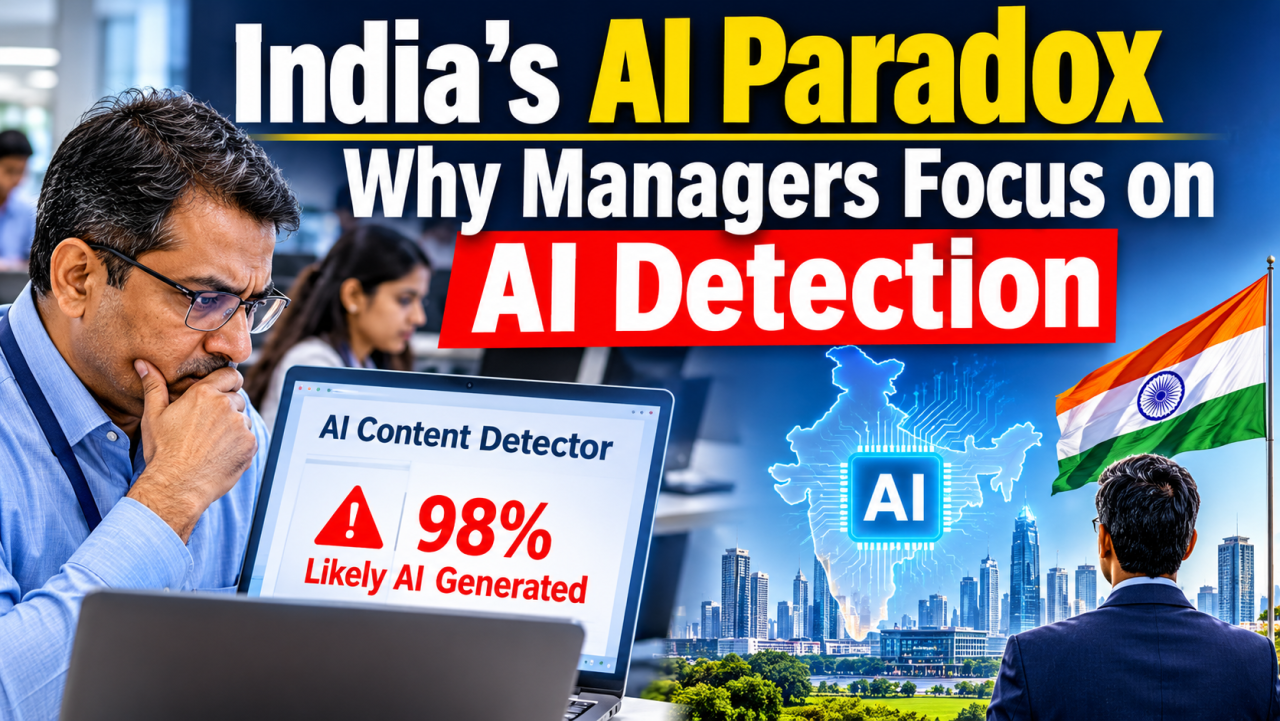
While the world races to harness artificial intelligence for innovation and economic power, many Indian workplaces remain preoccupied with identifying whether an employee has used AI or not?
Artificial intelligence was supposed to change how people work, research, communicate and create. It promised to remove repetitive tasks, improve productivity and give professionals more time to concentrate on ideas, analysis and original thinking. For content writers, it offered an opportunity to move beyond mechanical writing and devote more energy to research, storytelling, fact-checking and editorial judgement.
But a strange contradiction is emerging in parts of India's corporate workplace. Instead of learning how to use this technology intelligently, some managers appear more interested in finding out whether their employees have used it at all.
The obsession with AI detection has become particularly visible in the content industry. Writers are increasingly judged not simply by what they produce but by whether their work triggers an AI detector. The quality of an article, its research, factual accuracy, originality and relevance can become secondary to a software-generated percentage.
This is a deeply misplaced priority.
The technology is changing, but the mindset has not.
There is a fundamental difference between using AI to avoid thinking and using AI to think better. A writer who asks an AI tool to produce an entire article without checking its claims, understanding its subject or adding original insight is outsourcing professional responsibility. That deserves criticism. But a writer who uses AI to identify research leads, organise information, examine arguments, improve language or cross-check ideas is using technology as an assistant.
The distinction should be obvious to anyone responsible for editorial quality.
Unfortunately, some managerial approaches treat both practices as the same offence. An AI detection score becomes a substitute for reading, questioning and evaluating the actual work. A piece of writing can be rejected because a tool suspects machine involvement, even when the writer has invested considerable time in research and original thinking.
There is also a serious reliability problem. A Stanford-led study published in 2023 found that seven AI detectors incorrectly classified more than half of the non-native English writing samples examined as AI-generated. The researchers highlighted the risk of penalising writers whose language patterns differ from those of native English speakers. Other independent research has also questioned the accuracy of these detection systems.
For India, where English is often a second or third language, this deserves particular attention. A writer's preference for conventional vocabulary, grammatically structured sentences or polished language should not become evidence of machine authorship.
The larger concern is the message such practices send to an entire profession. Content writing is already undergoing a difficult transition. Basic writing assignments are being automated, organisations are reducing costs, and experienced writers are competing in a market that increasingly values speed over depth. Instead of helping professionals acquire new skills, some employers are adding another layer of suspicion to an already uncertain occupation.
This approach also exposes a wider contradiction in India's technology ambitions.
Governments, global corporations and technology leaders increasingly regard artificial intelligence as a strategic economic and geopolitical force. Nations are investing in computing infrastructure, research, semiconductor manufacturing, AI models and skilled workforces. The competition is no longer simply about who can use a new application. It is about who can develop the capabilities, institutions and talent to shape the next generation of technology.
India cannot aspire to be a global AI power while allowing workplace cultures to treat technological assistance as professional misconduct.
There is an uncomfortable historical parallel here. India's colonial experience was shaped partly by the consequences of unequal access to industrial knowledge, scientific advancement and economic power. It would be simplistic to attribute colonial subjugation to resistance to technology alone. But history offers a warning: societies that fail to adapt, invest in knowledge and develop their own capabilities risk becoming dependent on those that do.
The danger today is not that an Indian writer uses ChatGPT. It is that Indian organisations may fail to build a workforce capable of using AI productively while competitors move ahead.
Managers certainly have legitimate reasons to prevent fabricated research, plagiarism, confidential data leaks and unverified AI-generated material. No serious argument should defend careless automation. But these risks require clear policies, human supervision, transparent disclosure where appropriate and rigorous editorial standards, not blind dependence on detection software.
A better manager would ask: Is the article accurate? Does it offer original insight? Are its sources credible? Does the writer understand the subject? Can the arguments withstand scrutiny?
These questions demand professional competence. Checking an AI detection score demands very little.
AI will not eliminate the need for human intelligence. It will change what organisations expect from it. The future belongs to people who can combine technological capability with judgement, curiosity, creativity and accountability.
India's managers must decide whether they want to prepare their employees for that future or keep policing the tools that are already shaping it.
The real test of a writer is the quality of the work, not the percentage displayed by an AI detector.















Leave a Comment