
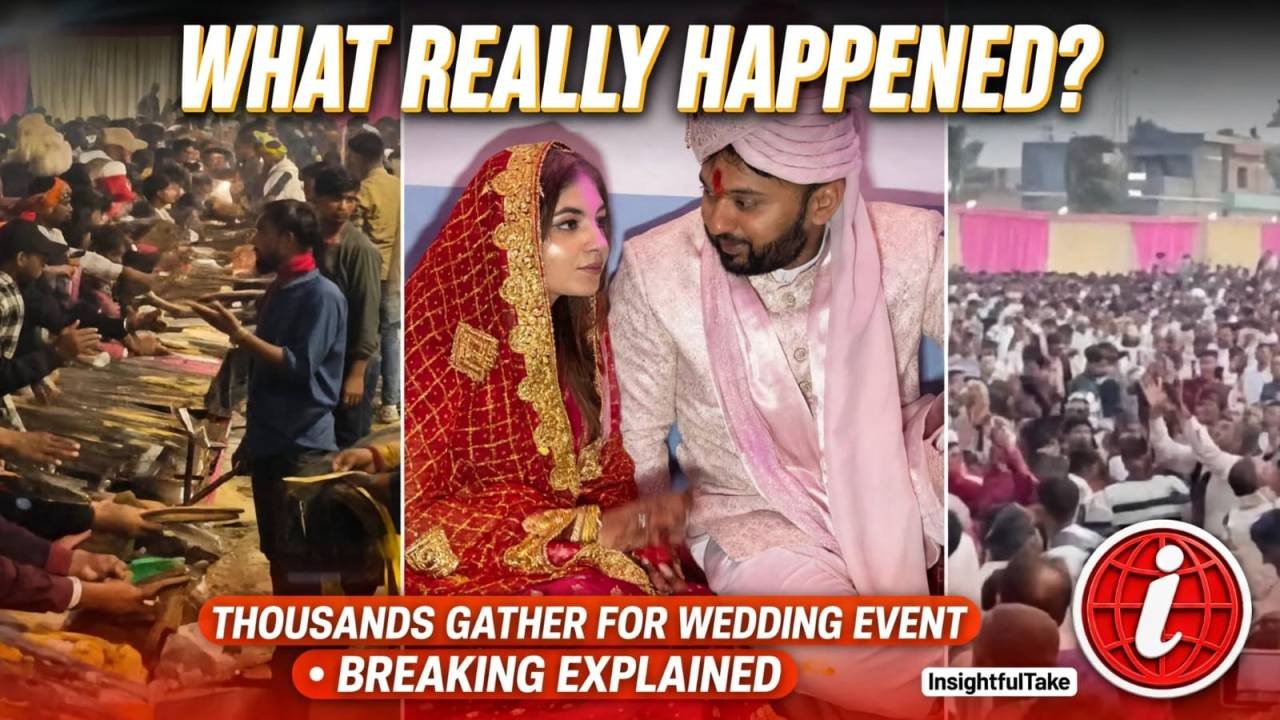
A lavish wedding in Mokama exposed more than extraordinary wealth. It offered a glimpse into Bihar’s enduring culture of political power, influence and spectacle.
A reported Rs 40-crore wedding in Bihar was more than an extravagant family celebration. It became a public demonstration of influence, muscle and political privilege, while much of the media appeared more fascinated by the spectacle than interested in asking difficult questions.
On November 25, Nadwan village in Mokama, Bihar, turned into an extraordinary stage. The occasion was the wedding of Shivangi, the younger daughter of Mokama MLA Anant Singh. By most accounts, it was among the grandest weddings Bihar has witnessed in recent years. Guests, political figures, local strongmen and thousands of curious onlookers converged on the village, transforming a family celebration into a public event of enormous proportions.
Anant Singh, popularly known as ‘Chhote Sarkar’, is no ordinary political figure. Recognisable for his trademark white attire and larger-than-life public persona, he occupies an unusual place in Bihar's political landscape. To his supporters, he is a powerful local leader who commands loyalty and gets things done. To his critics, he represents the enduring influence of strongman politics, where political authority, personal muscle and fear often operate in close proximity.
The reported scale of the wedding was extraordinary. Figures circulating in media and on social platforms put the expenditure at around Rs 40 crore, with approximately four lakh guests, a convoy of 151 cars, 52 horses and a menu featuring 150 dishes. These numbers have not been independently verified and should be treated with caution. But even allowing for exaggeration, the gathering was clearly designed to be seen, discussed and remembered.
Yet the most widely circulated images were not necessarily about the food, decorations or arrangements. They revealed something more uncomfortable about the culture surrounding power.
Videos showed Singh waving to crowds from the sunroof of a moving vehicle. Another clip appeared to show him kicking his driver. In a particularly disturbing episode, food plates were reportedly thrown into a crowd, prompting people to scramble for them. The scene was difficult to reconcile with the claims of an event planned on a scale of extraordinary wealth and hospitality.
Another video added a more troubling dimension. A man claiming to have known Singh in jail reportedly boasted that he had arrived at the wedding with 10 double-barrelled guns and 500 cartridges. He also claimed that he owed Singh for assistance in criminal cases. Whether the claims were accurate or merely an attempt to demonstrate personal proximity to the MLA, such a public boast should have attracted serious attention from law enforcement authorities.
A wedding may be a private celebration, but the public display of firearms and the glorification of criminal connections cannot be dismissed as wedding entertainment.
The political power behind the spectacle
Anant Singh's political journey offers important context for understanding why the wedding attracted such attention. His influence in Mokama has survived imprisonment, electoral changes and shifting political alliances.
In 2015, Singh won the Mokama Assembly seat as an Independent candidate while he was in jail. His wife campaigned on his behalf. In the 2025 Assembly election, he secured another victory, defeating Veena Devi, the wife of another influential political figure, Surajbhan Singh.
His electoral success reflects a political reality that Bihar has struggled to move beyond. In several constituencies, personal influence, caste equations, local networks and the ability to command loyalty can matter as much as party ideology or conventional political credentials.
Mainstream political parties, across ideological lines, have repeatedly found it necessary to engage with locally influential leaders who command votes and organisational strength. This is not unique to Bihar, but the state has a particularly long history of political figures whose influence extends well beyond the boundaries of formal party structures.
In this environment, a wedding attended by thousands becomes more than a social occasion. It can function as a demonstration of reach, loyalty and authority. The number of vehicles, the scale of the arrangements and the presence of influential guests become symbols of a political network capable of mobilising people on an extraordinary scale.
The celebration may have been organised for a daughter, but its public impact was unmistakably political.
The questions that deserved more attention
The scale of the event raises questions that cannot be answered through viral videos and social media commentary alone.
First, who paid for the celebration? The reported Rs 40-crore expenditure needs independent verification. If the figure is anywhere close to reality, it deserves scrutiny against the income, assets and financial disclosures made by the MLA in his election affidavit. There is nothing wrong with a family spending its legitimately earned wealth on a wedding. But public representatives are also accountable for the financial disclosures they make under election laws. The issue is transparency, not an assumption of wrongdoing.
Second, what happened with the firearms? A guest publicly claiming to have brought 10 double-barrelled guns and 500 cartridges to a wedding is not an ordinary anecdote. Did the local police take note of the video? Were the weapons licensed? Was their presence investigated? Even if the claims were exaggerated, they warranted verification.
Third, who was responsible for crowd management? A gathering reportedly involving lakhs of people presents serious logistical and safety challenges. Traffic congestion, access routes, emergency services, crowd movement and the possibility of a stampede are matters of public concern. Videos showing people climbing structures to catch a glimpse of the event should have prompted questions about safety arrangements. A gathering of this scale cannot be managed merely through personal influence and informal arrangements.
Finally, why was much of the media coverage so fascinated by the spectacle? The wedding generated television footage, social media reactions and countless discussions about its extravagant arrangements. But the fascination with luxury and the personality of the host often overshadowed questions about accountability, public safety and the political culture being celebrated.
There is a difference between reporting an extraordinary event and turning it into entertainment. When journalists focus only on the number of cars, horses, dishes and guests, they risk becoming part of the publicity surrounding the event rather than independent observers of its larger implications.
Bihar has seen this spectacle before
The wedding also brings back memories of another high-profile political marriage in Bihar.
In May 2002, the wedding of Rohini Acharya, daughter of then Chief Minister Rabri Devi and RJD leader Lalu Prasad Yadav, attracted national attention for its scale and extravagance. Allegations emerged that dozens of new cars had been taken from showrooms and stockyards to transport guests. The wedding arrangements reportedly included a massive pandal modelled on a luxury hotel.
The celebrations became a political talking point for years. Opposition leaders questioned the extravagance, particularly against the backdrop of Bihar's economic difficulties and the state's development challenges.
The political circumstances were different, and the two events should not be treated as identical. But the underlying pattern is familiar. In Bihar, extravagant weddings involving powerful political families have often become public demonstrations of wealth, connections and influence.
Such celebrations are not necessarily unlawful. Nor should ordinary citizens be denied the freedom to spend their legitimately acquired wealth as they wish. The concern arises when public office, political networks and displays of coercive influence become intertwined with private celebrations.
When power becomes its own publicity
India's democratic culture has always accommodated grand celebrations, lavish weddings and public displays of wealth. There is no reason to object to a family hosting a large wedding simply because it is politically connected.
But the context matters. When the host is an elected representative with a controversial public record, when the gathering reportedly attracts lakhs of people, and when videos of firearms and displays of personal dominance circulate alongside images of celebration, the event acquires a larger public significance.
The media has a responsibility to look beyond the spectacle. It must distinguish between popularity and accountability, influence and legitimacy, public fascination and public interest.
For a state that continues to struggle with unemployment, migration, inadequate infrastructure and uneven development, the spectacle of extraordinary political wealth naturally invites uncomfortable comparisons. Those comparisons should not become an excuse for moral policing, but neither should they be brushed aside as envy or entertainment.
The real story of Mokama's big fat wedding is not the reported cost, the number of dishes or the length of the car convoy. It is the ease with which political influence can turn a private celebration into a public demonstration of power.
A wedding lasts a few days. The political culture it reflects can last for generations.















Leave a Comment