
India has trained millions of women, but the bigger question remains: how many are actually getting jobs?
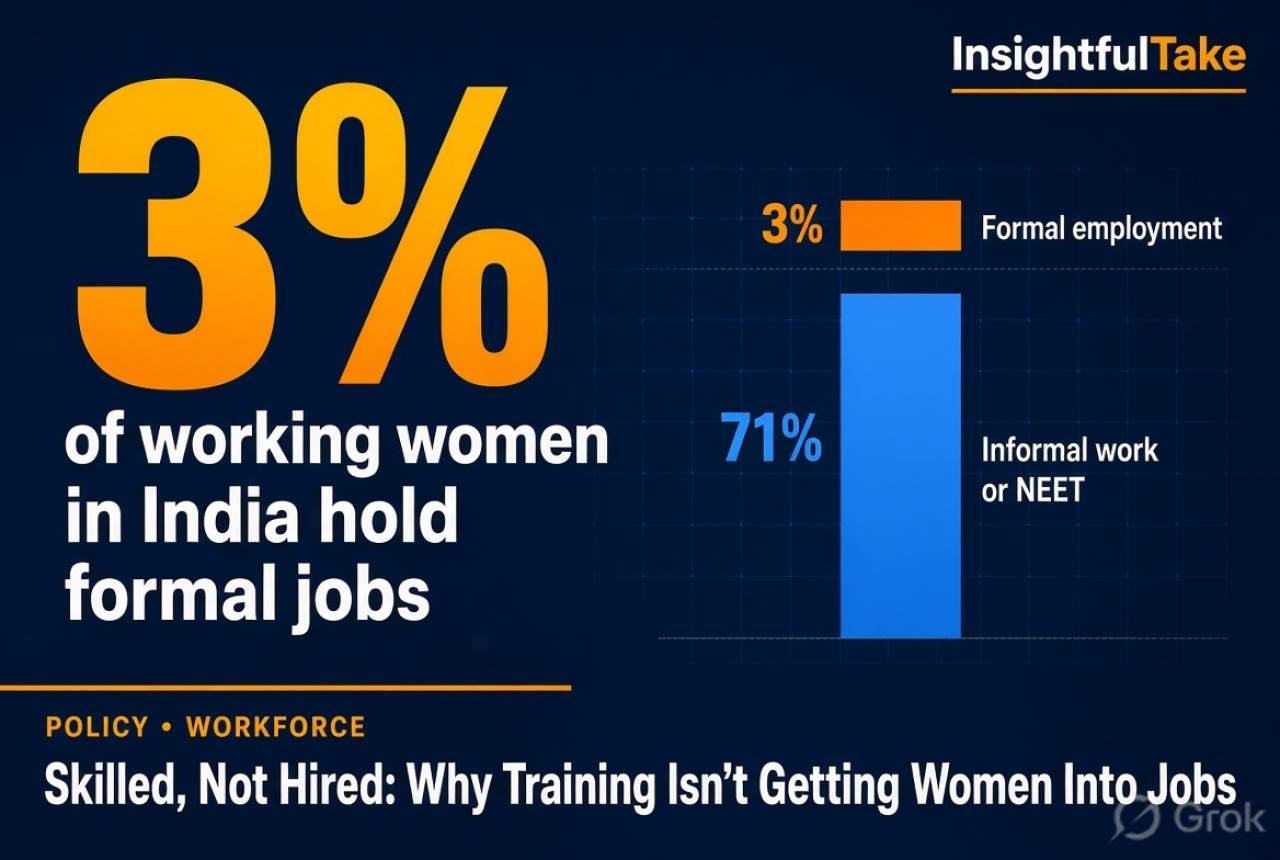
Three out of every hundred working women in India hold a formal job. The rest are either trapped in informal work without security or outside employment, education and training altogether.
That is not an activist slogan or an estimate pulled from thin air. It comes from the assessment of India's skilling ecosystem by a government think tank. And it exposes a problem that years of training programmes have failed to solve.
The numbers deserve a pause.
Seventy-one percent of women fall into informal employment or the NEET category, meaning they are not in employment, education or training. For a country that wants to become developed by 2047 and sees its young population as a major economic advantage, keeping most women outside secure, formal employment is not a peripheral concern.
It is a structural failure sitting at the centre of India's growth story.
Training Was Never the Real Problem
For more than a decade, India's skilling drive has often been measured by one familiar number: how many people were trained.
Crores of people have passed through government skilling programmes since 2014-15, while thousands of crores have been allocated to skilling initiatives over the years. On paper, the scale suggests enormous progress.
But a certificate is not a job.
That distinction is particularly important for women.
The latest assessment makes a point that should have been obvious much earlier. Training a woman and employing her are two different challenges. India has spent years concentrating on the first while doing far less to remove the barriers surrounding the second.
A woman can complete a course, acquire a marketable skill and receive a certificate. She can then return home to the same circumstances that prevented her from taking a job in the first place.
The training ends. The barrier remains.
What Actually Keeps Women Out
The obstacles are neither mysterious nor new.
Caregiving comes first.
Household responsibilities and childcare do not disappear simply because a woman has enrolled in a training programme. Yet many programmes operate around fixed schedules that assume the learner has no one else depending on her.
Then comes safety.
For many women, travelling to a training centre or workplace is not merely a question of convenience. The route, timing, transport and safety of the journey can determine whether a job is practically possible.
Distance makes the problem worse.
When a training centre or workplace is far from home, the daily cost is measured not only in money but also in time and family negotiations. For a woman responsible for children, elderly family members or household work, a distant opportunity can quickly become an impossible one.
Then there is the nature of the work itself.
Even when training leads to employment, the jobs available to women are often full-time, rigidly scheduled and located far from where they live. The assessment found that many women preferred training opportunities closer to home, while a significant share expressed a preference for part-time work that would allow them to balance earning with caregiving.
The system, as it currently operates, often offers neither.
A Familiar Story With Fresh Evidence
None of this will sound unfamiliar to anyone who has watched a mother, sister, daughter or neighbour attempt to combine paid work with running a household.
What is significant is that the problem has now been documented at the national policy level.
That changes the conversation.
For years, the conventional response to India's low female workforce participation has been more training centres, higher enrolment and more certificates.
But the evidence points towards a different equation.
The problem is not simply that India lacks skilled women.
It is that skilled women often lack access to jobs that fit the realities of their lives.
That means the missing pieces are not limited to training. They include safe transport, childcare, proximity to workplaces, flexible schedules, mentoring and pathways from training into actual employment.
India may have been solving the wrong problem.
What Changes If This Is Taken Seriously
The solutions proposed by the assessment are practical rather than spectacular.
Training spaces can be located closer to women's homes, particularly in communities where mobility is a major constraint.
Women can receive mentoring and support not only while completing a course but also during the transition from training to employment.
Public-private partnerships can help provide safe accommodation and transport around industrial hubs and job clusters, reducing the role that distance plays in excluding women from employment.
None of these ideas is revolutionary.
They are basic pieces of infrastructure that should have accompanied large-scale skilling programmes from the beginning.
The bigger question is whether governments, training providers and employers will actually redesign their systems around these findings.
India has effectively run the same experiment for years: train more people and expect employment to follow.
For millions of women, employment did not follow.
If the next generation of skilling policy continues to measure success primarily by how many women completed a course rather than how many entered stable employment, remained there and earned fairly, then the country risks producing impressive training numbers without creating an equally impressive workforce.
The Real Test of Viksit Bharat
India's ambition to become Viksit Bharat cannot be measured by the number of certificates issued to women.
It has to be measured by what happens after those certificates are issued.
How many women are hired?
How many remain employed?
How many receive fair wages?
How many can work without sacrificing safety or family responsibilities?
And how many can turn a skill into genuine economic independence?
Training can open a door. But if there is no job on the other side, the certificate becomes little more than paper.
The real measure of India's skilling ambition will therefore not be how many women were trained.
It will be how many were hired, retained and paid fairly for what they know.
Three out of every hundred working women in India hold a formal job. The rest are either trapped in informal work without security or outside employment, education and training altogether.
That is not an activist slogan or an estimate pulled from thin air. It comes from the assessment of India's skilling ecosystem by a government think tank. And it exposes a problem that years of training programmes have failed to solve.
The numbers deserve a pause.
Seventy-one percent of women fall into informal employment or the NEET category, meaning they are not in employment, education or training. For a country that wants to become developed by 2047 and sees its young population as a major economic advantage, keeping most women outside secure, formal employment is not a peripheral concern.
It is a structural failure sitting at the centre of India's growth story.
Training Was Never the Real Problem
For more than a decade, India's skilling drive has often been measured by one familiar number: how many people were trained.
Crores of people have passed through government skilling programmes since 2014-15, while thousands of crores have been allocated to skilling initiatives over the years. On paper, the scale suggests enormous progress.
But a certificate is not a job.
That distinction is particularly important for women.
The latest assessment makes a point that should have been obvious much earlier. Training a woman and employing her are two different challenges. India has spent years concentrating on the first while doing far less to remove the barriers surrounding the second.
A woman can complete a course, acquire a marketable skill and receive a certificate. She can then return home to the same circumstances that prevented her from taking a job in the first place.
The training ends. The barrier remains.
What Actually Keeps Women Out
The obstacles are neither mysterious nor new.
Caregiving comes first.
Household responsibilities and childcare do not disappear simply because a woman has enrolled in a training programme. Yet many programmes operate around fixed schedules that assume the learner has no one else depending on her.
Then comes safety.
For many women, travelling to a training centre or workplace is not merely a question of convenience. The route, timing, transport and safety of the journey can determine whether a job is practically possible.
Distance makes the problem worse.
When a training centre or workplace is far from home, the daily cost is measured not only in money but also in time and family negotiations. For a woman responsible for children, elderly family members or household work, a distant opportunity can quickly become an impossible one.
Then there is the nature of the work itself.
Even when training leads to employment, the jobs available to women are often full-time, rigidly scheduled and located far from where they live. The assessment found that many women preferred training opportunities closer to home, while a significant share expressed a preference for part-time work that would allow them to balance earning with caregiving.
The system, as it currently operates, often offers neither.
A Familiar Story With Fresh Evidence
None of this will sound unfamiliar to anyone who has watched a mother, sister, daughter or neighbour attempt to combine paid work with running a household.
What is significant is that the problem has now been documented at the national policy level.
That changes the conversation.
For years, the conventional response to India's low female workforce participation has been more training centres, higher enrolment and more certificates.
But the evidence points towards a different equation.
The problem is not simply that India lacks skilled women.
It is that skilled women often lack access to jobs that fit the realities of their lives.
That means the missing pieces are not limited to training. They include safe transport, childcare, proximity to workplaces, flexible schedules, mentoring and pathways from training into actual employment.
India may have been solving the wrong problem.
What Changes If This Is Taken Seriously
The solutions proposed by the assessment are practical rather than spectacular.
Training spaces can be located closer to women's homes, particularly in communities where mobility is a major constraint.
Women can receive mentoring and support not only while completing a course but also during the transition from training to employment.
Public-private partnerships can help provide safe accommodation and transport around industrial hubs and job clusters, reducing the role that distance plays in excluding women from employment.
None of these ideas is revolutionary.
They are basic pieces of infrastructure that should have accompanied large-scale skilling programmes from the beginning.
The bigger question is whether governments, training providers and employers will actually redesign their systems around these findings.
India has effectively run the same experiment for years: train more people and expect employment to follow.
For millions of women, employment did not follow.
If the next generation of skilling policy continues to measure success primarily by how many women completed a course rather than how many entered stable employment, remained there and earned fairly, then the country risks producing impressive training numbers without creating an equally impressive workforce.
The Real Test of Viksit Bharat
India's ambition to become Viksit Bharat cannot be measured by the number of certificates issued to women.
It has to be measured by what happens after those certificates are issued.
How many women are hired?
How many remain employed?
How many receive fair wages?
How many can work without sacrificing safety or family responsibilities?
And how many can turn a skill into genuine economic independence?
Training can open a door. But if there is no job on the other side, the certificate becomes little more than paper.
The real measure of India's skilling ambition will therefore not be how many women were trained.
It will be how many were hired, retained and paid fairly for what they know.


.jpeg)




















Leave a Comment