
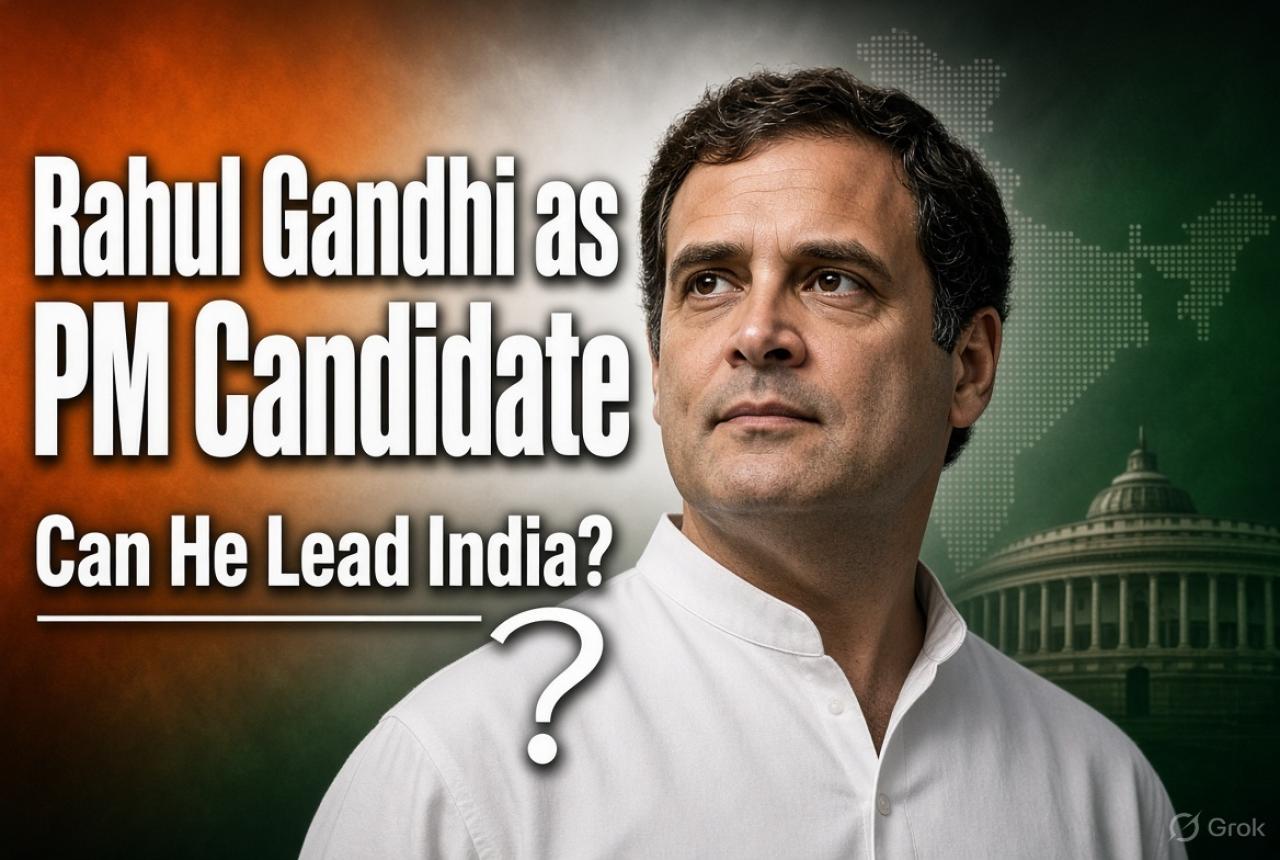
Rahul Gandhi's long political journey has brought him to a new test: can he turn opposition leadership into a credible claim to India's top political office?
Has the Long Political Journey Prepared Rahul for the Top Job?
Fourteenth-century historian Zia-ud-din Barani wrote about the importance of awe and splendour in maintaining the authority of a ruler. In a modern democracy, however, authority cannot rest on grandeur alone. It has to come from public trust, political credibility, administrative ability and the capacity to understand a country as diverse as India.
That is where Rahul Gandhi's political journey deserves a closer examination.
Whether he eventually becomes a prime ministerial candidate is a question that will be decided by electoral politics and the political equations of the opposition alliance. But after more than two decades in public life, he has reached a stage where his credentials for the country's top political office can no longer be discussed only through the old arguments about his surname or the Nehru-Gandhi family.
His political journey has been long, difficult and, at several points, deeply disappointing for his party. But it has also changed considerably.
Rahul Gandhi entered electoral politics in 2004, when he contested from Amethi in Uttar Pradesh. Before that, he had studied at Rollins College in Florida and later completed an M.Phil. in Development Studies from Trinity College, Cambridge. After his studies, he worked with the Monitor Group, a management consulting firm in London, and later set up a technology outsourcing company in Mumbai. His professional experience was therefore not limited to politics before he entered electoral life.
But education and professional experience alone do not prepare anyone for the office of Prime Minister.
Indian politics demands something much harder: the ability to understand people, negotiate competing interests, survive political attacks and build an organisation capable of winning elections.
Rahul Gandhi has spent more than two decades learning that lesson.
From Amethi to the National Stage
His political career began with an enormous advantage: the Gandhi surname. It gave him immediate recognition that most young politicians could only dream of acquiring. But the same surname also became a political burden.
Every election, every speech and almost every political decision was judged against the record of his father Rajiv Gandhi, his grandmother Indira Gandhi and his great-grandfather Jawaharlal Nehru.
For years, his opponents portrayed him as a privileged politician who had inherited a political position rather than earned it. His electoral setbacks strengthened that criticism.
The Congress fell to just 44 seats in the 2014 Lok Sabha election and 52 seats in 2019. Rahul Gandhi himself lost Amethi in 2019, although he won from Wayanad. His party's organisational decline became closely associated with questions about his leadership.
Yet politics is rarely a straight line.
The 2024 Lok Sabha election produced a different picture. Congress increased its tally from 52 seats in 2019 to 99 in 2024. The party remained far short of forming a government, but the result marked a substantial recovery from its earlier position. The Election Commission's official election data records the 2024 results and party performance.
More importantly for Rahul Gandhi personally, he won both Rae Bareli and Wayanad in 2024 before subsequently retaining Rae Bareli and vacating Wayanad.
He also acquired a constitutional parliamentary role that had eluded the Congress for a decade.
On June 9, 2024, Rahul Gandhi was appointed Leader of the Opposition in the Lok Sabha. For the first time in ten years, the House had a recognised Leader of the Opposition from the Congress.
This is not a ceremonial achievement.
The Leader of the Opposition is expected to scrutinise the government, raise questions of public importance and provide an alternative political voice inside Parliament. It gives Rahul Gandhi an institutional platform from which his political maturity can now be tested more closely.
The Bharat Jodo Moment
Perhaps the most important change in Rahul Gandhi's political image came not from Parliament but from the road.
The Bharat Jodo Yatra began from Kanyakumari on September 7, 2022 and travelled north towards Jammu and Kashmir. Congress records put the final journey at roughly 4,000 kilometres across 12 states and two Union Territories.
The significance of the Yatra was not merely the distance.
For a politician frequently criticised for being disconnected from ordinary Indians, walking for months through towns, villages and cities created a different political image.
Rahul Gandhi later said that one of the important lessons he took from the Yatra was the importance of listening. He acknowledged that politicians often begin conversations by trying to explain their own ideas rather than listening to what people are actually saying.
That admission may be more important than many of his speeches.
Politics requires communication, but leadership requires listening.
The Bharat Jodo Yatra also gave Rahul Gandhi a political vocabulary built around unemployment, inflation, inequality, social harmony and constitutional values. Whether one agrees with his interpretation of India's political situation or not, the Yatra showed a willingness to take a political argument directly to the public rather than confining it to Parliament and television studios.
The subsequent Bharat Jodo Nyay Yatra in 2024 continued that effort before the Lok Sabha election.
From Opposition Leader to Possible PM Face
The bigger question is whether these achievements are enough to make Rahul Gandhi a credible prime ministerial candidate.
The answer depends on what one expects from a Prime Minister.
The job is not simply about delivering speeches or defeating an opponent in Parliament. The Prime Minister has to manage a large political coalition, oversee the Union government, coordinate with chief ministers, handle economic challenges, deal with national security and represent India internationally.
It is here that Rahul Gandhi's political record remains a work in progress.
His critics point to his earlier electoral failures, the Congress's organisational weaknesses and the difficulty of translating his public campaigns into sustained electoral victories. His supporters point to his persistence, his willingness to undertake difficult political campaigns and the recovery of Congress in the 2024 election.
Both arguments deserve consideration.
There is also another complication. The opposition space is not controlled by the Congress alone. The INDIA bloc contains parties with their own leaders, regional interests and political ambitions. A national alliance cannot automatically assume that the leader of the largest opposition party will become its prime ministerial candidate.
This makes Rahul Gandhi's path to the PM's office fundamentally different from Narendra Modi's rise within the BJP-led political structure.
He would need not only the Congress to expand its own political base but also a broad coalition of regional parties willing to accept him as their leader.
That is a much harder political test.
The Test of Leadership
Rahul Gandhi's strongest political asset today may not be his surname, his education or even his parliamentary position.
It may be endurance.
He has remained in politics through two crushing Lok Sabha defeats, the decline of his party, personal electoral setbacks and years of relentless criticism. The 2024 election did not make him Prime Minister, but it changed the political circumstances around him.
Congress moved from 52 seats to 99. The opposition became stronger in Parliament. Rahul Gandhi became Leader of the Opposition. And the Congress leader who had spent years struggling to establish his political identity suddenly found himself occupying one of the most important constitutional positions in the parliamentary system.
That creates both an opportunity and a responsibility.
The next phase will be less about proving that he can oppose the government and more about demonstrating that he can present a credible alternative to it.
A Prime Ministerial candidate has to do more than identify problems. He has to explain how institutions will work, how the economy will grow, how jobs will be created, how national security will be handled, how federal relations will be managed and how India's interests will be represented abroad.
Rahul Gandhi now has the political platform to demonstrate those abilities.
Whether he can convert that platform into a convincing national leadership proposition will depend on what he does next.
India's political history has produced leaders who rose quickly and others who spent decades waiting for their moment. Rahul Gandhi belongs to the second category.
His journey from Amethi to the Opposition benches, from electoral defeats to the 2024 revival of Congress, and from the Bharat Jodo Yatra to the office of Leader of the Opposition shows a politician still being tested by history.
The question, therefore, is no longer simply whether Rahul Gandhi carries the Gandhi surname.
The more relevant question is whether he can turn that inheritance into political authority of his own.
For now, the answer remains unfinished.
And in a democracy as large and unpredictable as India, perhaps that is precisely where the real political contest begins.
Has the Long Political Journey Prepared Rahul for the Top Job?
Fourteenth-century historian Zia-ud-din Barani wrote about the importance of awe and splendour in maintaining the authority of a ruler. In a modern democracy, however, authority cannot rest on grandeur alone. It has to come from public trust, political credibility, administrative ability and the capacity to understand a country as diverse as India.
That is where Rahul Gandhi's political journey deserves a closer examination.
Whether he eventually becomes a prime ministerial candidate is a question that will be decided by electoral politics and the political equations of the opposition alliance. But after more than two decades in public life, he has reached a stage where his credentials for the country's top political office can no longer be discussed only through the old arguments about his surname or the Nehru-Gandhi family.
His political journey has been long, difficult and, at several points, deeply disappointing for his party. But it has also changed considerably.
Rahul Gandhi entered electoral politics in 2004, when he contested from Amethi in Uttar Pradesh. Before that, he had studied at Rollins College in Florida and later completed an M.Phil. in Development Studies from Trinity College, Cambridge. After his studies, he worked with the Monitor Group, a management consulting firm in London, and later set up a technology outsourcing company in Mumbai. His professional experience was therefore not limited to politics before he entered electoral life.
But education and professional experience alone do not prepare anyone for the office of Prime Minister.
Indian politics demands something much harder: the ability to understand people, negotiate competing interests, survive political attacks and build an organisation capable of winning elections.
Rahul Gandhi has spent more than two decades learning that lesson.
From Amethi to the National Stage
His political career began with an enormous advantage: the Gandhi surname. It gave him immediate recognition that most young politicians could only dream of acquiring. But the same surname also became a political burden.
Every election, every speech and almost every political decision was judged against the record of his father Rajiv Gandhi, his grandmother Indira Gandhi and his great-grandfather Jawaharlal Nehru.
For years, his opponents portrayed him as a privileged politician who had inherited a political position rather than earned it. His electoral setbacks strengthened that criticism.
The Congress fell to just 44 seats in the 2014 Lok Sabha election and 52 seats in 2019. Rahul Gandhi himself lost Amethi in 2019, although he won from Wayanad. His party's organisational decline became closely associated with questions about his leadership.
Yet politics is rarely a straight line.
The 2024 Lok Sabha election produced a different picture. Congress increased its tally from 52 seats in 2019 to 99 in 2024. The party remained far short of forming a government, but the result marked a substantial recovery from its earlier position. The Election Commission's official election data records the 2024 results and party performance.
More importantly for Rahul Gandhi personally, he won both Rae Bareli and Wayanad in 2024 before subsequently retaining Rae Bareli and vacating Wayanad.
He also acquired a constitutional parliamentary role that had eluded the Congress for a decade.
On June 9, 2024, Rahul Gandhi was appointed Leader of the Opposition in the Lok Sabha. For the first time in ten years, the House had a recognised Leader of the Opposition from the Congress.
This is not a ceremonial achievement.
The Leader of the Opposition is expected to scrutinise the government, raise questions of public importance and provide an alternative political voice inside Parliament. It gives Rahul Gandhi an institutional platform from which his political maturity can now be tested more closely.
The Bharat Jodo Moment
Perhaps the most important change in Rahul Gandhi's political image came not from Parliament but from the road.
The Bharat Jodo Yatra began from Kanyakumari on September 7, 2022 and travelled north towards Jammu and Kashmir. Congress records put the final journey at roughly 4,000 kilometres across 12 states and two Union Territories.
The significance of the Yatra was not merely the distance.
For a politician frequently criticised for being disconnected from ordinary Indians, walking for months through towns, villages and cities created a different political image.
Rahul Gandhi later said that one of the important lessons he took from the Yatra was the importance of listening. He acknowledged that politicians often begin conversations by trying to explain their own ideas rather than listening to what people are actually saying.
That admission may be more important than many of his speeches.
Politics requires communication, but leadership requires listening.
The Bharat Jodo Yatra also gave Rahul Gandhi a political vocabulary built around unemployment, inflation, inequality, social harmony and constitutional values. Whether one agrees with his interpretation of India's political situation or not, the Yatra showed a willingness to take a political argument directly to the public rather than confining it to Parliament and television studios.
The subsequent Bharat Jodo Nyay Yatra in 2024 continued that effort before the Lok Sabha election.
From Opposition Leader to Possible PM Face
The bigger question is whether these achievements are enough to make Rahul Gandhi a credible prime ministerial candidate.
The answer depends on what one expects from a Prime Minister.
The job is not simply about delivering speeches or defeating an opponent in Parliament. The Prime Minister has to manage a large political coalition, oversee the Union government, coordinate with chief ministers, handle economic challenges, deal with national security and represent India internationally.
It is here that Rahul Gandhi's political record remains a work in progress.
His critics point to his earlier electoral failures, the Congress's organisational weaknesses and the difficulty of translating his public campaigns into sustained electoral victories. His supporters point to his persistence, his willingness to undertake difficult political campaigns and the recovery of Congress in the 2024 election.
Both arguments deserve consideration.
There is also another complication. The opposition space is not controlled by the Congress alone. The INDIA bloc contains parties with their own leaders, regional interests and political ambitions. A national alliance cannot automatically assume that the leader of the largest opposition party will become its prime ministerial candidate.
This makes Rahul Gandhi's path to the PM's office fundamentally different from Narendra Modi's rise within the BJP-led political structure.
He would need not only the Congress to expand its own political base but also a broad coalition of regional parties willing to accept him as their leader.
That is a much harder political test.
The Test of Leadership
Rahul Gandhi's strongest political asset today may not be his surname, his education or even his parliamentary position.
It may be endurance.
He has remained in politics through two crushing Lok Sabha defeats, the decline of his party, personal electoral setbacks and years of relentless criticism. The 2024 election did not make him Prime Minister, but it changed the political circumstances around him.
Congress moved from 52 seats to 99. The opposition became stronger in Parliament. Rahul Gandhi became Leader of the Opposition. And the Congress leader who had spent years struggling to establish his political identity suddenly found himself occupying one of the most important constitutional positions in the parliamentary system.
That creates both an opportunity and a responsibility.
The next phase will be less about proving that he can oppose the government and more about demonstrating that he can present a credible alternative to it.
A Prime Ministerial candidate has to do more than identify problems. He has to explain how institutions will work, how the economy will grow, how jobs will be created, how national security will be handled, how federal relations will be managed and how India's interests will be represented abroad.
Rahul Gandhi now has the political platform to demonstrate those abilities.
Whether he can convert that platform into a convincing national leadership proposition will depend on what he does next.
India's political history has produced leaders who rose quickly and others who spent decades waiting for their moment. Rahul Gandhi belongs to the second category.
His journey from Amethi to the Opposition benches, from electoral defeats to the 2024 revival of Congress, and from the Bharat Jodo Yatra to the office of Leader of the Opposition shows a politician still being tested by history.
The question, therefore, is no longer simply whether Rahul Gandhi carries the Gandhi surname.
The more relevant question is whether he can turn that inheritance into political authority of his own.
For now, the answer remains unfinished.
And in a democracy as large and unpredictable as India, perhaps that is precisely where the real political contest begins.
.jpeg)








Leave a Comment