
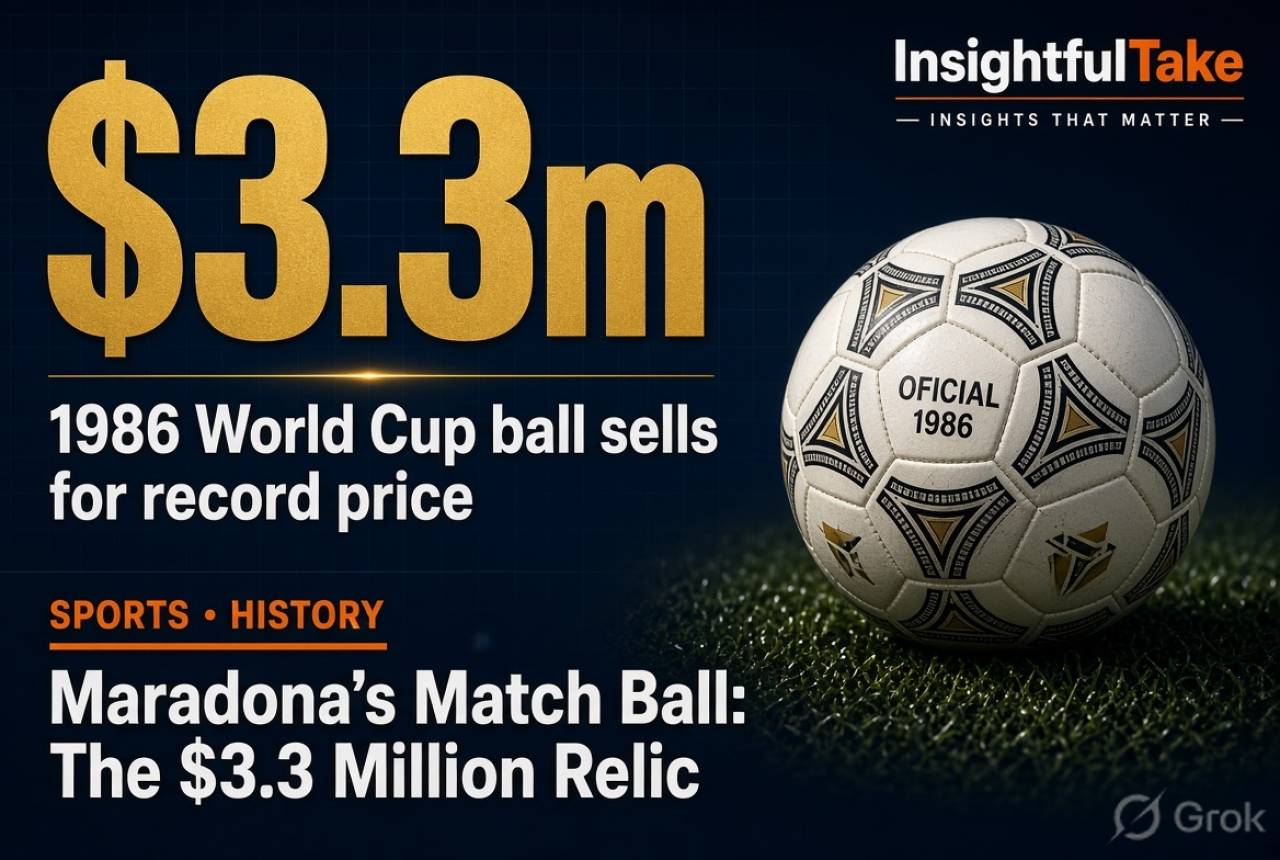
The ball behind Maradona’s most controversial goal just sold for $3.35 million, but its $10 million dream remained out of reach.
The football used for two of Diego Maradona’s most iconic goals has found a new owner, but its record-breaking auction dream remains unrealised.
The football that helped create one of the most controversial moments in World Cup history has changed hands again.
The Adidas Azteca ball used by Diego Maradona to score both his infamous “Hand of God” goal and the legendary “Goal of the Century” against England at the 1986 FIFA World Cup sold for $3.35 million at Heritage Auctions in the United States on August 22, 2026.
The figure is enormous by ordinary standards, but it was far below Heritage Auctions’ pre-sale expectation of around $10 million. Bidding opened at $2.5 million, with the auction house hoping the ball could become the most valuable piece of football memorabilia ever sold.
The result may have fallen short of the dream, but the sale still demonstrates something remarkable. Nearly four decades after that unforgettable afternoon in Mexico City, Maradona’s name continues to carry extraordinary value.
The Match That Never Stopped Being Talked About
To understand the value of the ball, it is necessary to return to June 22, 1986, at Mexico City’s Estadio Azteca.
Argentina and England met in a World Cup quarter-final charged with sporting and political tension. The match came only four years after the Falklands War, adding another layer of emotion to an already intense encounter.
In the 51st minute, Maradona challenged England goalkeeper Peter Shilton for a high ball. The Argentine captain appeared to punch the ball into the net with his left hand.
The referee, Tunisia’s Ali Bin Nasser, did not spot the infringement. The goal stood.
Four minutes later, Maradona produced something entirely different.
Collecting the ball inside his own half, he embarked on a remarkable solo run, weaving past five England players before beating Shilton. The goal would later be voted FIFA’s “Goal of the Century.”
The two goals became inseparable from Maradona’s mythology. When asked about the controversial opener after the match, Maradona famously described it as being scored partly with his head and partly with the “hand of God.”
The phrase became football history.
So did the ball.
From Referee’s Keepsake to Multimillion-Dollar Collectible
The ball’s journey is almost as fascinating as the goals scored with it.
Ali Bin Nasser, the referee who officiated the Argentina-England quarter-final, kept the ball for more than three decades. It eventually entered the auction market in 2022, when bidding reached £2 million. However, it did not meet the reserve price and was subsequently sold privately for $2.37 million. It was offered again in 2023 but failed to find a buyer.
Heritage Auctions brought it back to the market in 2026, describing it as potentially the most famous ball in the history of sport.
Its authenticity was strengthened by photographic matching. Experts compared distinctive markings on the Adidas Azteca with photographs from the 1986 match, linking the physical ball to Maradona’s two historic goals.
Heritage’s Mike Provenzale described it as a “true one-of-a-kind item” and arguably the most significant soccer collectible in existence.
The final $3.35 million price, however, shows that cultural importance does not automatically translate into a record-breaking auction result.
Why Did It Miss the $10 Million Mark?
The gap between expectation and reality is striking.
Heritage had hoped the ball might challenge the value of Maradona’s match-worn shirt from the same Argentina-England game. That shirt sold for almost $9.3 million at Sotheby’s in 2022.
The ball ultimately fetched only around one-third of that amount.
Timing may have played a role. The auction took place after the 2026 World Cup had concluded, while the tournament-related excitement surrounding football collectibles had already begun to cool.
There is also a fundamental difference between a shirt worn by Maradona and a ball used during a match. A shirt carries a direct physical connection to the player. The ball, although central to two historic goals, represents the event more than the individual.
Still, $3.35 million is hardly a failure.
It places the ball among the most valuable football artefacts ever sold and confirms that sports memorabilia has evolved far beyond simple fan collecting.
Why Indian Football Fans Will Understand the Obsession
Maradona occupies a special place in Indian football culture.
From Kolkata to Kerala and across football-loving communities in the Northeast, his 1986 performances have acquired an almost folklore-like quality. For generations of Indian fans, Maradona was not simply a footballer. He was an emotion, a symbol of genius and rebellion, and for many, the first global football icon they truly adopted.
That helps explain why an object as ordinary as a football can become a multimillion-dollar artefact.
The ball is no longer merely sporting equipment. It is a physical link to a moment millions of people remember, even if they never watched the match live.
That is precisely what makes sports memorabilia increasingly attractive to collectors and investors.
When Memory Becomes an Asset
The Maradona ball also illustrates a larger transformation in the memorabilia market.
Collectors are increasingly buying objects not simply because they are old or rare, but because they are attached to moments that have entered cultural history.
Maradona’s 1986 shirt is one example. The Adidas Azteca ball is another.
The value lies not in the leather, stitching or branding. It lies in the story.
Maradona died in November 2020 at the age of 60, but his cultural and commercial legacy remains remarkably powerful. The $3.35 million sale proves that his most controversial afternoon can still generate enormous financial interest.
The ball did not reach the hoped-for $10 million.
But perhaps that is beside the point.
Some sporting objects become valuable because they belonged to champions. Others become priceless because they were present when history happened.
This ball was there for both.
The football used for two of Diego Maradona’s most iconic goals has found a new owner, but its record-breaking auction dream remains unrealised.
The football that helped create one of the most controversial moments in World Cup history has changed hands again.
The Adidas Azteca ball used by Diego Maradona to score both his infamous “Hand of God” goal and the legendary “Goal of the Century” against England at the 1986 FIFA World Cup sold for $3.35 million at Heritage Auctions in the United States on August 22, 2026.
The figure is enormous by ordinary standards, but it was far below Heritage Auctions’ pre-sale expectation of around $10 million. Bidding opened at $2.5 million, with the auction house hoping the ball could become the most valuable piece of football memorabilia ever sold.
The result may have fallen short of the dream, but the sale still demonstrates something remarkable. Nearly four decades after that unforgettable afternoon in Mexico City, Maradona’s name continues to carry extraordinary value.
The Match That Never Stopped Being Talked About
To understand the value of the ball, it is necessary to return to June 22, 1986, at Mexico City’s Estadio Azteca.
Argentina and England met in a World Cup quarter-final charged with sporting and political tension. The match came only four years after the Falklands War, adding another layer of emotion to an already intense encounter.
In the 51st minute, Maradona challenged England goalkeeper Peter Shilton for a high ball. The Argentine captain appeared to punch the ball into the net with his left hand.
The referee, Tunisia’s Ali Bin Nasser, did not spot the infringement. The goal stood.
Four minutes later, Maradona produced something entirely different.
Collecting the ball inside his own half, he embarked on a remarkable solo run, weaving past five England players before beating Shilton. The goal would later be voted FIFA’s “Goal of the Century.”
The two goals became inseparable from Maradona’s mythology. When asked about the controversial opener after the match, Maradona famously described it as being scored partly with his head and partly with the “hand of God.”
The phrase became football history.
So did the ball.
From Referee’s Keepsake to Multimillion-Dollar Collectible
The ball’s journey is almost as fascinating as the goals scored with it.
Ali Bin Nasser, the referee who officiated the Argentina-England quarter-final, kept the ball for more than three decades. It eventually entered the auction market in 2022, when bidding reached £2 million. However, it did not meet the reserve price and was subsequently sold privately for $2.37 million. It was offered again in 2023 but failed to find a buyer.
Heritage Auctions brought it back to the market in 2026, describing it as potentially the most famous ball in the history of sport.
Its authenticity was strengthened by photographic matching. Experts compared distinctive markings on the Adidas Azteca with photographs from the 1986 match, linking the physical ball to Maradona’s two historic goals.
Heritage’s Mike Provenzale described it as a “true one-of-a-kind item” and arguably the most significant soccer collectible in existence.
The final $3.35 million price, however, shows that cultural importance does not automatically translate into a record-breaking auction result.
Why Did It Miss the $10 Million Mark?
The gap between expectation and reality is striking.
Heritage had hoped the ball might challenge the value of Maradona’s match-worn shirt from the same Argentina-England game. That shirt sold for almost $9.3 million at Sotheby’s in 2022.
The ball ultimately fetched only around one-third of that amount.
Timing may have played a role. The auction took place after the 2026 World Cup had concluded, while the tournament-related excitement surrounding football collectibles had already begun to cool.
There is also a fundamental difference between a shirt worn by Maradona and a ball used during a match. A shirt carries a direct physical connection to the player. The ball, although central to two historic goals, represents the event more than the individual.
Still, $3.35 million is hardly a failure.
It places the ball among the most valuable football artefacts ever sold and confirms that sports memorabilia has evolved far beyond simple fan collecting.
Why Indian Football Fans Will Understand the Obsession
Maradona occupies a special place in Indian football culture.
From Kolkata to Kerala and across football-loving communities in the Northeast, his 1986 performances have acquired an almost folklore-like quality. For generations of Indian fans, Maradona was not simply a footballer. He was an emotion, a symbol of genius and rebellion, and for many, the first global football icon they truly adopted.
That helps explain why an object as ordinary as a football can become a multimillion-dollar artefact.
The ball is no longer merely sporting equipment. It is a physical link to a moment millions of people remember, even if they never watched the match live.
That is precisely what makes sports memorabilia increasingly attractive to collectors and investors.
When Memory Becomes an Asset
The Maradona ball also illustrates a larger transformation in the memorabilia market.
Collectors are increasingly buying objects not simply because they are old or rare, but because they are attached to moments that have entered cultural history.
Maradona’s 1986 shirt is one example. The Adidas Azteca ball is another.
The value lies not in the leather, stitching or branding. It lies in the story.
Maradona died in November 2020 at the age of 60, but his cultural and commercial legacy remains remarkably powerful. The $3.35 million sale proves that his most controversial afternoon can still generate enormous financial interest.
The ball did not reach the hoped-for $10 million.
But perhaps that is beside the point.
Some sporting objects become valuable because they belonged to champions. Others become priceless because they were present when history happened.
This ball was there for both.























Leave a Comment