
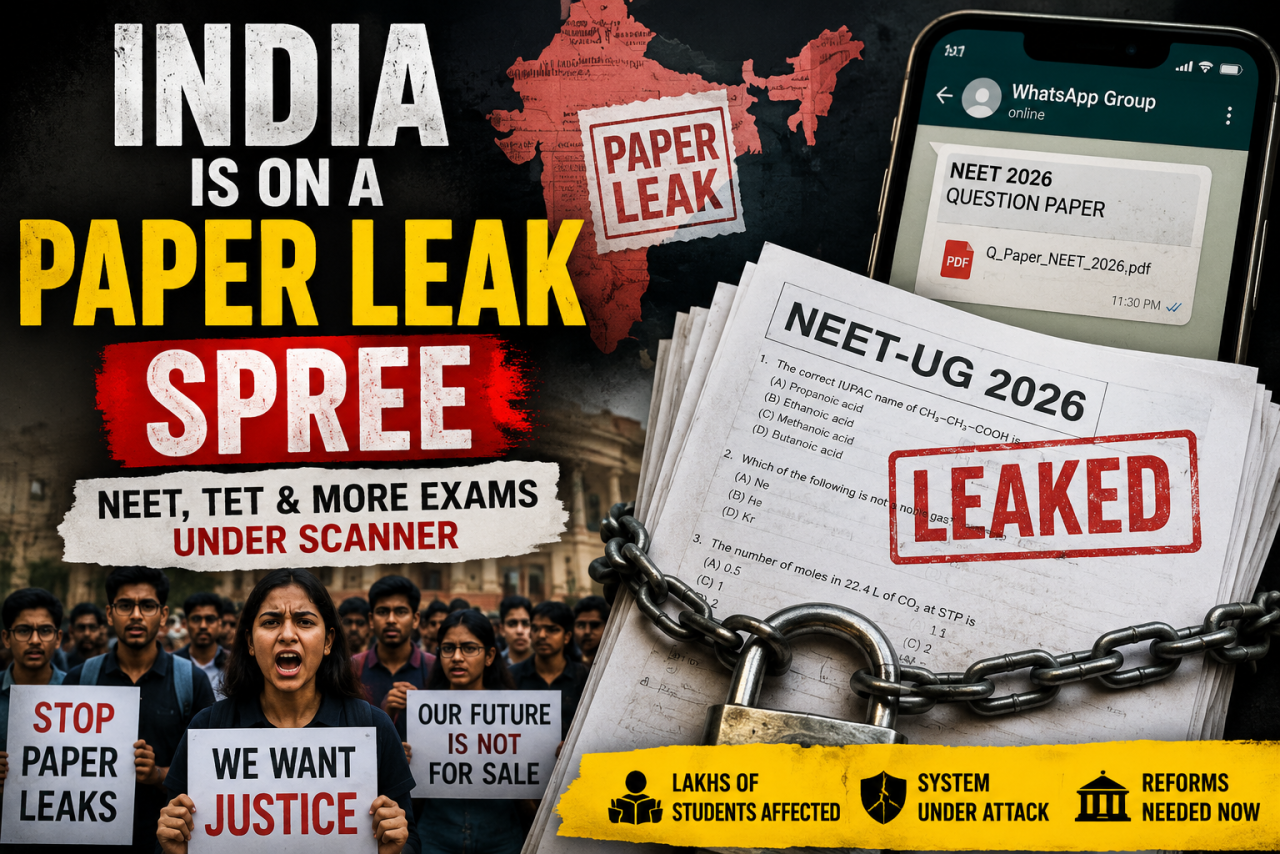
Millions study for success, but recurring paper leaks are turning India's toughest exams into a test of trust instead of merit.
India's education system has long been seen as a pathway to opportunity. Every year, millions of students spend years preparing for highly competitive examinations in the hope of securing a better future. But that faith is increasingly being tested. A series of major examination paper leaks over the past few months has exposed serious weaknesses in the system, leaving students anxious, parents frustrated, and public confidence badly shaken.
The biggest controversy erupted around NEET-UG 2026, one of India's most important entrance examinations for medical and dental colleges. Conducted on May 3 for more than 2.27 million candidates, the examination was cancelled on May 12 after investigators found evidence of a large-scale paper leak.
According to investigators, a "guess paper" circulated through WhatsApp groups and coaching centres, particularly in Rajasthan's Sikar district, closely matched the actual examination paper in subjects such as Chemistry and Biology. The Central Bureau of Investigation (CBI) arrested several people, including individuals allegedly linked to the National Testing Agency (NTA). Investigators are also examining whether the same network may have compromised the NEET examination in 2025.
The fallout has been severe. Students who spent years preparing suddenly found their future uncertain. Families who invested significant time and money in coaching were left wondering whether merit alone is enough to succeed. The Supreme Court criticised the functioning of the NTA, pointing to administrative failures that had caused immense hardship for students. Reports also suggested that Prime Minister Narendra Modi was closely monitoring the developments.
Before the dust had settled, another controversy surfaced in Maharashtra.
The Teacher Eligibility Test (TET), scheduled for June 28, 2026, was postponed just a day before the examination after reports emerged that the question paper had been leaked in Bhiwandi, Thane. Nearly 1.82 lakh candidates were expected to appear for the test. Authorities detained several suspects, despite earlier assurances that stronger security measures had been introduced following the NEET controversy.
The incident highlighted a worrying trend. Paper leaks are no longer limited to national-level entrance examinations. State-level recruitment and eligibility tests are also becoming increasingly vulnerable.
Maharashtra has witnessed similar incidents in recent months. In February 2026, the Higher Secondary Certificate (HSC) Class 12 Chemistry paper was allegedly circulated through WhatsApp before the examination. Police made arrests in Nagpur, although the state board denied that the leak was widespread and decided against holding a re-examination. Similar allegations also surfaced during the Secondary School Certificate (SSC) examinations.
Former examination officials say criminal networks have become far more sophisticated, while security systems have struggled to keep pace with advances in technology.
The problem extends well beyond one state. Investigations by The Indian Express have documented dozens of major paper leak cases between 2002 and 2025 involving NEET, UGC-NET, railway recruitment examinations, state public service commissions, and board examinations. Although thousands of arrests have been made over the years, convictions remain surprisingly rare.
States such as Bihar, Uttar Pradesh, Rajasthan, and Madhya Pradesh have witnessed repeated examination scandals. The infamous Vyapam scam remains one of the biggest reminders of how deeply corruption can affect recruitment and admissions. Experts say these leaks thrive because of a combination of intense competition, limited seats, organised education rackets, weak security during printing and transportation, and the rapid spread of information through encrypted messaging platforms.
The impact goes far beyond cancelled examinations.
Students often spend several years preparing for a single test. Many families invest their life savings in coaching, study material, and accommodation. When an examination is compromised, honest candidates pay the highest price. The emotional toll can be enormous, leading to stress, anxiety, and growing distrust in the system. Increasingly, students are asking whether hard work still matters or whether money and influence have become more important than merit.
Public anger has also intensified. Protests, social media campaigns, and demands for accountability have become common after every major paper leak. Yet many believe that little changes once public attention fades.
Experts have suggested several reforms to restore confidence. These include expanding computer-based testing with stronger cybersecurity, improving the chain of custody for question papers, introducing stricter punishment for those involved in paper leak rackets, conducting fast-track trials, and holding examination authorities directly accountable for security failures. Technologies such as AI-assisted monitoring and blockchain-based protection for question banks could strengthen the system, although both require significant investment and effective implementation.
India's demographic advantage depends on a fair and transparent education system. Competitive examinations are meant to reward talent and hard work, not become opportunities for organised criminal networks.
The recent series of paper leaks is more than a law-and-order problem. It reflects deeper failures in governance and institutional accountability. Unless comprehensive reforms are introduced, students will continue to lose faith in examinations that are supposed to shape their future.
India's young people deserve a system where success is determined by ability, not by who gains access to a leaked question paper. Restoring that trust should now be a national priority.
India's education system has long been seen as a pathway to opportunity. Every year, millions of students spend years preparing for highly competitive examinations in the hope of securing a better future. But that faith is increasingly being tested. A series of major examination paper leaks over the past few months has exposed serious weaknesses in the system, leaving students anxious, parents frustrated, and public confidence badly shaken.
The biggest controversy erupted around NEET-UG 2026, one of India's most important entrance examinations for medical and dental colleges. Conducted on May 3 for more than 2.27 million candidates, the examination was cancelled on May 12 after investigators found evidence of a large-scale paper leak.
According to investigators, a "guess paper" circulated through WhatsApp groups and coaching centres, particularly in Rajasthan's Sikar district, closely matched the actual examination paper in subjects such as Chemistry and Biology. The Central Bureau of Investigation (CBI) arrested several people, including individuals allegedly linked to the National Testing Agency (NTA). Investigators are also examining whether the same network may have compromised the NEET examination in 2025.
The fallout has been severe. Students who spent years preparing suddenly found their future uncertain. Families who invested significant time and money in coaching were left wondering whether merit alone is enough to succeed. The Supreme Court criticised the functioning of the NTA, pointing to administrative failures that had caused immense hardship for students. Reports also suggested that Prime Minister Narendra Modi was closely monitoring the developments.
Before the dust had settled, another controversy surfaced in Maharashtra.
The Teacher Eligibility Test (TET), scheduled for June 28, 2026, was postponed just a day before the examination after reports emerged that the question paper had been leaked in Bhiwandi, Thane. Nearly 1.82 lakh candidates were expected to appear for the test. Authorities detained several suspects, despite earlier assurances that stronger security measures had been introduced following the NEET controversy.
The incident highlighted a worrying trend. Paper leaks are no longer limited to national-level entrance examinations. State-level recruitment and eligibility tests are also becoming increasingly vulnerable.
Maharashtra has witnessed similar incidents in recent months. In February 2026, the Higher Secondary Certificate (HSC) Class 12 Chemistry paper was allegedly circulated through WhatsApp before the examination. Police made arrests in Nagpur, although the state board denied that the leak was widespread and decided against holding a re-examination. Similar allegations also surfaced during the Secondary School Certificate (SSC) examinations.
Former examination officials say criminal networks have become far more sophisticated, while security systems have struggled to keep pace with advances in technology.
The problem extends well beyond one state. Investigations by The Indian Express have documented dozens of major paper leak cases between 2002 and 2025 involving NEET, UGC-NET, railway recruitment examinations, state public service commissions, and board examinations. Although thousands of arrests have been made over the years, convictions remain surprisingly rare.
States such as Bihar, Uttar Pradesh, Rajasthan, and Madhya Pradesh have witnessed repeated examination scandals. The infamous Vyapam scam remains one of the biggest reminders of how deeply corruption can affect recruitment and admissions. Experts say these leaks thrive because of a combination of intense competition, limited seats, organised education rackets, weak security during printing and transportation, and the rapid spread of information through encrypted messaging platforms.
The impact goes far beyond cancelled examinations.
Students often spend several years preparing for a single test. Many families invest their life savings in coaching, study material, and accommodation. When an examination is compromised, honest candidates pay the highest price. The emotional toll can be enormous, leading to stress, anxiety, and growing distrust in the system. Increasingly, students are asking whether hard work still matters or whether money and influence have become more important than merit.
Public anger has also intensified. Protests, social media campaigns, and demands for accountability have become common after every major paper leak. Yet many believe that little changes once public attention fades.
Experts have suggested several reforms to restore confidence. These include expanding computer-based testing with stronger cybersecurity, improving the chain of custody for question papers, introducing stricter punishment for those involved in paper leak rackets, conducting fast-track trials, and holding examination authorities directly accountable for security failures. Technologies such as AI-assisted monitoring and blockchain-based protection for question banks could strengthen the system, although both require significant investment and effective implementation.
India's demographic advantage depends on a fair and transparent education system. Competitive examinations are meant to reward talent and hard work, not become opportunities for organised criminal networks.
The recent series of paper leaks is more than a law-and-order problem. It reflects deeper failures in governance and institutional accountability. Unless comprehensive reforms are introduced, students will continue to lose faith in examinations that are supposed to shape their future.
India's young people deserve a system where success is determined by ability, not by who gains access to a leaked question paper. Restoring that trust should now be a national priority.


















Leave a Comment