
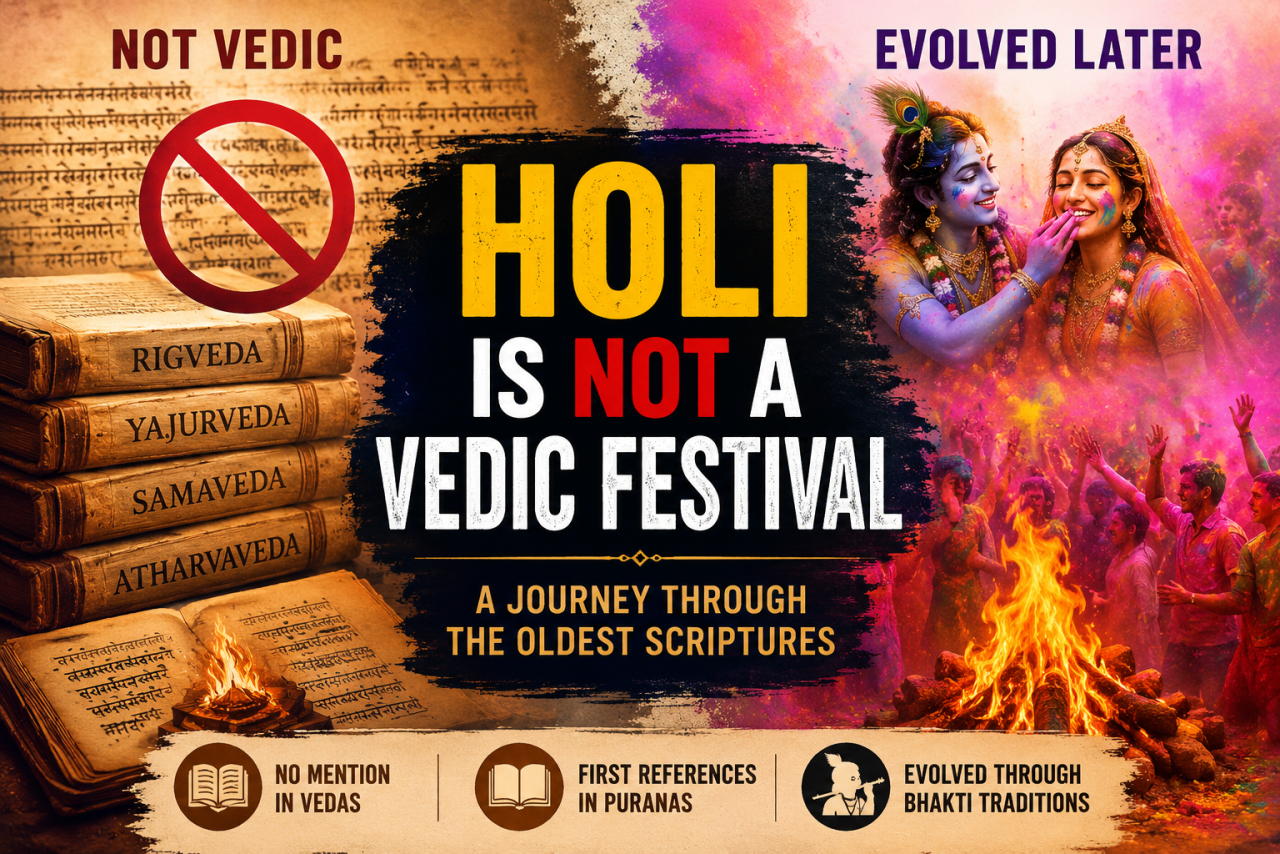
Most people believe Holi is a Vedic festival. But the oldest Hindu scriptures tell a different story—one that reveals how the Festival of Colors actually evolved centuries later.
Holi, India's festival of colors, is celebrated across the country as a joyous occasion of renewal, forgiveness, and social harmony. Yet the widely held belief that Holi originated in the Vedic age does not withstand close examination. A careful reading of Hinduism's oldest scriptures—the Vedas—reveals no reference to the festival or its defining rituals. Instead, the available textual evidence suggests that Holi emerged centuries later through Puranic literature, Bhakti traditions, and evolving cultural practices.
Tracing Holi's absence from the Vedas and its gradual appearance in post-Vedic texts provides a clearer understanding of how one of India's most beloved festivals evolved into its present form.
The Absence of Holi in the Vedas
The four Vedas—Rigveda, Yajurveda, Samaveda, and Atharvaveda—form the earliest religious and philosophical foundation of Hinduism. Composed between roughly 1500 BCE and 500 BCE, they contain hymns, sacrificial rituals, cosmological ideas, and theological discussions. If Holi were truly a Vedic festival, one would reasonably expect some reference to its rituals or central themes. Yet no such evidence exists.
1. Rigveda (c. 1500–1000 BCE)
The Rigveda, the oldest of the Vedas, consists primarily of hymns dedicated to deities such as Indra, Agni, Varuna, and Soma. It describes yajnas (sacrificial rituals) performed to maintain cosmic order and invoke divine blessings. Although the text acknowledges changing seasons and agricultural cycles, it contains no mention of a festival resembling Holi, nor any tradition involving colors, bonfires, or communal celebration.
2. Yajurveda (c. 1200–800 BCE)
The Yajurveda provides detailed instructions for conducting Vedic sacrifices. While it prescribes rituals connected to fertility, seasonal transitions, and divine worship, it contains no reference to Holi, Holika Dahan, or the playful throwing of colors that define the festival today.
3. Samaveda (c. 1200 BCE)
The Samaveda is primarily a liturgical text devoted to the musical chanting of Rigvedic hymns during sacrificial ceremonies. Its focus remains firmly on ritual performance, with no indication of a public spring festival comparable to Holi.
4. Atharvaveda (c. 1000–800 BCE)
Often regarded as the most folk-oriented of the four Vedas, the Atharvaveda includes spells, charms, healing practices, and domestic rituals. Even within this broader cultural framework, there is no description of Holi or any ceremony resembling its modern observance.
Taken together, the silence of all four Vedas strongly suggests that Holi did not originate during the Vedic period.
The Emergence of Holi in Post-Vedic Literature
Although Holi is absent from the Vedas, references to the festival begin appearing in later religious literature, particularly the Puranas and Smriti texts, composed many centuries afterward.
Bhavishya Purana (c. 3rd–7th century CE)
The Bhavishya Purana contains one of the earliest known references to Holika Dahan, the ceremonial bonfire symbolizing the triumph of good over evil through the story of Prahlada and Holika.
Vishnu Purana (c. 3rd–5th century CE)
The Vishnu Purana elaborates on the narrative of Hiranyakashipu, Prahlada, and Holika, presenting it within the broader framework of Vishnu's divine intervention. Since this text was composed long after the Vedic period, it reinforces the conclusion that Holi developed during the Puranic age rather than the Vedic era.
Narada Purana (c. 5th–10th century CE)
The Narada Purana describes festive celebrations involving joyful play with colors, particularly in connection with Krishna, Radha, and the Gopis. These references closely resemble elements associated with Holi today.
Bhagavata Purana (c. 10th century CE)
The Bhagavata Purana further develops the Krishna-centered tradition by portraying Krishna's playful use of colors as an expression of divine love and devotion. This text firmly establishes the devotional character that became central to Holi celebrations across northern India.
Collectively, these later texts demonstrate that Holi evolved through Puranic storytelling and the Bhakti movement rather than through the sacrificial traditions of the Vedas.
The Social and Cultural Evolution of Holi
The historical evolution of Holi also reflects broader transformations within Indian society. Over time, religious life gradually shifted from the ritual-centered practices of Vedic Brahmanism toward the more inclusive devotional traditions of the Puranic and Bhakti periods.
Holi's close association with Krishna, music, dance, and playful community participation represents a significant departure from the formal sacrificial culture described in the Vedas.
Its timing also corresponds with the spring harvest, suggesting that Holi may have originated as a regional agrarian festival before being incorporated into broader Hindu religious traditions. Likewise, the practice of Holika Dahan symbolizes the destruction of evil and the beginning of renewal, illustrating a transition from Vedic ritual sacrifice to mythology-based religious symbolism.
Final Take
The available textual evidence is clear: Holi is not a Vedic festival. Its complete absence from the Vedic corpus and its gradual emergence in later Puranic and Bhakti literature point to a distinctly post-Vedic origin.
This conclusion does not diminish Holi's religious or cultural importance. On the contrary, it highlights the dynamic nature of Hindu traditions. Like many enduring festivals, Holi evolved over centuries by absorbing regional customs, devotional movements, and new theological narratives.
Holi's history reminds us that religious traditions are rarely static. They grow, adapt, and reinterpret themselves across generations while remaining deeply meaningful to those who celebrate them. Recognizing that Holi is a post-Vedic festival therefore enriches, rather than weakens, our understanding of Hinduism's diverse and continuously evolving cultural heritage.
Holi, India's festival of colors, is celebrated across the country as a joyous occasion of renewal, forgiveness, and social harmony. Yet the widely held belief that Holi originated in the Vedic age does not withstand close examination. A careful reading of Hinduism's oldest scriptures—the Vedas—reveals no reference to the festival or its defining rituals. Instead, the available textual evidence suggests that Holi emerged centuries later through Puranic literature, Bhakti traditions, and evolving cultural practices.
Tracing Holi's absence from the Vedas and its gradual appearance in post-Vedic texts provides a clearer understanding of how one of India's most beloved festivals evolved into its present form.
The Absence of Holi in the Vedas
The four Vedas—Rigveda, Yajurveda, Samaveda, and Atharvaveda—form the earliest religious and philosophical foundation of Hinduism. Composed between roughly 1500 BCE and 500 BCE, they contain hymns, sacrificial rituals, cosmological ideas, and theological discussions. If Holi were truly a Vedic festival, one would reasonably expect some reference to its rituals or central themes. Yet no such evidence exists.
1. Rigveda (c. 1500–1000 BCE)
The Rigveda, the oldest of the Vedas, consists primarily of hymns dedicated to deities such as Indra, Agni, Varuna, and Soma. It describes yajnas (sacrificial rituals) performed to maintain cosmic order and invoke divine blessings. Although the text acknowledges changing seasons and agricultural cycles, it contains no mention of a festival resembling Holi, nor any tradition involving colors, bonfires, or communal celebration.
2. Yajurveda (c. 1200–800 BCE)
The Yajurveda provides detailed instructions for conducting Vedic sacrifices. While it prescribes rituals connected to fertility, seasonal transitions, and divine worship, it contains no reference to Holi, Holika Dahan, or the playful throwing of colors that define the festival today.
3. Samaveda (c. 1200 BCE)
The Samaveda is primarily a liturgical text devoted to the musical chanting of Rigvedic hymns during sacrificial ceremonies. Its focus remains firmly on ritual performance, with no indication of a public spring festival comparable to Holi.
4. Atharvaveda (c. 1000–800 BCE)
Often regarded as the most folk-oriented of the four Vedas, the Atharvaveda includes spells, charms, healing practices, and domestic rituals. Even within this broader cultural framework, there is no description of Holi or any ceremony resembling its modern observance.
Taken together, the silence of all four Vedas strongly suggests that Holi did not originate during the Vedic period.
The Emergence of Holi in Post-Vedic Literature
Although Holi is absent from the Vedas, references to the festival begin appearing in later religious literature, particularly the Puranas and Smriti texts, composed many centuries afterward.
Bhavishya Purana (c. 3rd–7th century CE)
The Bhavishya Purana contains one of the earliest known references to Holika Dahan, the ceremonial bonfire symbolizing the triumph of good over evil through the story of Prahlada and Holika.
Vishnu Purana (c. 3rd–5th century CE)
The Vishnu Purana elaborates on the narrative of Hiranyakashipu, Prahlada, and Holika, presenting it within the broader framework of Vishnu's divine intervention. Since this text was composed long after the Vedic period, it reinforces the conclusion that Holi developed during the Puranic age rather than the Vedic era.
Narada Purana (c. 5th–10th century CE)
The Narada Purana describes festive celebrations involving joyful play with colors, particularly in connection with Krishna, Radha, and the Gopis. These references closely resemble elements associated with Holi today.
Bhagavata Purana (c. 10th century CE)
The Bhagavata Purana further develops the Krishna-centered tradition by portraying Krishna's playful use of colors as an expression of divine love and devotion. This text firmly establishes the devotional character that became central to Holi celebrations across northern India.
Collectively, these later texts demonstrate that Holi evolved through Puranic storytelling and the Bhakti movement rather than through the sacrificial traditions of the Vedas.
The Social and Cultural Evolution of Holi
The historical evolution of Holi also reflects broader transformations within Indian society. Over time, religious life gradually shifted from the ritual-centered practices of Vedic Brahmanism toward the more inclusive devotional traditions of the Puranic and Bhakti periods.
Holi's close association with Krishna, music, dance, and playful community participation represents a significant departure from the formal sacrificial culture described in the Vedas.
Its timing also corresponds with the spring harvest, suggesting that Holi may have originated as a regional agrarian festival before being incorporated into broader Hindu religious traditions. Likewise, the practice of Holika Dahan symbolizes the destruction of evil and the beginning of renewal, illustrating a transition from Vedic ritual sacrifice to mythology-based religious symbolism.
Final Take
The available textual evidence is clear: Holi is not a Vedic festival. Its complete absence from the Vedic corpus and its gradual emergence in later Puranic and Bhakti literature point to a distinctly post-Vedic origin.
This conclusion does not diminish Holi's religious or cultural importance. On the contrary, it highlights the dynamic nature of Hindu traditions. Like many enduring festivals, Holi evolved over centuries by absorbing regional customs, devotional movements, and new theological narratives.
Holi's history reminds us that religious traditions are rarely static. They grow, adapt, and reinterpret themselves across generations while remaining deeply meaningful to those who celebrate them. Recognizing that Holi is a post-Vedic festival therefore enriches, rather than weakens, our understanding of Hinduism's diverse and continuously evolving cultural heritage.
























Leave a Comment