
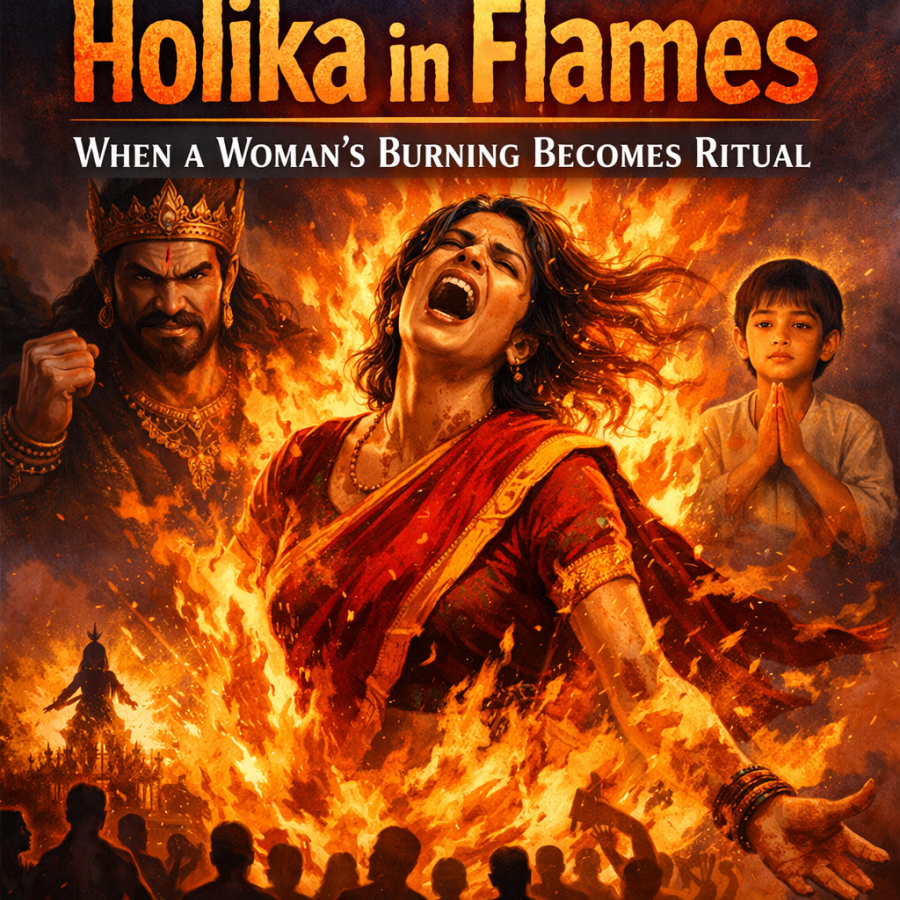
Every year during Holika Dahan, we light a fire to celebrate the victory of good over evil — but why does that victory still require a woman in flames?
On the eve of Holi, towering bonfires mark the ritual of Holika Dahan across India. The flames are said to cleanse negativity and symbolize the triumph of good over evil. At the center of this tradition stands Holika, who burns while the child devotee Prahlad survives, protected by faith, defying the cruelty of the tyrant king Hiranyakashipu.
The story is familiar. The message appears clear. Yet from a woman’s perspective, one question refuses to fade: why does the purification of society require the spectacle of a woman in flames?
Holika Dahan is celebrated as a victory of devotion over arrogance. But visually and symbolically, it is also the ritualized destruction of a female figure. Year after year, communities gather to watch her burn — not as a tragic character, not as a complex figure shaped by circumstance, but as the embodiment of evil that must be erased.
This is where dogma takes root.
Dogma begins when stories are stripped of nuance and turned into unquestionable moral templates. In most retellings, Holika is simply wicked. She is power-hungry. She misuses her boon. She aids her brother’s tyranny. Her death becomes necessary. End of story.
But notice how her identity is framed. She is introduced through male relationships — a sister obeying a king, an aunt targeting a child. Her motivations are secondary. Her humanity is absent. She is reduced to a cautionary symbol.
Across cultures, women who defy moral codes have often been punished publicly and dramatically. Whether branded as witches, sinners, or threats to order, their destruction has served as a warning. The pattern is historical: when a woman embodies danger, her downfall is turned into a lesson.
Holika’s burning fits into that broader narrative pattern, even if unintentionally.
Supporters argue — rightly — that the story is not about gender but about ego and injustice. Holika burns because she misused divine protection, not because she was a woman. And that interpretation carries spiritual weight. Yet symbolism operates beyond intent. It interacts with social realities.
In a country where women still face violence justified in the name of honor, morality, or family reputation, the image of a woman consumed by fire cannot feel entirely neutral. History has seen real women burned — for dowry disputes, for defiance, for suspicion. The visual parallel makes reflection inevitable.
The concern is not with faith itself. Hindu philosophy is vast, layered, and open to reinterpretation. It has survived precisely because it evolves. The concern is with the unquestioned repetition of a narrative where female destruction becomes the cleansing act.
Look closely at the myth’s true center of cruelty. It is not Holika alone. It is Hiranyakashipu — the authoritarian king who demands worship and punishes dissent. He represents ego at its most dangerous. Yet the annual ritual does not burn his effigy in the same way. The fire is reserved for her.
Why does the spotlight fall so intensely on the woman?
When male tyranny is contextual and female wrongdoing is dramatized, a subtle cultural message forms: women’s transgressions demand visible punishment. Their mistakes must be spectacularly corrected. Their power, if misused, must be annihilated.
This is the dogma that needs interrogation — not the festival, not devotion, but the embedded narrative hierarchy.
From a modern feminist lens, Holika’s story can be reclaimed rather than rejected. What if the fire symbolized the burning of blind obedience to unjust authority? What if it represented dismantling oppressive systems — the very system Hiranyakashipu built? What if Holika were discussed as someone complicit in patriarchy rather than as evil incarnate?
Children listening to this story deserve more than a binary of good boy versus bad woman. They deserve to understand power dynamics, loyalty pressures, and moral complexity.
Rituals shape imagination. Imagination shapes norms.
When young girls see Holika burn, they should not internalize fear of stepping beyond prescribed boundaries. They should understand that ego, cruelty, and misuse of power destroy anyone — regardless of gender. When young boys watch the flames, they should learn that tyranny, not femininity, is the true evil.
The goal of Holika Dahan is purification. But purification must include reexamining inherited interpretations. Faith does not weaken when questioned; it deepens. Traditions do not collapse when reinterpreted; they mature.
Holika in flames can remain a symbol — but the meaning assigned to those flames must evolve with society. The real transformation lies not in watching a woman perish in legend, but in burning the dogma that made her perishing unquestionable.
That is the conversation worth having — around the fire, before the colors of Holi fill the air.


.jpeg)





















Leave a Comment