
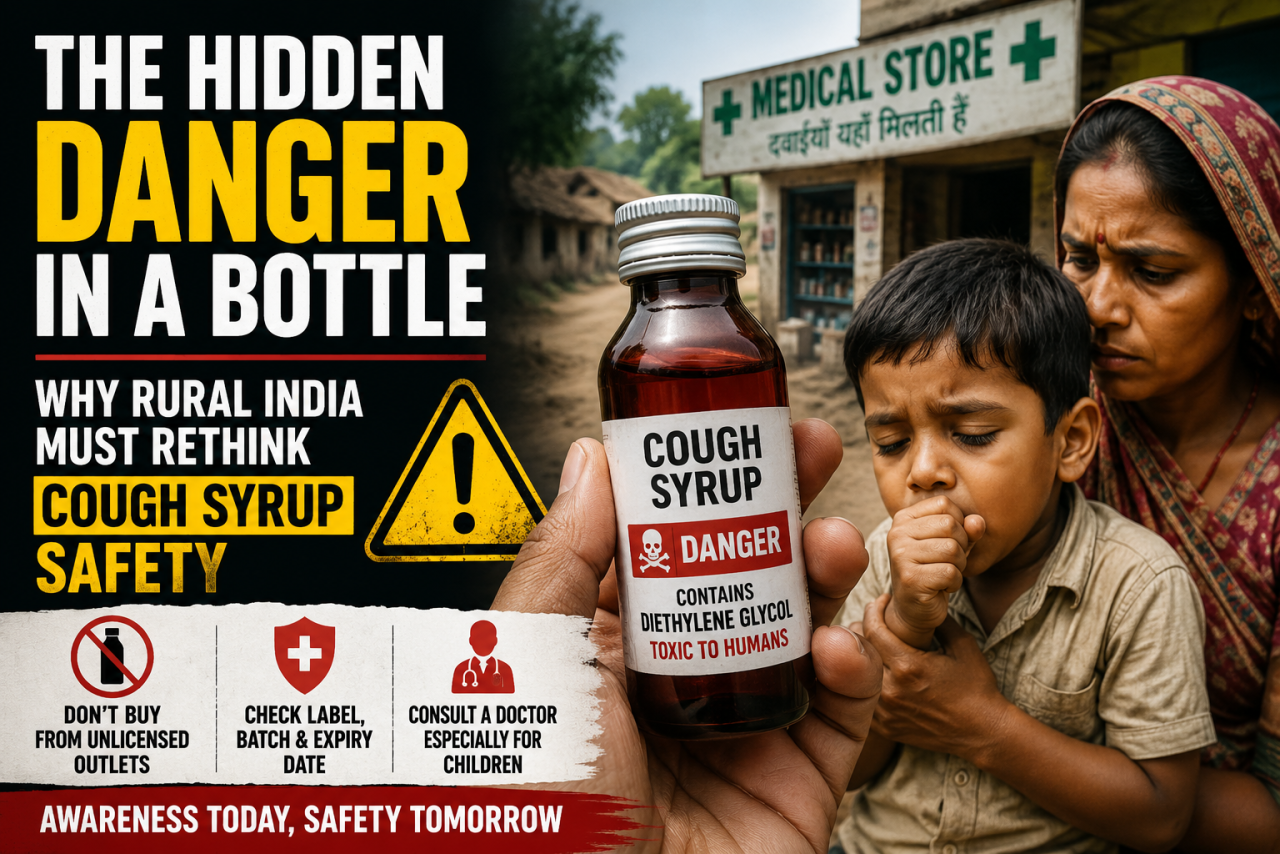
A routine cough remedy became a deadly threat for several children. The tragedy has exposed critical gaps in medicine safety and sparked important regulatory changes across India.
In thousands of villages across India, a common scene repeats itself every monsoon and winter season. A child develops a cough, and instead of a visit to a doctor, a family member walks to the nearest medical store and buys a bottle of cough syrup. No prescription is asked for, no questions are raised, and the syrup is given by the spoonful, sometimes for days. This small, ordinary act, repeated in millions of homes, has recently revealed a frightening danger hiding in plain sight.
Last year, India witnessed a heartbreaking tragedy when more than twenty children, most of them in Rajasthan, lost their lives after consuming contaminated cough syrup. Laboratory tests showed that the syrup contained diethylene glycol, a toxic chemical normally used in industrial products like brake fluid and antifreeze, never meant for human consumption. The contamination levels were found to be hundreds of times higher than what is considered safe. These were not isolated accidents; reports later revealed that some India-made cough syrups exported abroad had also been linked to child deaths in other countries. The tragedy exposed a gap that rural India can no longer afford to ignore.
For decades, an old rule called Schedule K allowed cough syrups to be sold without a proper drug licence in villages with a population of less than one thousand. The idea behind this exemption was reasonable: small villages often lack pharmacies, and people needed access to basic medicines. But this same exemption became a loophole. Cough syrups began to be manufactured and sold by establishments with little or no quality control, and without any pharmacist to check whether a medicine was genuine, safe, or appropriate for a child's age and weight.
This problem runs deeper than just contamination. In many parts of rural and even urban India, cough syrups containing certain chemicals are misused as a cheap and easily available substitute for alcohol or narcotic drugs. Their easy availability, low cost, and lack of regulation made them attractive not only to unwell patients but also to those seeking an intoxicating effect. This silent misuse has, in many cases, gone unnoticed by families until it was too late.
Recognising the scale of this danger, the Union health ministry has now removed cough syrups from the Schedule K list altogether. This means that, going forward, cough syrups can only be sold through properly licensed pharmacies, no matter how small the village or town. The decision is an important step, but a government order alone cannot protect every family. Awareness at the ground level is just as essential.
For rural households, a few simple habits can make a real difference. Cough syrup should never be bought from an unlicensed medical store or seller, however convenient that may seem. A bottle should always carry a clear manufacturing licence number, batch number, and expiry date, and any syrup without these details should be treated with suspicion. Children, especially those below the age of two, should never be given cough syrup without a doctor's advice, since their smaller bodies make them far more vulnerable to toxic chemicals. For mild coughs, time-tested home remedies such as warm water with honey, tulsi leaves, or steam inhalation remain safer first steps, while a persistent or severe cough should always be checked by a qualified doctor or the nearest primary health centre.
Local health workers such as ASHA and Anganwadi workers can play a powerful role here, not just as government employees but as trusted voices within their communities, spreading the message that a cheap medicine bought without proper verification can sometimes cost a life.
The new rule restricting cough syrup sales is not just a regulatory change buried in a government gazette. It is a reminder that something as ordinary as a spoonful of medicine deserves the same caution as any other serious health decision. Rural India, with its strong sense of community, has every capability to turn this warning into lasting change, one informed household at a time.
In thousands of villages across India, a common scene repeats itself every monsoon and winter season. A child develops a cough, and instead of a visit to a doctor, a family member walks to the nearest medical store and buys a bottle of cough syrup. No prescription is asked for, no questions are raised, and the syrup is given by the spoonful, sometimes for days. This small, ordinary act, repeated in millions of homes, has recently revealed a frightening danger hiding in plain sight.
Last year, India witnessed a heartbreaking tragedy when more than twenty children, most of them in Rajasthan, lost their lives after consuming contaminated cough syrup. Laboratory tests showed that the syrup contained diethylene glycol, a toxic chemical normally used in industrial products like brake fluid and antifreeze, never meant for human consumption. The contamination levels were found to be hundreds of times higher than what is considered safe. These were not isolated accidents; reports later revealed that some India-made cough syrups exported abroad had also been linked to child deaths in other countries. The tragedy exposed a gap that rural India can no longer afford to ignore.
For decades, an old rule called Schedule K allowed cough syrups to be sold without a proper drug licence in villages with a population of less than one thousand. The idea behind this exemption was reasonable: small villages often lack pharmacies, and people needed access to basic medicines. But this same exemption became a loophole. Cough syrups began to be manufactured and sold by establishments with little or no quality control, and without any pharmacist to check whether a medicine was genuine, safe, or appropriate for a child's age and weight.
This problem runs deeper than just contamination. In many parts of rural and even urban India, cough syrups containing certain chemicals are misused as a cheap and easily available substitute for alcohol or narcotic drugs. Their easy availability, low cost, and lack of regulation made them attractive not only to unwell patients but also to those seeking an intoxicating effect. This silent misuse has, in many cases, gone unnoticed by families until it was too late.
Recognising the scale of this danger, the Union health ministry has now removed cough syrups from the Schedule K list altogether. This means that, going forward, cough syrups can only be sold through properly licensed pharmacies, no matter how small the village or town. The decision is an important step, but a government order alone cannot protect every family. Awareness at the ground level is just as essential.
For rural households, a few simple habits can make a real difference. Cough syrup should never be bought from an unlicensed medical store or seller, however convenient that may seem. A bottle should always carry a clear manufacturing licence number, batch number, and expiry date, and any syrup without these details should be treated with suspicion. Children, especially those below the age of two, should never be given cough syrup without a doctor's advice, since their smaller bodies make them far more vulnerable to toxic chemicals. For mild coughs, time-tested home remedies such as warm water with honey, tulsi leaves, or steam inhalation remain safer first steps, while a persistent or severe cough should always be checked by a qualified doctor or the nearest primary health centre.
Local health workers such as ASHA and Anganwadi workers can play a powerful role here, not just as government employees but as trusted voices within their communities, spreading the message that a cheap medicine bought without proper verification can sometimes cost a life.
The new rule restricting cough syrup sales is not just a regulatory change buried in a government gazette. It is a reminder that something as ordinary as a spoonful of medicine deserves the same caution as any other serious health decision. Rural India, with its strong sense of community, has every capability to turn this warning into lasting change, one informed household at a time.


















Leave a Comment