
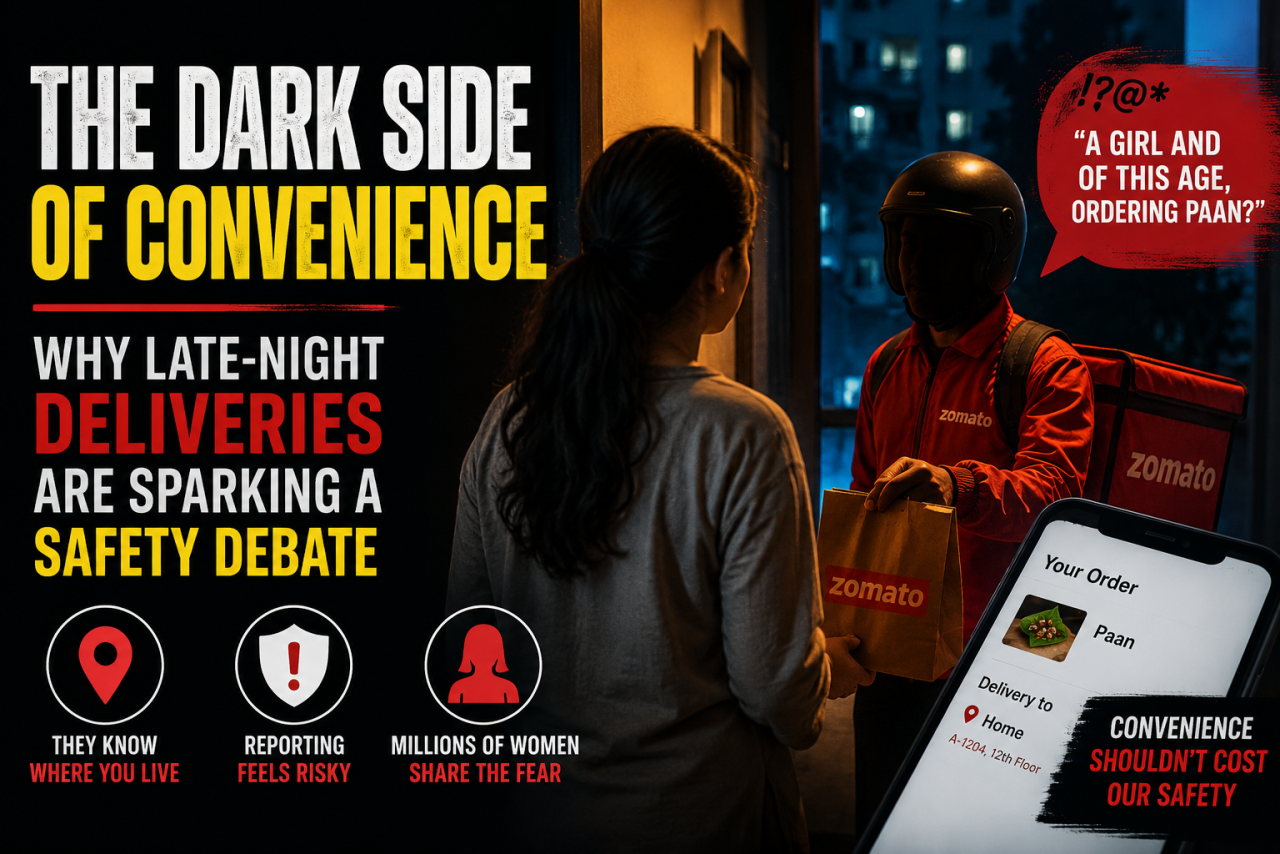
A midnight food order should be nothing more than a moment of convenience. But when a stranger at your doorstep knows where you live and feels entitled to judge your choices, convenience begins to feel a lot less comfortable.
In modern urban life, convenience has become one of the most prized commodities. Whether it is a late-night craving, an urgent grocery requirement, or a forgotten household item, delivery apps have transformed how people live. With just a few taps on a smartphone, almost anything can arrive at a customer's doorstep within minutes. Yet beneath this seamless experience lies an uncomfortable question: Are customers, particularly women, paying a hidden price for this convenience?
A recent incident in Delhi has reignited concerns about safety, privacy, and accountability in the rapidly expanding gig economy.
The Incident That Sparked a Larger Conversation
The debate gained momentum after Delhi-based professional Aanya Wig shared a troubling experience on LinkedIn. According to her account, she placed an order for an after-dinner paan around 11 PM through Zomato. When she stepped outside alone to collect the delivery, what should have been a routine exchange quickly became uncomfortable.
The delivery partner allegedly questioned whether she was the person who had placed the order and then proceeded to comment on her age and gender while handing over the package. The remark may have appeared minor to some observers, but for many women, it represented something far more significant: an unsolicited judgment from a stranger who had access to their personal information and home address.
Wig later questioned why a delivery worker should have any authority to comment on a customer's purchase decisions. Her post struck a chord because it highlighted a concern that many women quietly experience but rarely discuss publicly.
When Reporting Feels Risky
The most alarming aspect of the incident was not merely the comment itself but the hesitation to report it.
For many customers, filing a complaint is a straightforward process. However, for women living alone or returning home late at night, the calculation can be very different. Delivery personnel often know a customer's exact address, apartment details, and routine ordering patterns. This creates an uncomfortable power imbalance.
If a complaint leads to disciplinary action or job-related consequences, some women fear the possibility of retaliation. Whether that fear is justified or not, its existence is enough to discourage reporting. As a result, incidents that make customers feel unsafe often go undocumented and unresolved.
The problem is not necessarily widespread misconduct but the perception of vulnerability. When customers feel they must choose between their safety and their right to complain, the system has a serious flaw.
A Shared Urban Reality
The response to Wig's post revealed that her experience was far from isolated. Women across major cities shared similar concerns about interactions with delivery personnel, ride-hailing drivers, and other service workers who gain temporary access to personal information through digital platforms.
Many admitted that they have developed their own safety strategies. Some avoid opening the door alone after dark. Others pretend to be speaking with a male family member on the phone when receiving deliveries. A few have stopped placing late-night orders altogether despite paying for services specifically designed to provide round-the-clock convenience.
These behavioural adjustments may seem small, but collectively they reveal a deeper issue. Technology has successfully solved the challenge of rapid delivery, yet it has not fully addressed the emotional and psychological dimensions of customer safety.
What Delivery Platforms Must Rethink
Companies operating in the gig economy have invested heavily in logistics, speed, and customer experience. The next phase of innovation may need to focus on trust and security.
First, delivery personnel should receive regular training on professional boundaries, customer interaction, and privacy expectations. A delivery transaction should remain strictly professional, free from personal opinions or judgments.
Second, platforms should examine how much information is truly necessary for delivery workers to access. While location details are essential for completing deliveries, visibility into specific order contents may not always be required.
Third, technology companies can explore privacy-enhancing features such as temporary address masking, secure pickup points, digital verification systems, and stronger reporting mechanisms that protect customer anonymity.
Finally, complaints related to inappropriate behaviour should be handled with transparency and urgency. Customers need confidence that concerns can be raised without creating additional safety risks.
Convenience Must Not Come at the Cost of Safety
The rise of delivery platforms has undeniably improved modern life. They save time, increase accessibility, and provide essential services around the clock. However, convenience alone cannot be the measure of success.
For millions of women, true convenience means being able to order food, groceries, or medicines at any hour without worrying about judgment, discomfort, or personal safety. As digital platforms become increasingly embedded in everyday life, companies must recognize that delivering a package is only part of the service. Delivering a sense of security is equally important.
The conversation sparked by one late-night delivery is ultimately about something much larger: ensuring that technological progress enhances freedom rather than creating new vulnerabilities.
In modern urban life, convenience has become one of the most prized commodities. Whether it is a late-night craving, an urgent grocery requirement, or a forgotten household item, delivery apps have transformed how people live. With just a few taps on a smartphone, almost anything can arrive at a customer's doorstep within minutes. Yet beneath this seamless experience lies an uncomfortable question: Are customers, particularly women, paying a hidden price for this convenience?
A recent incident in Delhi has reignited concerns about safety, privacy, and accountability in the rapidly expanding gig economy.
The Incident That Sparked a Larger Conversation
The debate gained momentum after Delhi-based professional Aanya Wig shared a troubling experience on LinkedIn. According to her account, she placed an order for an after-dinner paan around 11 PM through Zomato. When she stepped outside alone to collect the delivery, what should have been a routine exchange quickly became uncomfortable.
The delivery partner allegedly questioned whether she was the person who had placed the order and then proceeded to comment on her age and gender while handing over the package. The remark may have appeared minor to some observers, but for many women, it represented something far more significant: an unsolicited judgment from a stranger who had access to their personal information and home address.
Wig later questioned why a delivery worker should have any authority to comment on a customer's purchase decisions. Her post struck a chord because it highlighted a concern that many women quietly experience but rarely discuss publicly.
When Reporting Feels Risky
The most alarming aspect of the incident was not merely the comment itself but the hesitation to report it.
For many customers, filing a complaint is a straightforward process. However, for women living alone or returning home late at night, the calculation can be very different. Delivery personnel often know a customer's exact address, apartment details, and routine ordering patterns. This creates an uncomfortable power imbalance.
If a complaint leads to disciplinary action or job-related consequences, some women fear the possibility of retaliation. Whether that fear is justified or not, its existence is enough to discourage reporting. As a result, incidents that make customers feel unsafe often go undocumented and unresolved.
The problem is not necessarily widespread misconduct but the perception of vulnerability. When customers feel they must choose between their safety and their right to complain, the system has a serious flaw.
A Shared Urban Reality
The response to Wig's post revealed that her experience was far from isolated. Women across major cities shared similar concerns about interactions with delivery personnel, ride-hailing drivers, and other service workers who gain temporary access to personal information through digital platforms.
Many admitted that they have developed their own safety strategies. Some avoid opening the door alone after dark. Others pretend to be speaking with a male family member on the phone when receiving deliveries. A few have stopped placing late-night orders altogether despite paying for services specifically designed to provide round-the-clock convenience.
These behavioural adjustments may seem small, but collectively they reveal a deeper issue. Technology has successfully solved the challenge of rapid delivery, yet it has not fully addressed the emotional and psychological dimensions of customer safety.
What Delivery Platforms Must Rethink
Companies operating in the gig economy have invested heavily in logistics, speed, and customer experience. The next phase of innovation may need to focus on trust and security.
First, delivery personnel should receive regular training on professional boundaries, customer interaction, and privacy expectations. A delivery transaction should remain strictly professional, free from personal opinions or judgments.
Second, platforms should examine how much information is truly necessary for delivery workers to access. While location details are essential for completing deliveries, visibility into specific order contents may not always be required.
Third, technology companies can explore privacy-enhancing features such as temporary address masking, secure pickup points, digital verification systems, and stronger reporting mechanisms that protect customer anonymity.
Finally, complaints related to inappropriate behaviour should be handled with transparency and urgency. Customers need confidence that concerns can be raised without creating additional safety risks.
Convenience Must Not Come at the Cost of Safety
The rise of delivery platforms has undeniably improved modern life. They save time, increase accessibility, and provide essential services around the clock. However, convenience alone cannot be the measure of success.
For millions of women, true convenience means being able to order food, groceries, or medicines at any hour without worrying about judgment, discomfort, or personal safety. As digital platforms become increasingly embedded in everyday life, companies must recognize that delivering a package is only part of the service. Delivering a sense of security is equally important.
The conversation sparked by one late-night delivery is ultimately about something much larger: ensuring that technological progress enhances freedom rather than creating new vulnerabilities.




















Leave a Comment