
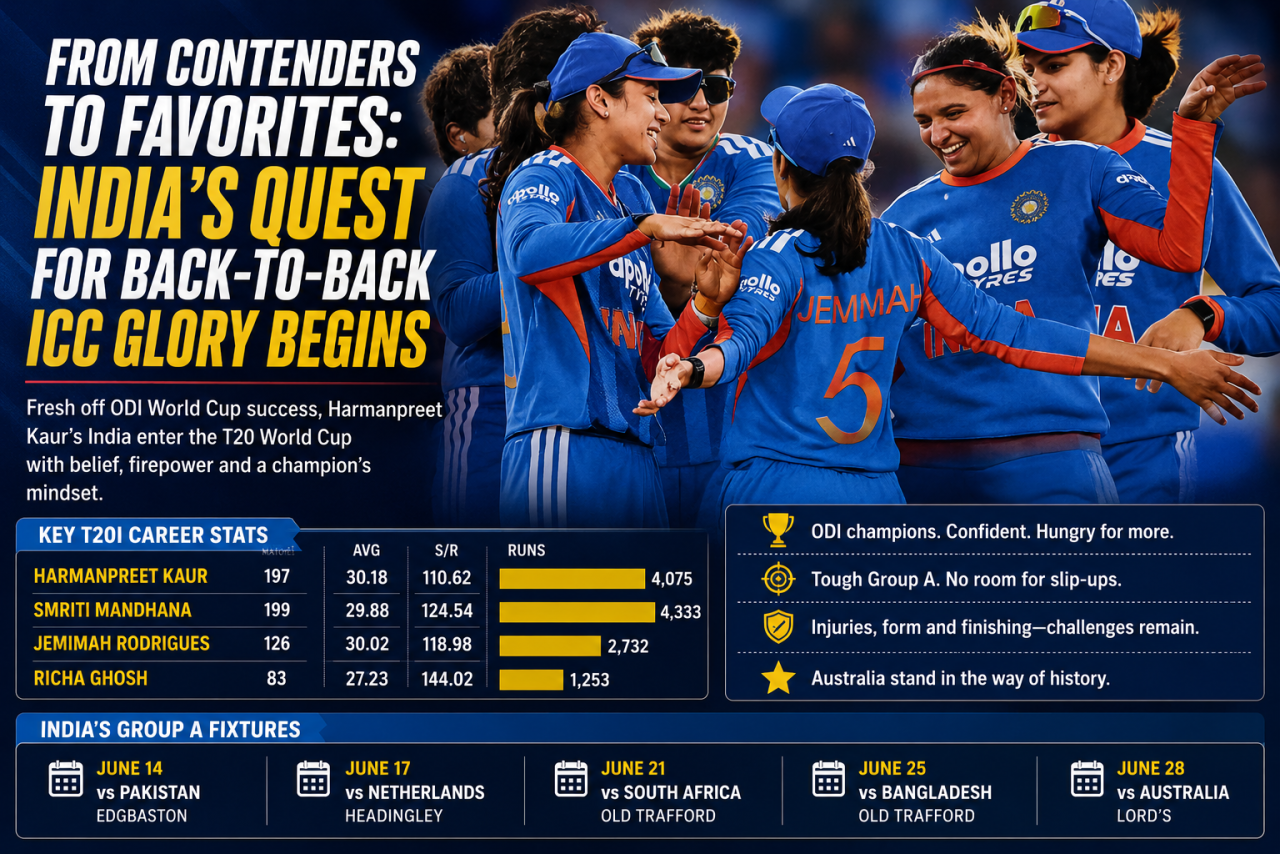
India enter the Women's T20 World Cup as favorites after their ODI World Cup triumph. Can Harmanpreet Kaur's team overcome injuries and Australia to lift another ICC trophy?
For years, the Indian women's cricket team entered global tournaments carrying the tag of talented contenders—capable of challenging the best but often falling just short when the stakes were highest. That perception has changed dramatically. Armed with the confidence of their recent ODI World Cup triumph and buoyed by a growing culture of success, India now enters the ICC Women's T20 World Cup as one of the tournament's leading favorites.
The transformation has been years in the making. Under the leadership of captain Harmanpreet Kaur and vice-captain Smriti Mandhana, India has evolved from a side seeking validation into one that expects success. The ODI World Cup victory on home soil was more than just a historic achievement; it marked a shift in mentality. Players and management alike have openly embraced the ambition of making global titles a regular occurrence rather than a rare accomplishment.
A Rocky Build-Up Raises Questions
Despite the optimism surrounding the squad, India's preparations have been far from ideal. Bilateral series defeats against South Africa and England exposed weaknesses that opponents will be eager to exploit. In the shortest format, where momentum can swing within a few deliveries, such shortcomings carry significant weight.
The injury setbacks suffered by all-rounders Amanjot Kaur and Kashvee Gautam have further complicated India's plans. Their absence has disrupted the balance of the squad, forcing the team management to rethink combinations at a crucial stage. Several senior players are also still searching for peak form, leaving India with important questions to answer before the tournament gains momentum.
Navigating the Group of Death
India's path to the knockout stages is anything but straightforward. Drawn in Group A alongside Australia, South Africa, Pakistan, Bangladesh, and the Netherlands, the team faces one of the toughest group-stage assignments in the competition.
In a format where a single defeat can dramatically alter qualification scenarios and net run rate calculations, early victories will be essential. India cannot afford a slow start.
One of the key tactical decisions revolves around the batting order. The return of Yastika Bhatia after a lengthy injury layoff has given the management greater flexibility. Her promotion to No. 3 during the England series highlighted the confidence selectors have in her ability to stabilize and accelerate innings when required.
Meanwhile, the inclusion of Bharti Fulmali is expected to strengthen the middle and lower order with much-needed power-hitting capabilities.
The Finishing Problem
While India's top order remains among the strongest in the world, concerns persist over the team's finishing ability.
Wicketkeeper-batter Richa Ghosh remains one of the most destructive players in women's T20 cricket, but recent inconsistency has raised concerns. India's lower-order depth is not as formidable as some of its rivals, making the performances of established batters even more critical.
If India is to consistently post winning totals or chase challenging targets, contributions from the top and middle order will be indispensable.
Australia Remain the Ultimate Obstacle
Any discussion about India's title chances inevitably leads to Australia.
The six-time champions continue to set the benchmark in women's cricket and remain the biggest hurdle standing between India and another ICC trophy. Their winning culture, tournament experience, and ability to thrive under pressure make them the team to beat.
For India, the challenge is no longer about proving they belong among the elite. That debate has already been settled. The real question is whether they can consistently produce their best cricket against the strongest opposition when it matters most.
A Golden Opportunity
There is every reason for optimism. India possesses world-class batters, experienced leaders, proven match-winners, and a squad that has gained invaluable exposure in high-pressure contests.
More importantly, the team now carries a champion's mindset. They are no longer entering global tournaments hoping to upset the established order—they are part of that order.
If Harmanpreet Kaur's side can navigate injuries, settle on the right combinations, and peak at the right time, India has a genuine opportunity to make history once again and secure back-to-back ICC titles.
Key T20I Career Statistics
Smriti Mandhana — 199 Matches | 4,333 Runs | Average: 29.88 | Strike Rate: 124.54
Harmanpreet Kaur — 197 Matches | 4,075 Runs | Average: 30.18 | Strike Rate: 110.62
Jemimah Rodrigues — 126 Matches | 2,732 Runs | Average: 30.02 | Strike Rate: 118.98
Richa Ghosh — 83 Matches | 1,253 Runs | Average: 27.23 | Strike Rate: 144.02
India's Group A Fixtures
- June 14: Pakistan — Edgbaston
- June 17: Netherlands — Headingley
- June 21: South Africa — Old Trafford
- June 25: Bangladesh — Old Trafford
- June 28: Australia — Lord's
For years, the Indian women's cricket team entered global tournaments carrying the tag of talented contenders—capable of challenging the best but often falling just short when the stakes were highest. That perception has changed dramatically. Armed with the confidence of their recent ODI World Cup triumph and buoyed by a growing culture of success, India now enters the ICC Women's T20 World Cup as one of the tournament's leading favorites.
The transformation has been years in the making. Under the leadership of captain Harmanpreet Kaur and vice-captain Smriti Mandhana, India has evolved from a side seeking validation into one that expects success. The ODI World Cup victory on home soil was more than just a historic achievement; it marked a shift in mentality. Players and management alike have openly embraced the ambition of making global titles a regular occurrence rather than a rare accomplishment.
A Rocky Build-Up Raises Questions
Despite the optimism surrounding the squad, India's preparations have been far from ideal. Bilateral series defeats against South Africa and England exposed weaknesses that opponents will be eager to exploit. In the shortest format, where momentum can swing within a few deliveries, such shortcomings carry significant weight.
The injury setbacks suffered by all-rounders Amanjot Kaur and Kashvee Gautam have further complicated India's plans. Their absence has disrupted the balance of the squad, forcing the team management to rethink combinations at a crucial stage. Several senior players are also still searching for peak form, leaving India with important questions to answer before the tournament gains momentum.
Navigating the Group of Death
India's path to the knockout stages is anything but straightforward. Drawn in Group A alongside Australia, South Africa, Pakistan, Bangladesh, and the Netherlands, the team faces one of the toughest group-stage assignments in the competition.
In a format where a single defeat can dramatically alter qualification scenarios and net run rate calculations, early victories will be essential. India cannot afford a slow start.
One of the key tactical decisions revolves around the batting order. The return of Yastika Bhatia after a lengthy injury layoff has given the management greater flexibility. Her promotion to No. 3 during the England series highlighted the confidence selectors have in her ability to stabilize and accelerate innings when required.
Meanwhile, the inclusion of Bharti Fulmali is expected to strengthen the middle and lower order with much-needed power-hitting capabilities.
The Finishing Problem
While India's top order remains among the strongest in the world, concerns persist over the team's finishing ability.
Wicketkeeper-batter Richa Ghosh remains one of the most destructive players in women's T20 cricket, but recent inconsistency has raised concerns. India's lower-order depth is not as formidable as some of its rivals, making the performances of established batters even more critical.
If India is to consistently post winning totals or chase challenging targets, contributions from the top and middle order will be indispensable.
Australia Remain the Ultimate Obstacle
Any discussion about India's title chances inevitably leads to Australia.
The six-time champions continue to set the benchmark in women's cricket and remain the biggest hurdle standing between India and another ICC trophy. Their winning culture, tournament experience, and ability to thrive under pressure make them the team to beat.
For India, the challenge is no longer about proving they belong among the elite. That debate has already been settled. The real question is whether they can consistently produce their best cricket against the strongest opposition when it matters most.
A Golden Opportunity
There is every reason for optimism. India possesses world-class batters, experienced leaders, proven match-winners, and a squad that has gained invaluable exposure in high-pressure contests.
More importantly, the team now carries a champion's mindset. They are no longer entering global tournaments hoping to upset the established order—they are part of that order.
If Harmanpreet Kaur's side can navigate injuries, settle on the right combinations, and peak at the right time, India has a genuine opportunity to make history once again and secure back-to-back ICC titles.
Key T20I Career Statistics
Smriti Mandhana — 199 Matches | 4,333 Runs | Average: 29.88 | Strike Rate: 124.54
Harmanpreet Kaur — 197 Matches | 4,075 Runs | Average: 30.18 | Strike Rate: 110.62
Jemimah Rodrigues — 126 Matches | 2,732 Runs | Average: 30.02 | Strike Rate: 118.98
Richa Ghosh — 83 Matches | 1,253 Runs | Average: 27.23 | Strike Rate: 144.02
India's Group A Fixtures
- June 14: Pakistan — Edgbaston
- June 17: Netherlands — Headingley
- June 21: South Africa — Old Trafford
- June 25: Bangladesh — Old Trafford
- June 28: Australia — Lord's
























Leave a Comment