
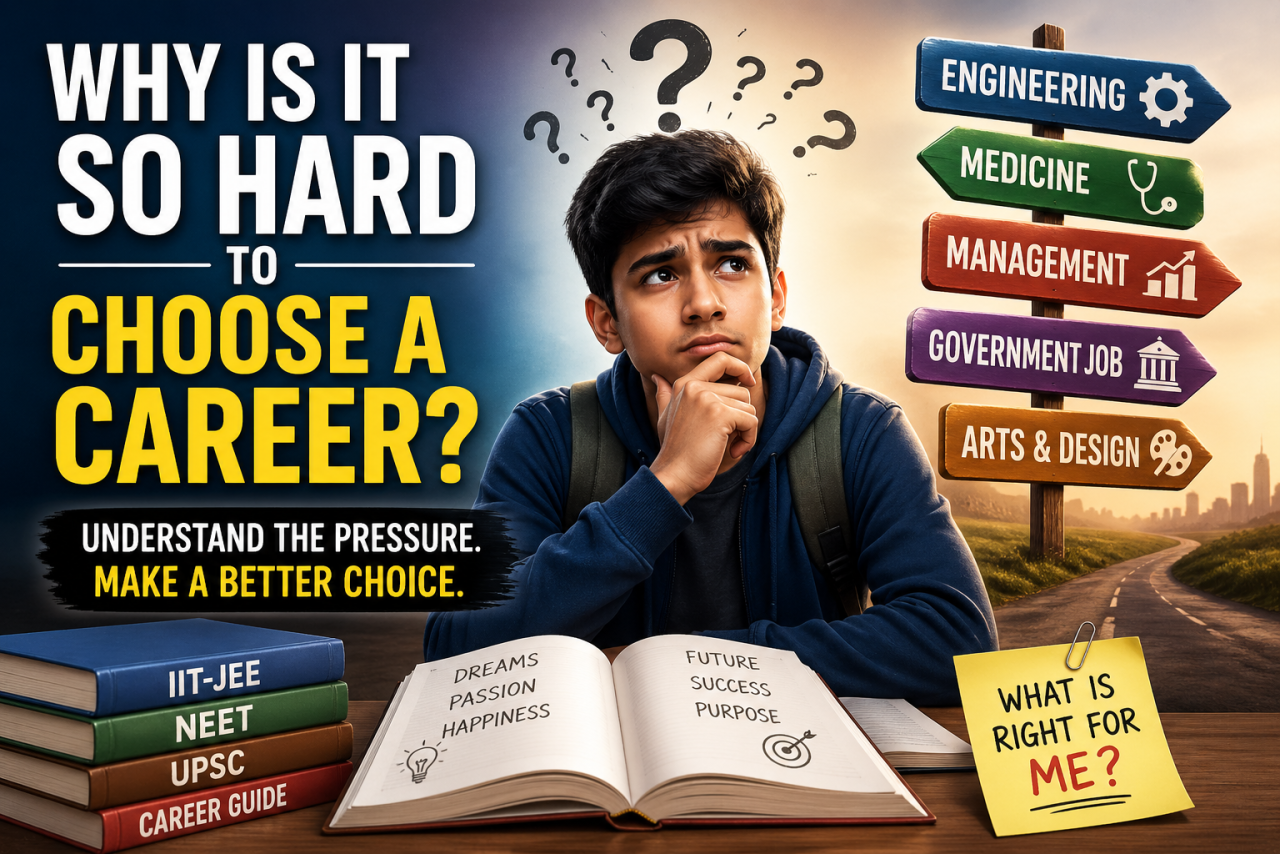
Why are children expected to decide their entire future before they even understand the world—and is this pressure doing more harm than good?
In contemporary times, choosing a career has become an increasingly difficult task for students. Children as young as 7–8 years are routinely asked, “What do you want to become in life?”—at home, in school, at social gatherings, and even in their neighborhoods. Depending on intent, this question may be a polite inquiry, a genuine curiosity, or casual teasing. Yet, regardless of intent, it often reflects a certain lack of thoughtfulness. How can a child, at such an early age, meaningfully decide their life’s direction? The expectation defies logic. Still, the question persists—and not without reason.
For decades, society has internalized the belief that the world is intensely competitive. The narrative goes: if you do not prepare early, you will fall behind. And to prepare early, you must decide early. Despite limited empirical evidence supporting this rigid approach, most people accept it unquestioningly. But while nudging children toward early career decisions, do we ever consider whether they truly understand professions like medicine, engineering, or management? The answer is clearly no. We simply follow convention. The more important question, then, is: what is the right way to prepare young minds for the future? This article attempts to offer a less conventional but constructive perspective.
There is no denying that competition for quality education and jobs has intensified globally. In India, this pressure is especially pronounced due to its vast population and limited number of high-quality institutions. Exams like IIT-JEE, NEET, CAT, and UPSC attract millions of aspirants every year, making the selection process extraordinarily competitive. The imbalance between opportunity and demand, coupled with inadequate public investment in education, exacerbates the situation.
Amid this pressure, children are often criticized for not being serious enough or for failing to make sacrifices. They are constantly exposed to motivational speeches and success stories. Quotes about dreams, struggle, and perseverance are repeated endlessly. While such messages may temporarily inspire, their impact is often short-lived. The emotional appeal works more because of the environment in which these words are delivered rather than their intrinsic depth. Once the moment passes, the effect fades.
More importantly, while we celebrate success stories, we rarely examine the underlying journeys. Was Isaac Newton destined to become a great scientist? Could anyone have predicted that Mohandas Karamchand Gandhi would emerge as Mahatma Gandhi? Or that A.P.J. Abdul Kalam would be known as the “Missile Man of India”? Gandhi’s transformation began with a defining moment in South Africa. Newton’s curiosity was sparked by an ordinary falling apple. These examples remind us that greatness often evolves from unexpected experiences rather than predefined plans.
Today’s global culture, driven by consumerism and competition, compels individuals to constantly prove their worth—first to secure a job, and then to retain it. This creates a cycle of anxiety that begins early in life. Children are repeatedly reminded of how unforgiving the world is. However, this fear-based approach does little to help them make meaningful career choices.
Parents and teachers play a crucial role in shaping a child’s worldview. Instead of instilling fear about competition, they should focus on guiding children toward self-discovery. Unfortunately, many children are pushed toward a narrow set of “secure” careers such as engineering, medicine, or business. Over time, this pressure becomes deeply ingrained, leading to anxiety and self-doubt if they fail to meet these expectations. The reality is simple: not everyone is suited for exams like IIT-JEE, NEET, CAT, or UPSC. Success in these fields requires a specific mindset, aptitude, and interest—not just hard work.
So, what should students do?
First, they must choose a path they genuinely believe in. A career chosen under pressure is likely to lead to dissatisfaction. Second, they should learn to enjoy the process rather than view it as a burden. This makes the initial decision even more important. Third, consistency is key. Studies suggest that sustained effort over even six months can significantly accelerate progress compared to inconsistent attempts. Consistency not only builds competence but also reduces regret.
Additionally, commitment distinguishes clarity from confusion. When individuals are truly committed, they are less likely to feel lost or overwhelmed. Finally, passion remains a powerful driver. Those who excel—whether in sports, science, or the arts—often do so because they love what they do. Their work is not just an obligation; it is an expression of who they are.
Choosing a career is not about predicting the future at an early age. It is about exploring interests, developing skills, and making informed decisions over time. When students align their choices with their beliefs and commit to them wholeheartedly, even the toughest challenges begin to feel manageable.
Opinion expressed by:
Dr. Md. Intekhab Alam Khan
Assistant Professor
Department of Political Science
Nazir Ajmal Memorial College of Education (Hojai), Assam
In contemporary times, choosing a career has become an increasingly difficult task for students. Children as young as 7–8 years are routinely asked, “What do you want to become in life?”—at home, in school, at social gatherings, and even in their neighborhoods. Depending on intent, this question may be a polite inquiry, a genuine curiosity, or casual teasing. Yet, regardless of intent, it often reflects a certain lack of thoughtfulness. How can a child, at such an early age, meaningfully decide their life’s direction? The expectation defies logic. Still, the question persists—and not without reason.
For decades, society has internalized the belief that the world is intensely competitive. The narrative goes: if you do not prepare early, you will fall behind. And to prepare early, you must decide early. Despite limited empirical evidence supporting this rigid approach, most people accept it unquestioningly. But while nudging children toward early career decisions, do we ever consider whether they truly understand professions like medicine, engineering, or management? The answer is clearly no. We simply follow convention. The more important question, then, is: what is the right way to prepare young minds for the future? This article attempts to offer a less conventional but constructive perspective.
There is no denying that competition for quality education and jobs has intensified globally. In India, this pressure is especially pronounced due to its vast population and limited number of high-quality institutions. Exams like IIT-JEE, NEET, CAT, and UPSC attract millions of aspirants every year, making the selection process extraordinarily competitive. The imbalance between opportunity and demand, coupled with inadequate public investment in education, exacerbates the situation.
Amid this pressure, children are often criticized for not being serious enough or for failing to make sacrifices. They are constantly exposed to motivational speeches and success stories. Quotes about dreams, struggle, and perseverance are repeated endlessly. While such messages may temporarily inspire, their impact is often short-lived. The emotional appeal works more because of the environment in which these words are delivered rather than their intrinsic depth. Once the moment passes, the effect fades.
More importantly, while we celebrate success stories, we rarely examine the underlying journeys. Was Isaac Newton destined to become a great scientist? Could anyone have predicted that Mohandas Karamchand Gandhi would emerge as Mahatma Gandhi? Or that A.P.J. Abdul Kalam would be known as the “Missile Man of India”? Gandhi’s transformation began with a defining moment in South Africa. Newton’s curiosity was sparked by an ordinary falling apple. These examples remind us that greatness often evolves from unexpected experiences rather than predefined plans.
Today’s global culture, driven by consumerism and competition, compels individuals to constantly prove their worth—first to secure a job, and then to retain it. This creates a cycle of anxiety that begins early in life. Children are repeatedly reminded of how unforgiving the world is. However, this fear-based approach does little to help them make meaningful career choices.
Parents and teachers play a crucial role in shaping a child’s worldview. Instead of instilling fear about competition, they should focus on guiding children toward self-discovery. Unfortunately, many children are pushed toward a narrow set of “secure” careers such as engineering, medicine, or business. Over time, this pressure becomes deeply ingrained, leading to anxiety and self-doubt if they fail to meet these expectations. The reality is simple: not everyone is suited for exams like IIT-JEE, NEET, CAT, or UPSC. Success in these fields requires a specific mindset, aptitude, and interest—not just hard work.
So, what should students do?
First, they must choose a path they genuinely believe in. A career chosen under pressure is likely to lead to dissatisfaction. Second, they should learn to enjoy the process rather than view it as a burden. This makes the initial decision even more important. Third, consistency is key. Studies suggest that sustained effort over even six months can significantly accelerate progress compared to inconsistent attempts. Consistency not only builds competence but also reduces regret.
Additionally, commitment distinguishes clarity from confusion. When individuals are truly committed, they are less likely to feel lost or overwhelmed. Finally, passion remains a powerful driver. Those who excel—whether in sports, science, or the arts—often do so because they love what they do. Their work is not just an obligation; it is an expression of who they are.
Choosing a career is not about predicting the future at an early age. It is about exploring interests, developing skills, and making informed decisions over time. When students align their choices with their beliefs and commit to them wholeheartedly, even the toughest challenges begin to feel manageable.
Opinion expressed by:
Dr. Md. Intekhab Alam Khan
Assistant Professor
Department of Political Science
Nazir Ajmal Memorial College of Education (Hojai), Assam


























Leave a Comment