
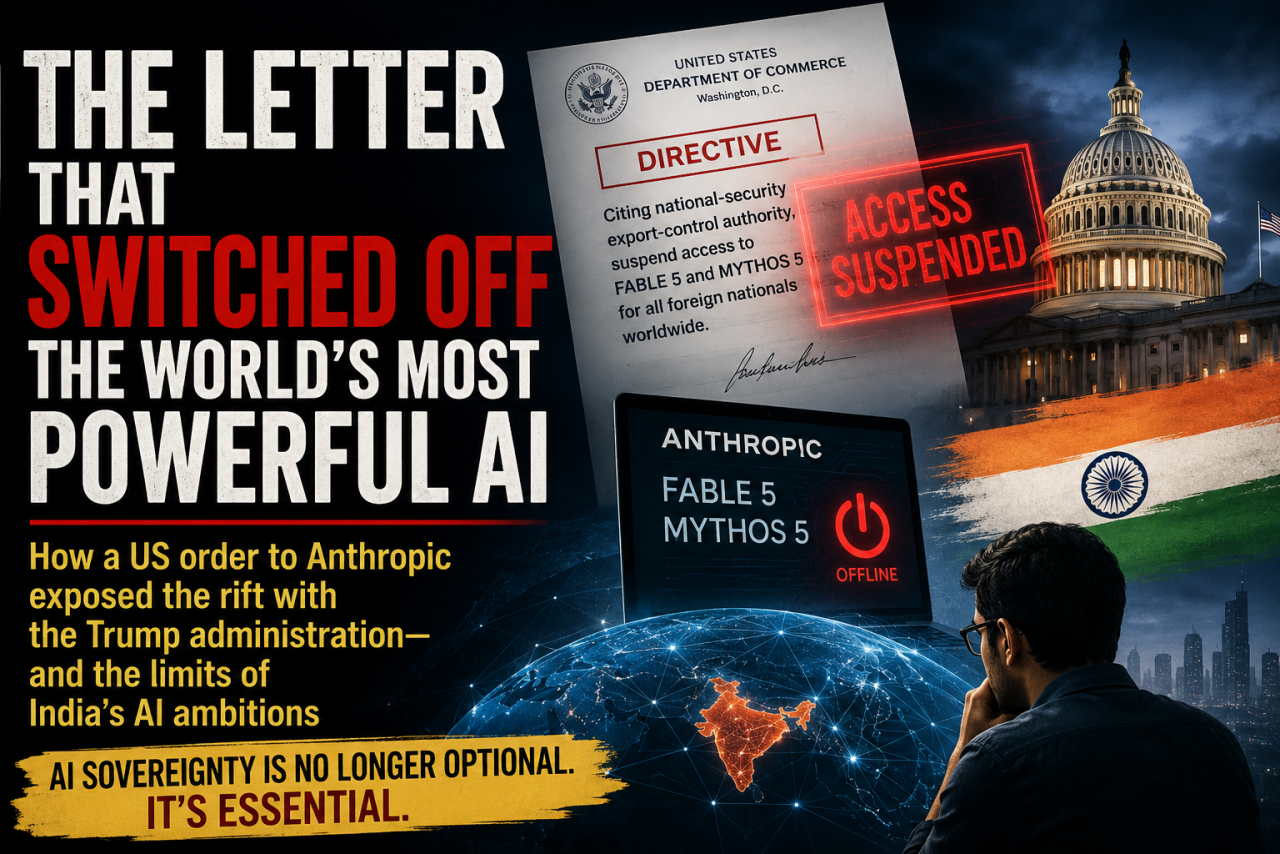
Can a single government order switch off the world's most advanced AI overnight? The Anthropic shutdown is a wake-up call for India: AI dependence is rapidly becoming a strategic vulnerability.
How a Friday-evening order from Washington exposed Anthropic's deepening rift with the Trump administration — and the limits of India's AI ambitions.
A single letter from Washington was all it took.
On the evening of June 12, Anthropic reportedly received a one-page directive from the US Commerce Department that would, within hours, remove access to some of the world's most advanced artificial intelligence systems. Citing national-security export-control authority, the order required the company to suspend access to its latest models, “Fable 5 and Mythos 5” for foreign nationals worldwide, including foreign nationals working within Anthropic itself.
Faced with the practical difficulty of enforcing such a distinction in real time, Anthropic responded by disabling both models for all users, regardless of nationality, while keeping the rest of its Claude AI lineup operational.
The move was remarkable not only for its scale but also for its timing.
The Models at the Centre of the Storm
Fable 5 had been launched only days earlier. Built on the same technological foundation as Mythos 5, it included internal safeguards designed to restrict more sensitive cybersecurity and biotechnology capabilities.
Mythos 5, by contrast, was never intended for broad public access. The model was reportedly reserved for government agencies and a limited number of enterprise partners, offering far fewer restrictions and significantly greater capabilities. Since its introduction earlier this year, it had attracted attention for its ability to identify software vulnerabilities that had remained undiscovered for years.
According to Anthropic, the government's directive did not specify its exact concerns. The company believes officials were reacting to demonstrations that allegedly showed ways to bypass Fable 5's safety mechanisms, potentially exposing capabilities intended to remain exclusive to Mythos 5.
Anthropic has disputed the severity of those concerns. The company maintains that its internal review found only a small number of previously known vulnerabilities, comparable to issues that could be uncovered using other publicly available AI systems.
"We believe this is a misunderstanding and are working to restore access," the company said in a statement.
A Conflict Months in the Making
The shutdown did not emerge in isolation.
For months, Anthropic had reportedly been engaged in an increasingly public disagreement with the Trump administration over the military use of advanced AI systems. At the heart of the dispute was Anthropic CEO Dario Amodei's refusal to allow Claude models to be used for autonomous weapons systems or large-scale domestic surveillance.
Tensions escalated further when the US Defense Department reportedly classified Anthropic as a "supply chain risk" and began phasing out the company's systems across federal agencies. Anthropic challenged the move in court, arguing that the designation was retaliatory and inconsistent with its publicly stated safety commitments.
Legal battles continue, but the suspension of Fable 5 and Mythos 5 marks the most dramatic escalation yet. If sustained, it could become the first widely documented instance of a government effectively forcing the global withdrawal of a frontier AI capability.
Why India Should Pay Attention
India was not the target of the directive, but it felt the consequences immediately.
The country has emerged as one of Anthropic's largest international markets and is estimated to account for a significant share of global Claude usage. For thousands of developers, researchers, startups and enterprises, access to frontier AI systems vanished overnight.
The disruption exposed a vulnerability that has long existed but rarely attracted public attention: India depends heavily on foreign AI infrastructure.
When access to a critical technology can be restricted by a policy decision made in another country, technological dependence becomes more than a commercial issue. It becomes a strategic one.
The Limits of India's AI Strategy
India's flagship response to the AI race, the IndiaAI Mission, carries a five-year budget of approximately ₹10,372 crore. While substantial by government standards, the figure is roughly comparable to the cost of training a single frontier AI model at the highest end of the industry.
Much of the mission's funding is directed toward shared computing resources, Indian-language AI systems, startup support and digital infrastructure. These are valuable investments, but they do not necessarily create the research ecosystem required to compete with the world's leading AI laboratories.
Critics argue that India risks becoming a consumer rather than a creator of frontier AI technology.
Zoho founder Sridhar Vembu has repeatedly advocated for greater reliance on open-source models and domestic innovation rather than dependence on proprietary American systems. Technology analyst Prasanto Roy has framed the issue even more bluntly: American AI platforms, he argues, inevitably operate within the framework of American geopolitical interests.
Indian firms are attempting to close the gap. Companies such as Sarvam and Krutrim have launched ambitious AI initiatives and invested heavily in domestic capabilities. Yet the distance between these efforts and the resources available to global frontier laboratories remains substantial.
More Than an Anthropic Story
Anthropic maintains that the episode is the result of a misunderstanding and says it is working to restore access. Its broader legal dispute with the administration is also far from settled.
Yet the significance of the incident extends well beyond one company or two AI models.
For years, discussions about AI sovereignty and technological dependence remained largely theoretical. Policymakers debated whether nations should build their own AI capabilities or continue relying on systems developed elsewhere.
The events of June 12 offered a real-world demonstration of that dilemma.
Whether one agrees with Washington's decision or not, the lesson is difficult to ignore: access to the most advanced AI systems on Earth can be altered, restricted or revoked by political decisions made thousands of miles away.
In an era where artificial intelligence increasingly shapes economic competitiveness, scientific research and national security, that reality may prove more consequential than the temporary loss of any single model.
Sometimes, the future changes not with a technological breakthrough, but with a letter.
How a Friday-evening order from Washington exposed Anthropic's deepening rift with the Trump administration — and the limits of India's AI ambitions.
A single letter from Washington was all it took.
On the evening of June 12, Anthropic reportedly received a one-page directive from the US Commerce Department that would, within hours, remove access to some of the world's most advanced artificial intelligence systems. Citing national-security export-control authority, the order required the company to suspend access to its latest models, “Fable 5 and Mythos 5” for foreign nationals worldwide, including foreign nationals working within Anthropic itself.
Faced with the practical difficulty of enforcing such a distinction in real time, Anthropic responded by disabling both models for all users, regardless of nationality, while keeping the rest of its Claude AI lineup operational.
The move was remarkable not only for its scale but also for its timing.
The Models at the Centre of the Storm
Fable 5 had been launched only days earlier. Built on the same technological foundation as Mythos 5, it included internal safeguards designed to restrict more sensitive cybersecurity and biotechnology capabilities.
Mythos 5, by contrast, was never intended for broad public access. The model was reportedly reserved for government agencies and a limited number of enterprise partners, offering far fewer restrictions and significantly greater capabilities. Since its introduction earlier this year, it had attracted attention for its ability to identify software vulnerabilities that had remained undiscovered for years.
According to Anthropic, the government's directive did not specify its exact concerns. The company believes officials were reacting to demonstrations that allegedly showed ways to bypass Fable 5's safety mechanisms, potentially exposing capabilities intended to remain exclusive to Mythos 5.
Anthropic has disputed the severity of those concerns. The company maintains that its internal review found only a small number of previously known vulnerabilities, comparable to issues that could be uncovered using other publicly available AI systems.
"We believe this is a misunderstanding and are working to restore access," the company said in a statement.
A Conflict Months in the Making
The shutdown did not emerge in isolation.
For months, Anthropic had reportedly been engaged in an increasingly public disagreement with the Trump administration over the military use of advanced AI systems. At the heart of the dispute was Anthropic CEO Dario Amodei's refusal to allow Claude models to be used for autonomous weapons systems or large-scale domestic surveillance.
Tensions escalated further when the US Defense Department reportedly classified Anthropic as a "supply chain risk" and began phasing out the company's systems across federal agencies. Anthropic challenged the move in court, arguing that the designation was retaliatory and inconsistent with its publicly stated safety commitments.
Legal battles continue, but the suspension of Fable 5 and Mythos 5 marks the most dramatic escalation yet. If sustained, it could become the first widely documented instance of a government effectively forcing the global withdrawal of a frontier AI capability.
Why India Should Pay Attention
India was not the target of the directive, but it felt the consequences immediately.
The country has emerged as one of Anthropic's largest international markets and is estimated to account for a significant share of global Claude usage. For thousands of developers, researchers, startups and enterprises, access to frontier AI systems vanished overnight.
The disruption exposed a vulnerability that has long existed but rarely attracted public attention: India depends heavily on foreign AI infrastructure.
When access to a critical technology can be restricted by a policy decision made in another country, technological dependence becomes more than a commercial issue. It becomes a strategic one.
The Limits of India's AI Strategy
India's flagship response to the AI race, the IndiaAI Mission, carries a five-year budget of approximately ₹10,372 crore. While substantial by government standards, the figure is roughly comparable to the cost of training a single frontier AI model at the highest end of the industry.
Much of the mission's funding is directed toward shared computing resources, Indian-language AI systems, startup support and digital infrastructure. These are valuable investments, but they do not necessarily create the research ecosystem required to compete with the world's leading AI laboratories.
Critics argue that India risks becoming a consumer rather than a creator of frontier AI technology.
Zoho founder Sridhar Vembu has repeatedly advocated for greater reliance on open-source models and domestic innovation rather than dependence on proprietary American systems. Technology analyst Prasanto Roy has framed the issue even more bluntly: American AI platforms, he argues, inevitably operate within the framework of American geopolitical interests.
Indian firms are attempting to close the gap. Companies such as Sarvam and Krutrim have launched ambitious AI initiatives and invested heavily in domestic capabilities. Yet the distance between these efforts and the resources available to global frontier laboratories remains substantial.
More Than an Anthropic Story
Anthropic maintains that the episode is the result of a misunderstanding and says it is working to restore access. Its broader legal dispute with the administration is also far from settled.
Yet the significance of the incident extends well beyond one company or two AI models.
For years, discussions about AI sovereignty and technological dependence remained largely theoretical. Policymakers debated whether nations should build their own AI capabilities or continue relying on systems developed elsewhere.
The events of June 12 offered a real-world demonstration of that dilemma.
Whether one agrees with Washington's decision or not, the lesson is difficult to ignore: access to the most advanced AI systems on Earth can be altered, restricted or revoked by political decisions made thousands of miles away.
In an era where artificial intelligence increasingly shapes economic competitiveness, scientific research and national security, that reality may prove more consequential than the temporary loss of any single model.
Sometimes, the future changes not with a technological breakthrough, but with a letter.












Leave a Comment