
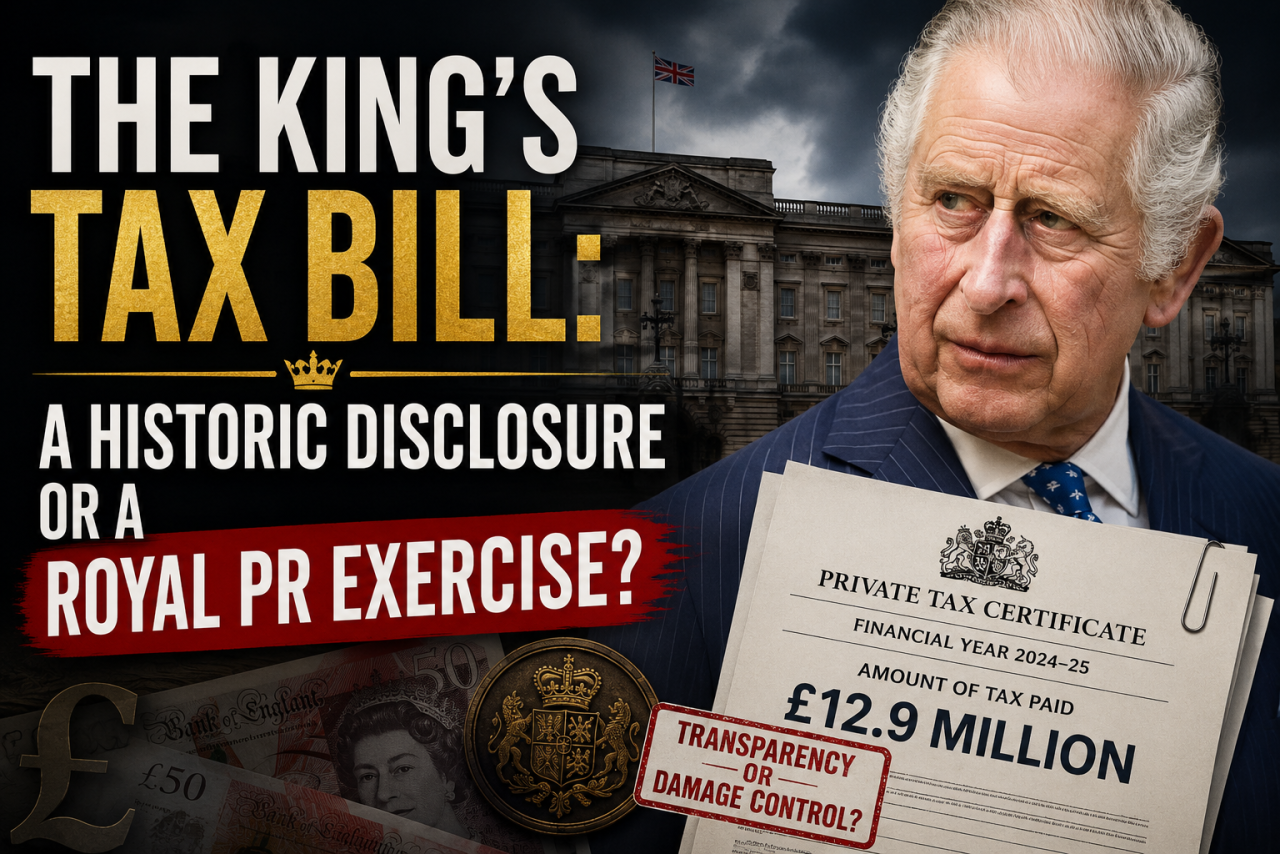
For the first time in British history, a reigning monarch has revealed his personal tax bill. But does the disclosure mark a new era of royal transparency—or simply a masterclass in reputation management?
For more than a thousand years, British monarchs inhabited a financial world unlike that of any other citizen. They stood above taxation, beyond routine public scrutiny, and largely insulated from the questions ordinary Britons confront every tax season. That tradition shifted, at least in part, on June 25, 2026, when King Charles III became the first reigning British monarch to publicly disclose his personal tax bill.
The figure is striking. Buckingham Palace revealed that the King paid £12.9 million in tax during the 2024–25 financial year. It also disclosed that he paid £11.7 million the previous year, bringing his total voluntary tax payments to more than £30 million since ascending the throne in September 2022. Prince William joined the transparency initiative, voluntarily paying more than £20 million in tax since inheriting the title of Prince of Wales.
At first glance, the announcement appears to mark a modern monarchy embracing openness and accountability. Yet a closer look suggests a more complicated story—one that raises questions not only about transparency but also about reputation management.
Where the King's Wealth Comes From
To understand the significance of the tax disclosure, it is necessary to understand the King's sources of income.
The largest share of his private income comes from the Duchy of Lancaster, a centuries-old portfolio of farmland, commercial property, and other assets valued at hundreds of millions of pounds. The estate generated around £25 million for the monarch last year. Beyond the duchy, King Charles owns the private estates of Balmoral and Sandringham, along with a personal investment portfolio managed on a discretionary basis, the value of which remains undisclosed.
Prince William's principal income comes from the Duchy of Cornwall, which owns around 130,000 acres of land and reported profits of £22.9 million last year.
These are substantial financial interests. What makes the King's tax payment historically significant, however, is that it was not legally required.
Under British constitutional law, statutes imposing income tax, capital gains tax, and inheritance tax do not automatically bind the Sovereign. In other words, the King is under no legal obligation to pay these taxes. His payments are entirely voluntary.
Queen Elizabeth II began paying taxes voluntarily in 1993, but the Palace never disclosed the amounts publicly. King Charles has now broken with that longstanding convention by placing an actual figure before the public.
The Andrew Factor
Buckingham Palace has described the disclosure as part of the King's effort to promote greater public understanding and accountability. While that explanation may be genuine, the timing is difficult to ignore.
The announcement follows growing public and parliamentary demands for greater financial transparency after revelations involving the King's younger brother, Prince Andrew.
Now known as Andrew Mountbatten-Windsor after being stripped of his royal titles in 2025, Andrew is under investigation for alleged misconduct in public office connected to his relationship with convicted sex offender Jeffrey Epstein. Reports that Andrew occupied a large royal residence rent-free and questions surrounding the King's use of Privy Purse funds prompted the House of Commons Public Accounts Committee to examine aspects of royal financial arrangements.
Against that backdrop, the disclosure appears to serve another purpose: distancing the institution from the controversy surrounding Andrew.
The message from Buckingham Palace is unmistakable. Charles is not Andrew. Charles pays his taxes.
Transparency—or Only Part of the Story?
Not everyone is convinced that the disclosure represents genuine transparency.
Graham Smith, chief executive of the anti-monarchy campaign group Republic, argues that publishing a tax figure without revealing the underlying income offers only a partial picture.
His criticism raises an important question.
The public now knows that King Charles paid £12.9 million in tax. What remains unknown is how much he actually earned, what deductions were claimed, how much income came from investments, what proportion of the Duchy of Lancaster's surplus was treated as official expenditure, and the overall scale of the King's private wealth.
Without those details, it is impossible to judge the true significance of the headline figure.
The broader financial picture also deserves attention.
Last year, Buckingham Palace published a 159-page report detailing how it spent the £86.3 million Sovereign Grant provided by taxpayers to fund the monarchy's official duties. Viewed alongside that public funding, the King's voluntary tax payments become only one element of a much larger financial relationship between the monarchy and the British state.
There is also another issue that remains untouched by the announcement.
Assets passed from one monarch to the next are exempt from inheritance tax. Vast estates, landholdings, artworks, and other royal assets accumulated over centuries can therefore transfer between sovereigns without attracting the inheritance taxes paid by ordinary British families.
The King's tax disclosure does nothing to alter that longstanding constitutional privilege.
A Monarchy Under Pressure
Ultimately, this episode says as much about the monarchy's future as it does about its finances.
The tax announcement coincided with another symbolic decision: King Charles confirmed that he will not take up residence in Buckingham Palace once its £369 million refurbishment is complete. Together, these decisions suggest an institution seeking to project a more modest, accountable, and modern image.
There is genuine significance in the King's decision to disclose his tax payments. For an institution that has historically operated with little obligation to explain its finances, even partial openness represents a meaningful change.
But transparency requires more than a single headline figure.
A tax bill, without the broader context of income, wealth, assets, exemptions, and financial arrangements, risks becoming a public relations exercise rather than full public accountability.
The British public funds the monarchy through taxation and the Sovereign Grant. It is therefore reasonable for citizens to ask not only how much the King paid in tax, but also how the wider architecture of royal wealth operates—its private investments, inherited estates, constitutional exemptions, and long-standing financial privileges.
King Charles has opened the door to greater transparency.
Whether he chooses to open it fully may determine how the modern monarchy earns public trust in the years ahead.
For more than a thousand years, British monarchs inhabited a financial world unlike that of any other citizen. They stood above taxation, beyond routine public scrutiny, and largely insulated from the questions ordinary Britons confront every tax season. That tradition shifted, at least in part, on June 25, 2026, when King Charles III became the first reigning British monarch to publicly disclose his personal tax bill.
The figure is striking. Buckingham Palace revealed that the King paid £12.9 million in tax during the 2024–25 financial year. It also disclosed that he paid £11.7 million the previous year, bringing his total voluntary tax payments to more than £30 million since ascending the throne in September 2022. Prince William joined the transparency initiative, voluntarily paying more than £20 million in tax since inheriting the title of Prince of Wales.
At first glance, the announcement appears to mark a modern monarchy embracing openness and accountability. Yet a closer look suggests a more complicated story—one that raises questions not only about transparency but also about reputation management.
Where the King's Wealth Comes From
To understand the significance of the tax disclosure, it is necessary to understand the King's sources of income.
The largest share of his private income comes from the Duchy of Lancaster, a centuries-old portfolio of farmland, commercial property, and other assets valued at hundreds of millions of pounds. The estate generated around £25 million for the monarch last year. Beyond the duchy, King Charles owns the private estates of Balmoral and Sandringham, along with a personal investment portfolio managed on a discretionary basis, the value of which remains undisclosed.
Prince William's principal income comes from the Duchy of Cornwall, which owns around 130,000 acres of land and reported profits of £22.9 million last year.
These are substantial financial interests. What makes the King's tax payment historically significant, however, is that it was not legally required.
Under British constitutional law, statutes imposing income tax, capital gains tax, and inheritance tax do not automatically bind the Sovereign. In other words, the King is under no legal obligation to pay these taxes. His payments are entirely voluntary.
Queen Elizabeth II began paying taxes voluntarily in 1993, but the Palace never disclosed the amounts publicly. King Charles has now broken with that longstanding convention by placing an actual figure before the public.
The Andrew Factor
Buckingham Palace has described the disclosure as part of the King's effort to promote greater public understanding and accountability. While that explanation may be genuine, the timing is difficult to ignore.
The announcement follows growing public and parliamentary demands for greater financial transparency after revelations involving the King's younger brother, Prince Andrew.
Now known as Andrew Mountbatten-Windsor after being stripped of his royal titles in 2025, Andrew is under investigation for alleged misconduct in public office connected to his relationship with convicted sex offender Jeffrey Epstein. Reports that Andrew occupied a large royal residence rent-free and questions surrounding the King's use of Privy Purse funds prompted the House of Commons Public Accounts Committee to examine aspects of royal financial arrangements.
Against that backdrop, the disclosure appears to serve another purpose: distancing the institution from the controversy surrounding Andrew.
The message from Buckingham Palace is unmistakable. Charles is not Andrew. Charles pays his taxes.
Transparency—or Only Part of the Story?
Not everyone is convinced that the disclosure represents genuine transparency.
Graham Smith, chief executive of the anti-monarchy campaign group Republic, argues that publishing a tax figure without revealing the underlying income offers only a partial picture.
His criticism raises an important question.
The public now knows that King Charles paid £12.9 million in tax. What remains unknown is how much he actually earned, what deductions were claimed, how much income came from investments, what proportion of the Duchy of Lancaster's surplus was treated as official expenditure, and the overall scale of the King's private wealth.
Without those details, it is impossible to judge the true significance of the headline figure.
The broader financial picture also deserves attention.
Last year, Buckingham Palace published a 159-page report detailing how it spent the £86.3 million Sovereign Grant provided by taxpayers to fund the monarchy's official duties. Viewed alongside that public funding, the King's voluntary tax payments become only one element of a much larger financial relationship between the monarchy and the British state.
There is also another issue that remains untouched by the announcement.
Assets passed from one monarch to the next are exempt from inheritance tax. Vast estates, landholdings, artworks, and other royal assets accumulated over centuries can therefore transfer between sovereigns without attracting the inheritance taxes paid by ordinary British families.
The King's tax disclosure does nothing to alter that longstanding constitutional privilege.
A Monarchy Under Pressure
Ultimately, this episode says as much about the monarchy's future as it does about its finances.
The tax announcement coincided with another symbolic decision: King Charles confirmed that he will not take up residence in Buckingham Palace once its £369 million refurbishment is complete. Together, these decisions suggest an institution seeking to project a more modest, accountable, and modern image.
There is genuine significance in the King's decision to disclose his tax payments. For an institution that has historically operated with little obligation to explain its finances, even partial openness represents a meaningful change.
But transparency requires more than a single headline figure.
A tax bill, without the broader context of income, wealth, assets, exemptions, and financial arrangements, risks becoming a public relations exercise rather than full public accountability.
The British public funds the monarchy through taxation and the Sovereign Grant. It is therefore reasonable for citizens to ask not only how much the King paid in tax, but also how the wider architecture of royal wealth operates—its private investments, inherited estates, constitutional exemptions, and long-standing financial privileges.
King Charles has opened the door to greater transparency.
Whether he chooses to open it fully may determine how the modern monarchy earns public trust in the years ahead.
























Leave a Comment