
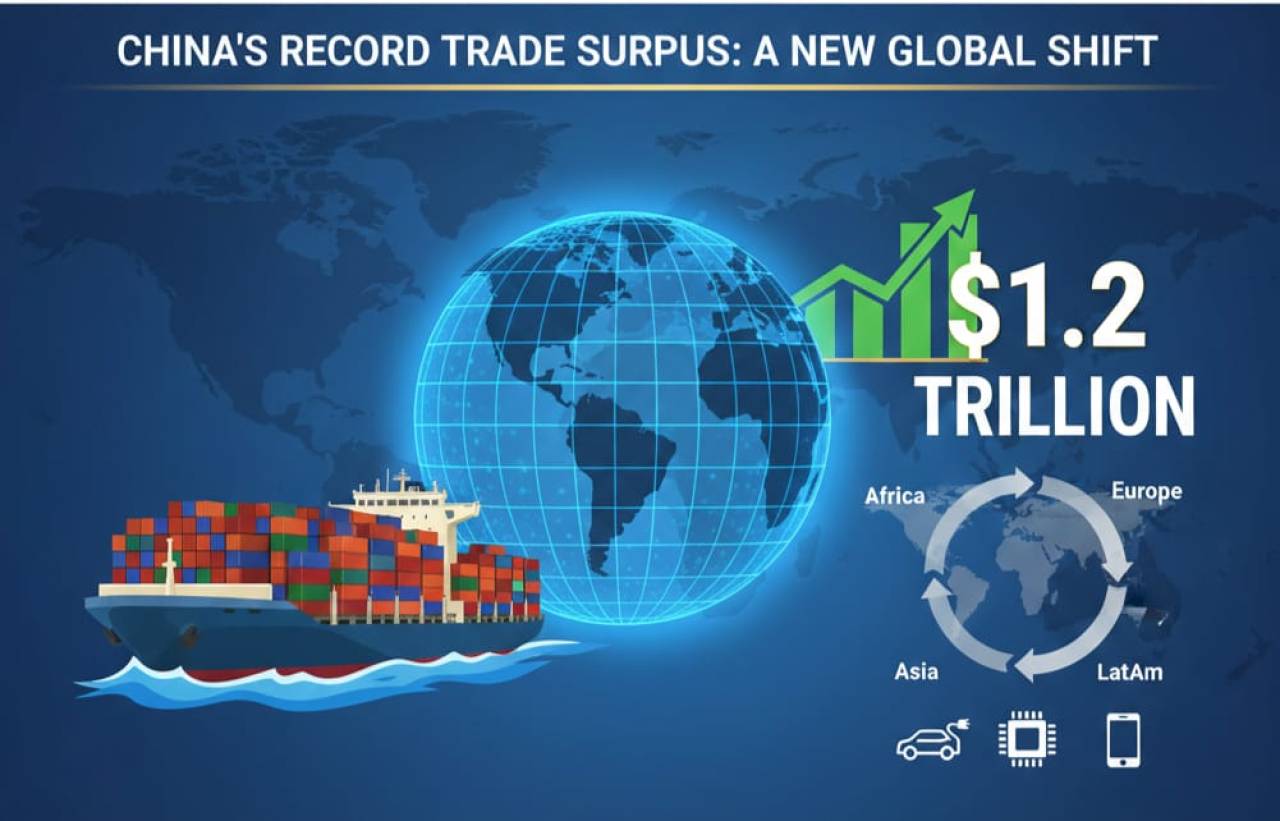
A single number, $1.2 trillion, now defines how China quietly reshaped the balance of global trade in 2025.
In the contemporary world, the integration of national economies through foreign trade and investment has created a highly interconnected global market. According to recent economic data from 2025, China has achieved a historic milestone in its international trade relations. The country reported a record trade surplus of nearly $1.2 trillion, an increase from $992 billion in the previous year. To put this in perspective, this surplus alone is equivalent to the total economic output (GDP) of a top-20 global economy.
Understanding the Trade Surplus
In economic terms, a trade surplus occurs when the value of a country's exports (goods sold to other nations) exceeds the value of its imports (goods bought from other nations). In 2025, China's total exports rose to $3.77 trillion, while its imports remained stagnant at $2.58 trillion. This widening gap resulted in the historic $1.2 trillion surplus.
This phenomenon is largely driven by a process of market integration. As some traditional markets become less accessible due to trade barriers and tariffs, producers look for new opportunities in different regions. This is exactly what has transpired over the last year.
The Shift in Global Partners
A significant change has been observed in the direction of China’s foreign trade. Due to escalating trade tensions and new tariffs, China’s exports to the United States fell sharply by 20%. By the end of 2025, the U.S. share of China’s exports hit a record low of 11%.
However, globalisation has allowed China to diversify its trading partners. Instead of relying solely on Western markets, there has been a rapid expansion into the Global South:
- Africa: Trade increased by a remarkable 26%.
- Southeast Asia: Exports grew by 13%.
- Latin America: A steady growth of 7% was recorded.
- European Union: Despite various challenges, exports grew by 8%.
Evolution of Export Categories
The nature of goods being traded is also changing. While China was once known for low-end manufacturing like toys and clothing, it has now shifted toward higher-value manufacturing. Key export categories now include:
- Automobiles: Exports of electric and plug-in hybrid vehicles surged by 21%, exceeding 7 million units.
- Electronics: High-tech electrical equipment and semiconductors saw a growth of over 8%.
- Advanced Technology: A focus on chips and specialized machinery is replacing older, labor-intensive industries.
Challenges and Future Outlook
While a record surplus indicates strong manufacturing and export capabilities, it also highlights certain vulnerabilities. Economists note that China is “leaning” heavily on exports because domestic consumer demand at home remains weak. This is often linked to a downturn in the internal property market.
Looking ahead to 2026, experts predict that while exports will remain a pillar of growth, there are significant risks. These include protectionist measures from other countries who may feel that their own domestic industries are threatened by the large volume of Chinese goods. This pushback is a reminder that in a globalised world, the economic health of one nation is deeply linked to the policies and stability of its trading partners.



























Leave a Comment