
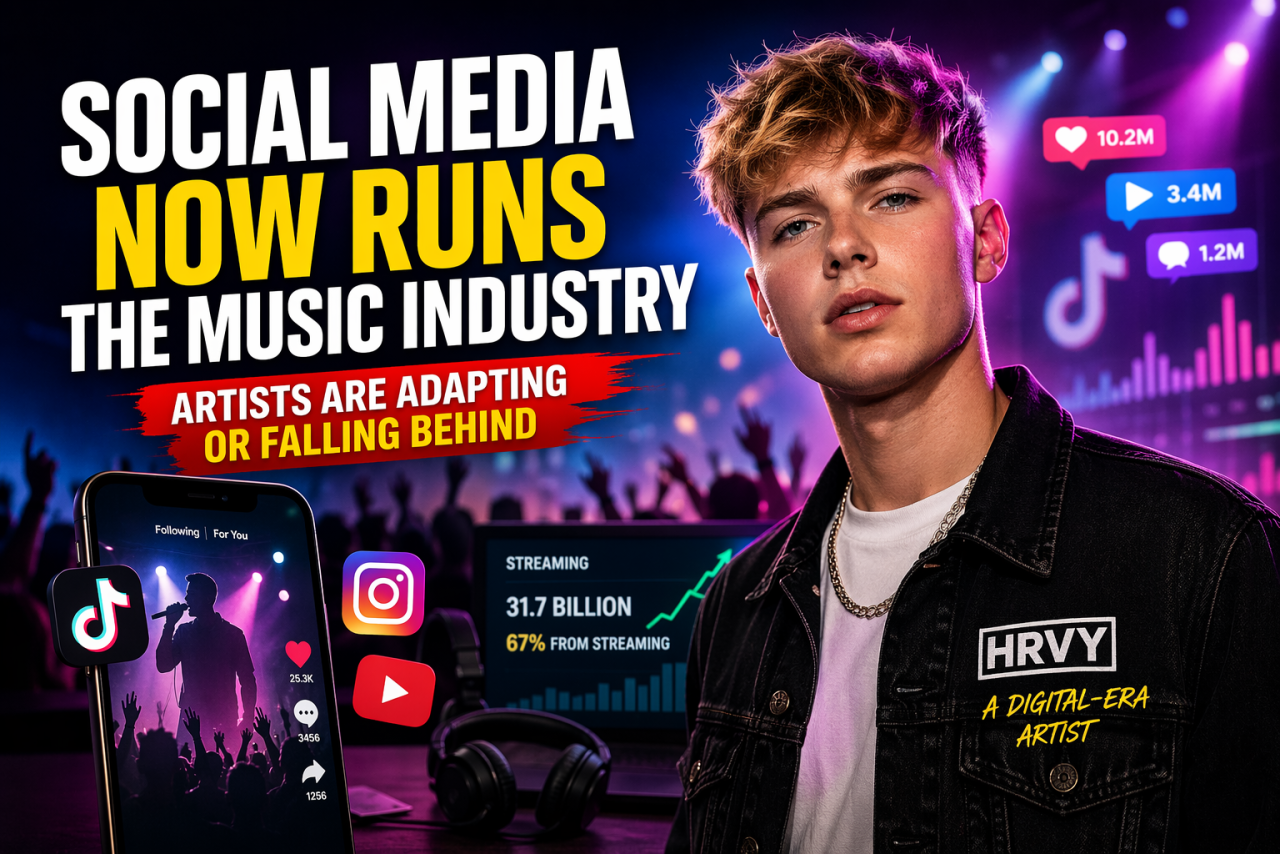
Today, the success of music depends heavily on how it performs on social media platforms.
British pop sensation HRVY recently shared a blunt observation that social media now runs the music industry. This is not just a passing remark. It reflects a deep transformation in how music is discovered, promoted, and consumed across the world.
At just 27, HRVY has lived through this shift. He began as a teenager posting covers on YouTube and went on to build a global fanbase with millions of followers. His journey mirrors a larger reality that digital platforms have become the new gatekeepers of fame.
The Shift from Labels to Algorithms
For decades, record labels controlled the industry. They decided which artists got studio backing, radio play, and visibility. Today, that control has weakened. In its place, algorithms and audience behavior dictate success.
Platforms like YouTube, TikTok and Instagram now determine what trends and what fades away. A short clip—sometimes just 15 seconds—can launch an unknown artist into global charts overnight.
Industry data supports this shift. In 2025, global recorded music revenues reached around $31.7 billion, with more than 67% coming from streaming. Much of that streaming is driven by viral moments on social media.
HRVY acknowledges this reality. He believes social media is now the most powerful tool for gaining attention. But he also admits that using it effectively requires strategy. Early in his career, his content lacked direction. Over time, he has become more intentional.
His recent single "Lie To Me" reflects that evolution. It carries more depth and authenticity, showing a move away from content-for-content’s-sake toward meaningful artistic expression.
Bridging Cultures in a Digital World
One of the biggest advantages of social media is its ability to erase borders. Artists can now connect with audiences across continents instantly.
HRVY has shown strong interest in India’s music scene. He recently praised the collaboration between Ed Sheeran and Arijit Singh on the track "Sapphire". Such cross-cultural projects highlight how global music has become.
India, in particular, is emerging as a major growth market. By 2026, global paid streaming subscribers reached approximately 837 million, with a significant share coming from countries like India.
HRVY has also connected with Indian culture beyond music. From performing in Mumbai to attending an Indian wedding, he describes the experience as vibrant and welcoming. He has openly expressed interest in collaborating with Indian artists in the future.
This kind of global exchange is powered by social media. It allows artists from different parts of the world to collaborate, experiment, and build shared audiences.
The Challenges Behind Digital Fame
While social media offers opportunity, it also comes with pressure. Online negativity is a constant challenge for artists.
HRVY admits he once engaged with criticism in comment sections. Over time, he learned to step back. Ignoring hate and focusing on meaningful engagement has become essential for maintaining mental well-being in the digital age.
There are also structural concerns within the industry. Streaming fraud, often driven by AI manipulation, is becoming a growing issue. Fake streams can divert revenue away from genuine creators.
In response, record companies are beginning to work with AI developers to create ethical systems and licensing frameworks. The goal is to protect real artistry while adapting to technological change.
The New Artist-Fan Equation
Today’s artist is more than a performer. They are also a content creator, marketer, and community builder.
HRVY’s collaboration with NCT Dream highlights this shift. He recalls intense moments during shoots, including early morning sessions where cultural exchange became part of the process. These interactions help build deeper fan connections.
In 2026, success is no longer defined by follower count alone. Engagement, loyalty, and direct fan relationships matter more. Many artists are now focusing on building dedicated fan communities, often referred to as “superfans.”
Final Take
The music industry is no longer controlled solely by executives in boardrooms. It is shaped by users, trends, and algorithms in real time.
For artists, the message is to either adapt or risk being left behind.
HRVY’s journey from YouTube covers to global recognition shows what is possible in this new ecosystem. But it also underlines a key lesson. In a world driven by virality, authenticity remains the only sustainable strategy.
Social media may run the industry, but staying true to one’s voice is what ensures longevity.
British pop sensation HRVY recently shared a blunt observation that social media now runs the music industry. This is not just a passing remark. It reflects a deep transformation in how music is discovered, promoted, and consumed across the world.
At just 27, HRVY has lived through this shift. He began as a teenager posting covers on YouTube and went on to build a global fanbase with millions of followers. His journey mirrors a larger reality that digital platforms have become the new gatekeepers of fame.
The Shift from Labels to Algorithms
For decades, record labels controlled the industry. They decided which artists got studio backing, radio play, and visibility. Today, that control has weakened. In its place, algorithms and audience behavior dictate success.
Platforms like YouTube, TikTok and Instagram now determine what trends and what fades away. A short clip—sometimes just 15 seconds—can launch an unknown artist into global charts overnight.
Industry data supports this shift. In 2025, global recorded music revenues reached around $31.7 billion, with more than 67% coming from streaming. Much of that streaming is driven by viral moments on social media.
HRVY acknowledges this reality. He believes social media is now the most powerful tool for gaining attention. But he also admits that using it effectively requires strategy. Early in his career, his content lacked direction. Over time, he has become more intentional.
His recent single "Lie To Me" reflects that evolution. It carries more depth and authenticity, showing a move away from content-for-content’s-sake toward meaningful artistic expression.
Bridging Cultures in a Digital World
One of the biggest advantages of social media is its ability to erase borders. Artists can now connect with audiences across continents instantly.
HRVY has shown strong interest in India’s music scene. He recently praised the collaboration between Ed Sheeran and Arijit Singh on the track "Sapphire". Such cross-cultural projects highlight how global music has become.
India, in particular, is emerging as a major growth market. By 2026, global paid streaming subscribers reached approximately 837 million, with a significant share coming from countries like India.
HRVY has also connected with Indian culture beyond music. From performing in Mumbai to attending an Indian wedding, he describes the experience as vibrant and welcoming. He has openly expressed interest in collaborating with Indian artists in the future.
This kind of global exchange is powered by social media. It allows artists from different parts of the world to collaborate, experiment, and build shared audiences.
The Challenges Behind Digital Fame
While social media offers opportunity, it also comes with pressure. Online negativity is a constant challenge for artists.
HRVY admits he once engaged with criticism in comment sections. Over time, he learned to step back. Ignoring hate and focusing on meaningful engagement has become essential for maintaining mental well-being in the digital age.
There are also structural concerns within the industry. Streaming fraud, often driven by AI manipulation, is becoming a growing issue. Fake streams can divert revenue away from genuine creators.
In response, record companies are beginning to work with AI developers to create ethical systems and licensing frameworks. The goal is to protect real artistry while adapting to technological change.
The New Artist-Fan Equation
Today’s artist is more than a performer. They are also a content creator, marketer, and community builder.
HRVY’s collaboration with NCT Dream highlights this shift. He recalls intense moments during shoots, including early morning sessions where cultural exchange became part of the process. These interactions help build deeper fan connections.
In 2026, success is no longer defined by follower count alone. Engagement, loyalty, and direct fan relationships matter more. Many artists are now focusing on building dedicated fan communities, often referred to as “superfans.”
Final Take
The music industry is no longer controlled solely by executives in boardrooms. It is shaped by users, trends, and algorithms in real time.
For artists, the message is to either adapt or risk being left behind.
HRVY’s journey from YouTube covers to global recognition shows what is possible in this new ecosystem. But it also underlines a key lesson. In a world driven by virality, authenticity remains the only sustainable strategy.
Social media may run the industry, but staying true to one’s voice is what ensures longevity.














Leave a Comment