
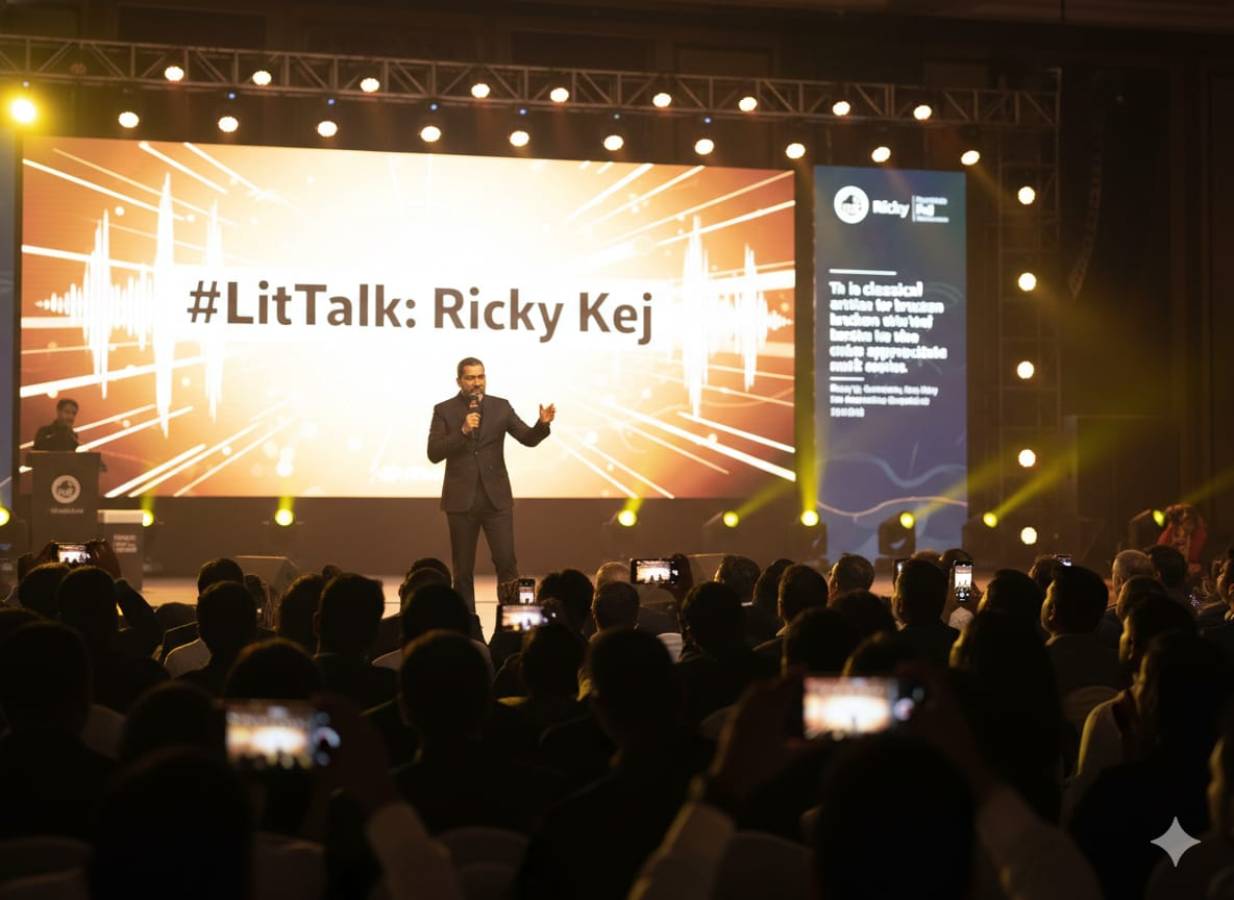
At the Bharat Literature Festival 2026, held at Bharat Mandapam in New Delhi, Grammy-winning composer Ricky Kej delivered a sharp and thought-provoking critique of how India values and consumes its cultural heritage. Speaking in conversation with author Paul Waters, Kej used the platform not to celebrate personal success, but to question long-standing habits within the Indian music ecosystem. His reflections touched on classical music, Bollywood’s dominance, the challenges faced by young artists, and the growing role of artificial intelligence in creative work.
Kej highlighted a troubling contradiction in India’s relationship with its own cultural icons. He described what he called the “Ravi Shankar Syndrome,” a situation where some of India’s greatest classical musicians receive more recognition abroad than they do at home. Artists like Pandit Ravi Shankar, Ustad Zakir Hussain, and Pandit Vishwamohan Bhatt are revered globally, performing to packed halls filled with audiences unfamiliar with Indian traditions. Yet within India, especially among younger generations, awareness of their work remains limited. Kej pointed out that while Ravi Shankar released dozens of albums and shaped global understanding of Indian classical music, many Indian listeners struggle to name even one of his works. According to Kej, the real issue is not rejection but silence, and that silence reflects a deeper cultural disconnect.
He urged Indians to reconnect with their roots, arguing that classical music is not outdated or irrelevant, but poorly communicated and under-supported. While the world celebrates India’s cultural depth, India itself often overlooks it in favor of more commercial forms of entertainment. Kej stressed that cultural pride cannot survive if it is only exported and not practiced at home.
A major part of Kej’s critique focused on Bollywood’s overwhelming influence on how music is defined in India. He explained that early in his career, he made a deliberate choice to stay away from the Hindi film industry. For Kej, Bollywood music largely serves a predictable audience, particularly the Indian diaspora, by relying on familiar formulas and nostalgia. While there is nothing inherently wrong with film music, he argued that its dominance has limited public exposure to other musical forms. His own goal has been to create music that speaks to global listeners who have no prior connection to India, using Indian sounds and themes without depending on cinema for validation. His international success, including multiple Grammy Awards, stands as proof that Indian music can thrive globally on its own terms.
Kej also shared personal experiences to underline how difficult it can be to choose a cultural path in a society driven by conventional expectations. Coming from a family of doctors, he faced strong pressure to pursue a medical career. Music, however, was his natural language of expression from a young age. Choosing it meant confronting family resistance and social uncertainty. By sharing this story, Kej encouraged young people to understand that preserving culture and building creative careers often requires courage and persistence. Cultural progress, he suggested, rarely comes from following the safest route.
Turning to the future, Kej addressed concerns around artificial intelligence and creativity. Unlike many artists who see AI as a threat, he described it as a powerful tool that can enhance music if used responsibly. He made it clear that technology itself is not the enemy, but resistance to change can be. According to Kej, artists who refuse to adapt to new tools will struggle to survive in a rapidly evolving industry. AI can speed up processes, open new creative possibilities, and help artists reach wider audiences. Those who learn to work with it, rather than against it, will shape the next phase of music.
Kej’s message at the festival went beyond personal opinion and became a broader call for cultural reflection. He challenged audiences to question why India often fails to nurture its own artistic legacy while celebrating commercial success. His remarks suggested that India’s real soft power does not lie in scale or spectacle, but in the depth of its traditions and the willingness to engage with them honestly. By looking beyond Bollywood, embracing classical roots, and adapting to modern tools, Kej believes India can reclaim a more balanced and authentic cultural identity.














Leave a Comment