
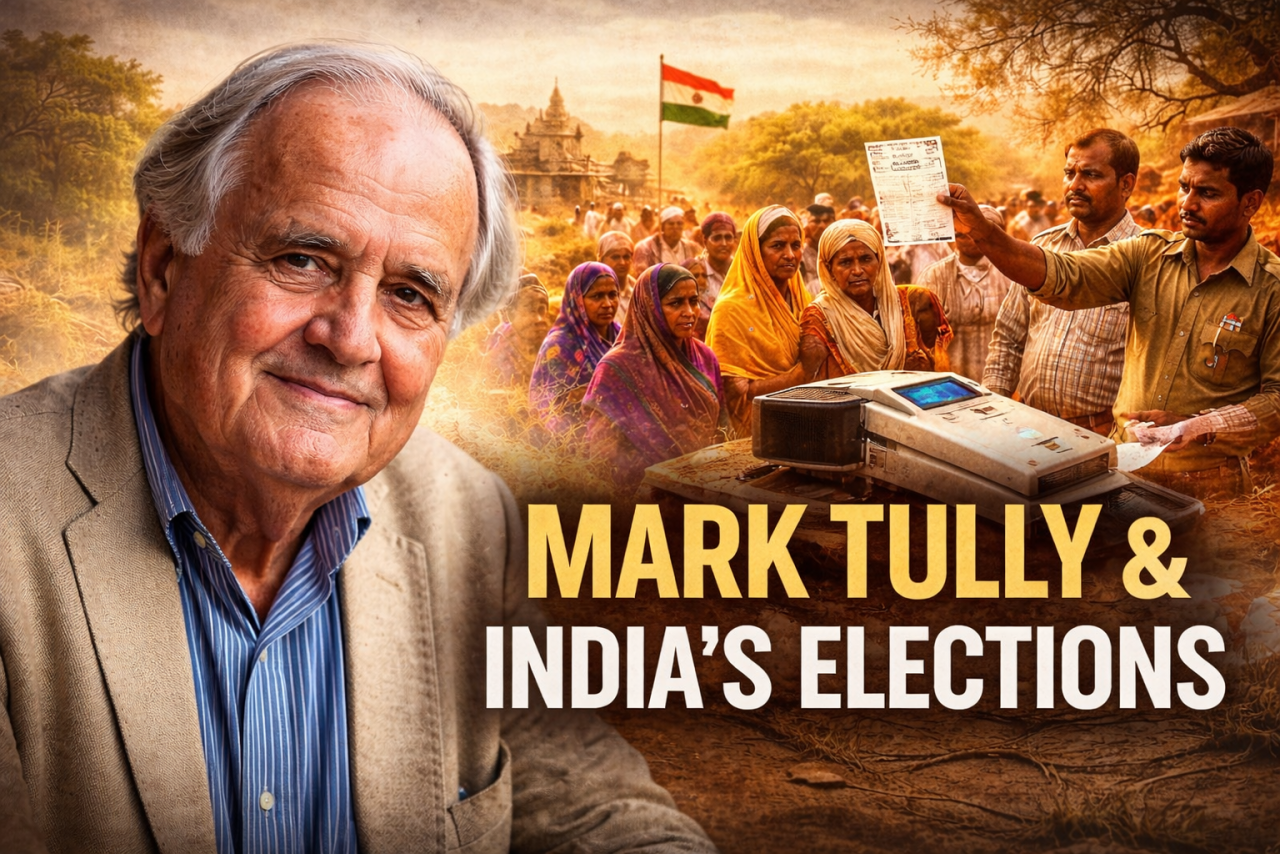
Before election results became television spectacles, Mark Tully carried them by radio to villages that voted long before they were heard.
Mark Tully came to be known in India not simply as a foreign correspondent who stayed on, but as a reporter who learned to listen before he spoke. His contribution to Indian journalism lay less in breaking news than in explaining India to itself, especially to those who were rarely the centre of political attention. Now that he is gone, it is worth recalling how deeply he shaped the way elections and democracy were understood beyond cities and television studios.
When Tully began reporting from India, elections were largely urban spectacles. Results were announced in English, debated by elites, and treated as a contest of leaders rather than a collective exercise of citizenship. Rural India voted in large numbers, but it often remained detached from the meaning of the outcome. Tully changed this quietly, not by slogans or campaigns, but by the tone and substance of his reporting.
As the long-serving head of the BBC bureau in Delhi, Tully used radio as a bridge between power and people. Radio mattered in villages long before television sets became common, and he understood that instinctively. His election reports did not begin with seat tallies or victory margins. They began with people—farmers, labourers, small traders—asking what a change of government would mean for prices, jobs, or peace in their district. In doing so, he made the election result relevant to everyday life.
Tully resisted the temptation to simplify India into binaries. He did not treat rural voters as a faceless mass swayed by caste or charisma. Instead, he described the slow calculations people made: loyalty to a local leader, disappointment with broken promises, fear of instability, hope for relief from hardship. By the time results were declared, listeners already understood why those numbers had emerged. The count became a conclusion, not a surprise.
One of his lasting contributions was to explain democracy as a process rather than an event. On election days, he was often less interested in the drama of polling booths than in the months that followed. He asked whether the winning party could govern, whether institutions would hold, and whether ordinary citizens felt heard. This approach helped rural audiences see that their vote was not a ritual completed once every five years, but a starting point for accountability.
Tully also played a crucial role in making rural India aware of the national picture. Villages often experienced politics locally, through the lens of district officials and state governments. Tully’s reports connected these experiences to decisions taken in Delhi. He explained how coalition governments worked, why a weak majority mattered, and how economic policies discussed in Parliament could shape village life. He did this without condescension, trusting listeners to grasp complexity if it was presented honestly.
His respect for Indian traditions gave his reporting credibility. He did not dismiss religion, custom, or community ties as obstacles to modern politics. Instead, he showed how they coexisted with democratic choice. This was especially important in election reporting, where rural voters were often portrayed as irrational or easily manipulated. Tully’s work quietly corrected that view by letting people speak for themselves.
Equally important was his independence. Tully was critical of governments without becoming cynical. He did not align himself with parties or ideologies. His loyalty was to the listener and to the idea that journalism should illuminate rather than inflame. In an era when election coverage increasingly resembles a contest of noise, his calm, measured voice stands out even more in memory.
Mark Tully’s legacy is not just a body of reports or books. It is a way of seeing India that insists on patience, humility, and attention to detail. He helped rural India understand election results not as distant headlines, but as developments rooted in their own choices and concerns. In doing so, he strengthened the bond between citizens and the democracy they sustain. That contribution endures, long after the votes he reported on have faded into history.




















Leave a Comment