
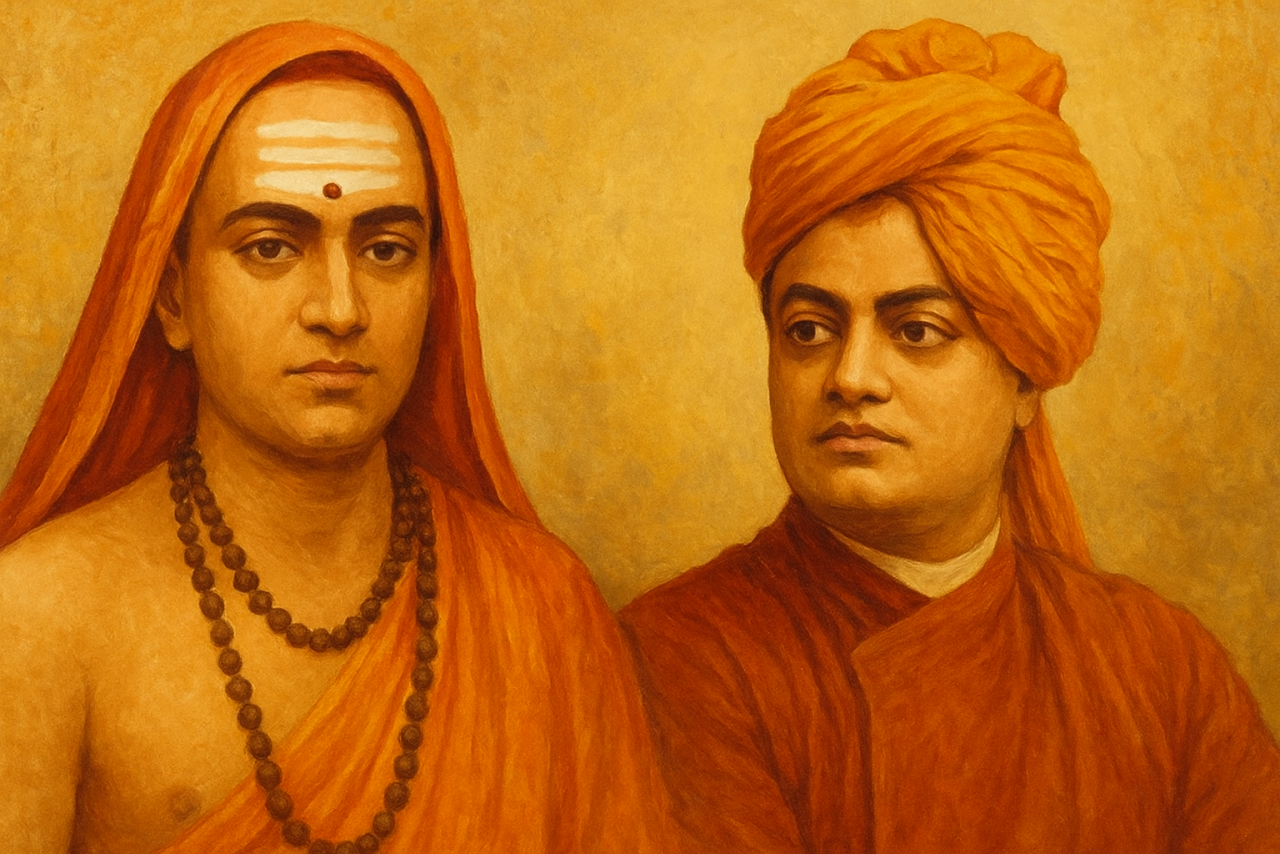
A Reflection on Adi Shankaracharya, Swami Vivekananda, and the Purpose of a Short Life
Throughout the long journey of human history, certain souls appear like blazing comets. They do not linger in the sky for long, yet in their brief passage they light up the entire horizon. Adi Shankaracharya and Swami Vivekananda were such souls. Both awakened the spiritual consciousness of millions. Both challenged ignorance, fear, and lifeless ritual. And both departed this world in their early forties. This has often puzzled the thinking mind. If they were instruments of divine awakening, why were their lives so brief?
The answer does not lie in the arithmetic of years, but in the depth of purpose.
The common human error is to measure life by its length rather than its intensity. Nature does not count time as we do. A lightning bolt exists for only a moment, yet it can split mountains. A fragrance may last for minutes, yet remain in memory for decades. Similarly, the lives of great spiritual beings are not meant to be long; they are meant to be complete.
Adi Shankaracharya walked the length and breadth of India before the age of thirty-two. In that short span, he revived Sanatana Dharma at a time when spiritual confusion and intellectual decay threatened its core. He unified thought through Advaita, established monastic centers, debated scholars, and infused logic with spirituality. What would ordinary men struggle to accomplish in several lifetimes, he fulfilled in one swift, burning arc of existence.
Swami Vivekananda, centuries later, carried that same flame to the modern world. He did not merely speak of salvation in some distant heaven; he spoke of strength, fearlessness, service, and the divinity inherent in every human being. He awakened a sleeping nation by telling it a simple yet revolutionary truth: You are not weak. You are not sinful. You are divine.
Such souls do not come to accumulate years; they come to deliver a message.
One must understand that enlightenment does not make the body immortal. The body is still bound by the laws of nature. But the enlightened soul is not attached to the body. For them, the body is an instrument, a vessel meant to be used intensely and then discarded. When the work is done, the instrument is laid aside without regret.
There is another deeper truth. Great souls often burn with a fire that ordinary bodies cannot sustain for long. Their compassion is vast, their discipline severe, their will relentless. They do not conserve themselves. They give everything—mind, body, and breath—for the upliftment of others. Vivekananda himself once said that he would rather wear out than rust out. He lived that truth.
We may ask: could they not have lived longer and done more? This question arises from our limited vision. We forget that their influence did not end with their physical departure. In fact, it multiplied. Their words became seeds. Their silence became instruction. Their lives became ideals. Today, long after their bodies have turned to dust, they continue to shape minds, awaken courage, and inspire seekers across generations.
The sun does not remain in one place all day to prove its importance. It rises, gives light, and moves on. Darkness returns only to remind us of the value of light. In the same way, the early departure of such souls leaves behind a sacred urgency. It tells humanity: Wake up now. Do not postpone truth. Do not delay courage.
Salvation, in the highest sense, is not escape from life. It is awakening within life. Shankaracharya and Vivekananda did not come to save individuals alone; they came to shake civilizations out of spiritual sleep. Once that shock was delivered, their presence in flesh was no longer required.
Their short lives were not tragedies. They were declarations.
They teach us that the worth of a life is not in how long we breathe, but in how deeply we live, how boldly we serve, and how fearlessly we speak the truth. If one life, lived with total dedication, can awaken millions, then that life—however brief—is complete.
Let us not ask why they left early. Let us ask why we remain asleep for so long.




















Leave a Comment