
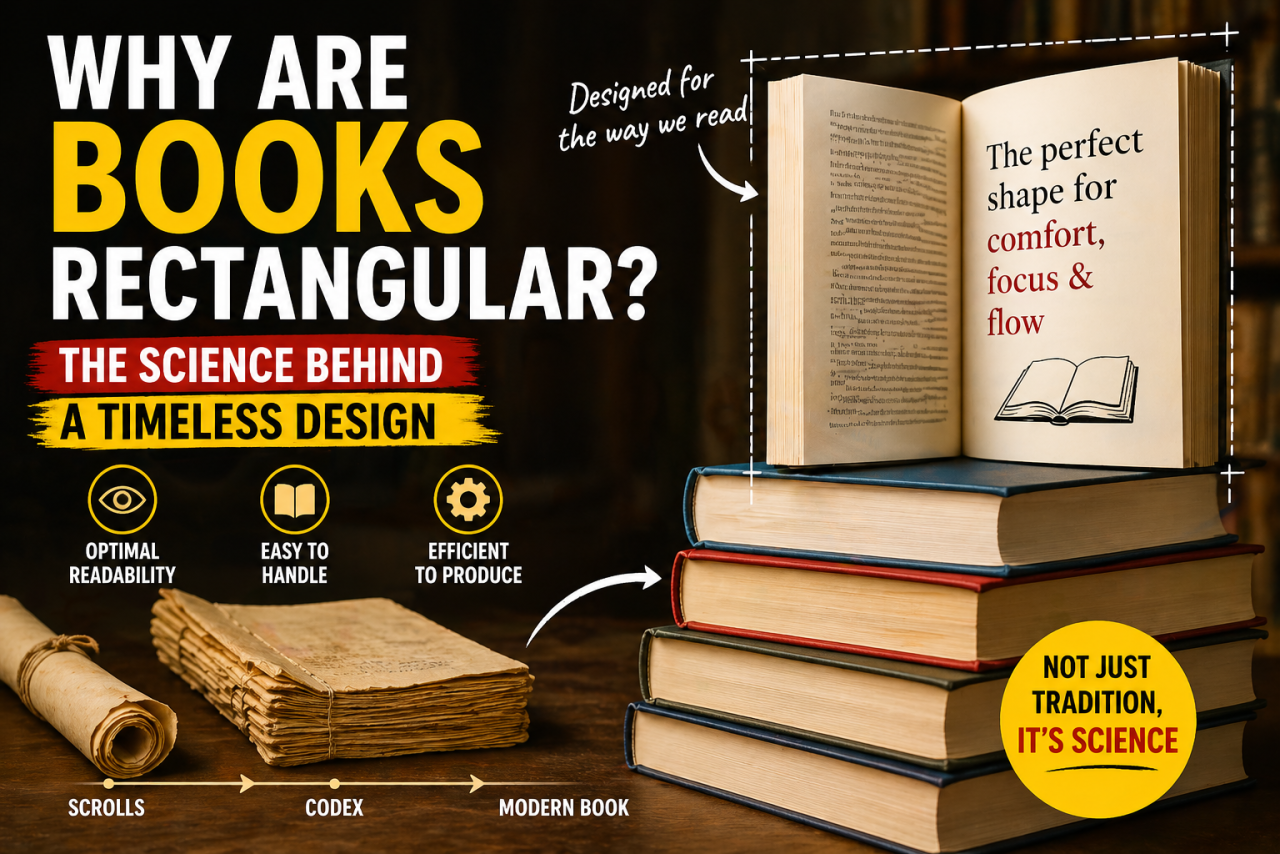
Ever wondered why every book looks the same? The rectangular shape isn’t tradition—it’s a design perfected by centuries of reading science and efficiency.
For centuries, books have predominantly been rectangular—a shape so familiar that most readers rarely question it. Yet this format is far from arbitrary. It is the result of centuries of refinement, balancing readability, practicality, and production efficiency. What may seem like a simple design choice is, in fact, a carefully optimized solution shaped by human behavior and technological evolution.
At the heart of this design lies readability. The rectangular page allows for an ideal line length, which plays a crucial role in how comfortably we read. If lines stretch too long, our eyes struggle to locate the beginning of the next line. If they are too short, constant eye movement disrupts the reading flow. Research suggests that the optimal line length ranges between 45 and 75 characters, with around 66 characters considered ideal. The rectangular shape naturally accommodates this balance, making reading smoother and less tiring.
The Evolution of Book Shape
Books were not always rectangular in the form we recognize today. In ancient times, information was recorded on papyrus scrolls or parchment sheets. These scrolls were unrolled vertically or horizontally and often required continuous movement to follow the text. While effective for their time, scrolls were not convenient for quick reference or easy navigation.
A major transformation came with the development of the codex—a bound collection of pages that could be flipped through rather than unrolled. This innovation marked a turning point in the history of books. Early codices often featured multiple columns per page, sometimes up to four, resembling modern newspapers. However, by the fourth century, a more compact and reader-friendly layout with one or two columns became the norm.
Initially, these early books were large, heavy, and considered luxury items. They were often placed on stands or pedestals while being read. Over time, advancements in bookbinding techniques allowed for smaller, more portable formats. As these improvements took hold, the rectangular shape emerged as the most efficient and practical standard, gradually becoming universal.
Practical Advantages of the Rectangular Shape
The dominance of the rectangular form is rooted in its numerous practical benefits:
Ease of Handling: Rectangular books fit naturally in the human hand. Their proportions make them comfortable to hold for extended periods, whether reading casually or studying in depth.
Efficient Use of Space: The shape allows for maximum content on each page without making the book bulky. It also enables books to be stacked neatly on shelves, making storage simple and organized.
Economic Production: Printing and binding processes are optimized for rectangular sheets. Standardization reduces material waste and lowers production costs, which is especially important in large-scale publishing.
Better Page-Turning Experience: The width-to-height ratio of rectangular pages ensures smooth and intuitive page-turning. Readers can flip through pages effortlessly without awkward movements.
Will Books Always Remain Rectangular?
Despite occasional experiments with unconventional formats, the rectangular book has stood the test of time. Its advantages are so deeply embedded in both production systems and reading habits that any major shift seems unlikely.
Digital reading platforms have introduced flexibility in layout and format, allowing users to adjust text size and orientation. However, even e-books often mimic the proportions of traditional pages, reinforcing how effective the rectangular design truly is.
Ultimately, the rectangular shape of books is more than just a tradition—it is a refined outcome of centuries of innovation. It reflects a perfect balance between human comfort, technological efficiency, and cultural continuity. As reading continues to evolve, this timeless design remains a testament to how form and function can come together to create something enduring.
For centuries, books have predominantly been rectangular—a shape so familiar that most readers rarely question it. Yet this format is far from arbitrary. It is the result of centuries of refinement, balancing readability, practicality, and production efficiency. What may seem like a simple design choice is, in fact, a carefully optimized solution shaped by human behavior and technological evolution.
At the heart of this design lies readability. The rectangular page allows for an ideal line length, which plays a crucial role in how comfortably we read. If lines stretch too long, our eyes struggle to locate the beginning of the next line. If they are too short, constant eye movement disrupts the reading flow. Research suggests that the optimal line length ranges between 45 and 75 characters, with around 66 characters considered ideal. The rectangular shape naturally accommodates this balance, making reading smoother and less tiring.
The Evolution of Book Shape
Books were not always rectangular in the form we recognize today. In ancient times, information was recorded on papyrus scrolls or parchment sheets. These scrolls were unrolled vertically or horizontally and often required continuous movement to follow the text. While effective for their time, scrolls were not convenient for quick reference or easy navigation.
A major transformation came with the development of the codex—a bound collection of pages that could be flipped through rather than unrolled. This innovation marked a turning point in the history of books. Early codices often featured multiple columns per page, sometimes up to four, resembling modern newspapers. However, by the fourth century, a more compact and reader-friendly layout with one or two columns became the norm.
Initially, these early books were large, heavy, and considered luxury items. They were often placed on stands or pedestals while being read. Over time, advancements in bookbinding techniques allowed for smaller, more portable formats. As these improvements took hold, the rectangular shape emerged as the most efficient and practical standard, gradually becoming universal.
Practical Advantages of the Rectangular Shape
The dominance of the rectangular form is rooted in its numerous practical benefits:
Ease of Handling: Rectangular books fit naturally in the human hand. Their proportions make them comfortable to hold for extended periods, whether reading casually or studying in depth.
Efficient Use of Space: The shape allows for maximum content on each page without making the book bulky. It also enables books to be stacked neatly on shelves, making storage simple and organized.
Economic Production: Printing and binding processes are optimized for rectangular sheets. Standardization reduces material waste and lowers production costs, which is especially important in large-scale publishing.
Better Page-Turning Experience: The width-to-height ratio of rectangular pages ensures smooth and intuitive page-turning. Readers can flip through pages effortlessly without awkward movements.
Will Books Always Remain Rectangular?
Despite occasional experiments with unconventional formats, the rectangular book has stood the test of time. Its advantages are so deeply embedded in both production systems and reading habits that any major shift seems unlikely.
Digital reading platforms have introduced flexibility in layout and format, allowing users to adjust text size and orientation. However, even e-books often mimic the proportions of traditional pages, reinforcing how effective the rectangular design truly is.
Ultimately, the rectangular shape of books is more than just a tradition—it is a refined outcome of centuries of innovation. It reflects a perfect balance between human comfort, technological efficiency, and cultural continuity. As reading continues to evolve, this timeless design remains a testament to how form and function can come together to create something enduring.

























Leave a Comment