
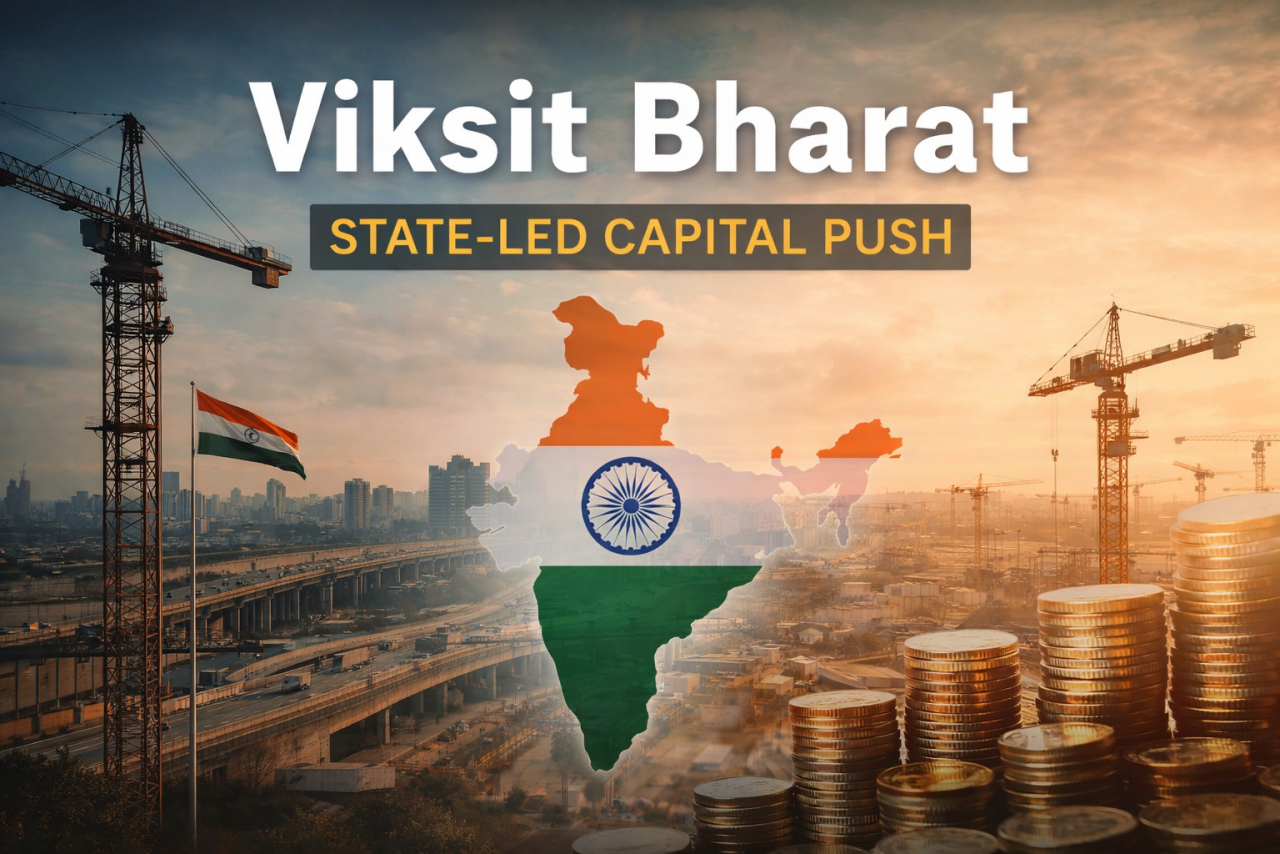
When India speaks of Viksit Bharat, the phrase often sounds aspirational, pointing towards a goal set for 2047. Beneath this vision, however, lies a series of concrete economic choices that are already shaping policy. These choices are not announced loudly, but they are visible in budget discussions, fiscal decisions, and a growing emphasis on long-term public investment. The recent pre-budget meeting between the Union government and state finance ministers offered a clear window into how this idea is being translated into action, especially at a time when global uncertainty has become a defining feature of the international landscape.
At the meeting chaired by Union finance minister Nirmala Sitharaman, most states expressed support for the Centre’s development agenda aimed at achieving a developed India by the time the country completes 100 years of independence. A key demand that emerged was the continuation of the Special Assistance to States for Capital Investment (SASCI) scheme. This scheme, which provides states with 50-year interest-free loans for capital expenditure, has steadily become central to India’s development approach. The logic behind it is simple but significant: long-term public investment is necessary if India is to build economic strength that can withstand global shocks.
The scale of this intervention has grown steadily over the past few years. Introduced in 2020–21 with an allocation of ₹12,000 crore as a post-pandemic stimulus, the scheme expanded rapidly. By 2022–23, the allocation rose to ₹1.07 lakh crore. In 2023–24, it increased further to ₹1.30 lakh crore, with actual spending crossing ₹1.09 lakh crore. For 2025–26, the allocation has been raised to ₹1.50 lakh crore. Taken together, more than ₹4.24 lakh crore has been released to states under this scheme since its inception.
These figures reflect more than fiscal generosity. They point to a deliberate shift in development thinking. For a country with a population of 1.4 billion, growth cannot rely only on consumption or private investment cycles. Infrastructure—roads, railways, power systems, housing, urban services, and digital networks—requires patient capital that delivers returns over decades. By offering long-term, interest-free loans, the Centre is allowing states to invest without immediate pressure on their finances, while strengthening the foundations of future growth.
This approach becomes particularly important when viewed against current global realities. The world is witnessing increasing geopolitical tensions, from conflicts in Europe and West Asia to political instability in the Western Hemisphere. Such events have repeatedly disrupted energy supplies, trade routes, and global supply chains. For India, these developments underline a basic reality: economic vulnerability at home reduces strategic flexibility abroad. A stronger domestic economy offers greater room to respond to external shocks.
In this context, Viksit Bharat is being framed as an exercise in resilience as much as prosperity. Infrastructure investment is not only meant to boost growth rates, but also to reduce dependence on external systems. Improved logistics strengthen internal trade. A stronger manufacturing base reduces exposure to global shortages. Investments in renewable energy and transition technologies help cushion the economy against volatile oil prices triggered by distant conflicts.
The broad support for the SASCI scheme from states across regions—from large states to smaller ones such as Meghalaya and Sikkim—reflects recognition of this longer-term view. Many states see capital assistance not as a temporary fiscal relief, but as a necessary tool to improve competitiveness and employment over time.
At the same time, this strategy highlights an important limitation. Development on India’s scale cannot be centrally driven alone. While the Centre provides direction and resources, actual outcomes depend on states’ administrative capacity, planning ability, and fiscal discipline. The emphasis on cooperative federalism in recent budget consultations reflects this reality. Without effective implementation at the state level, even well-designed schemes risk falling short.
Beyond infrastructure and fiscal transfers, the true test of Viksit Bharat will lie in everyday outcomes. For most citizens, development will be judged by the availability of stable jobs, access to healthcare and education, and improvements in living standards. With a large young population entering the workforce each year, job creation remains the most critical measure of success. Capital investment must ultimately translate into productive enterprises and sustainable livelihoods, or the gap between economic indicators and lived experience will widen.
Viewed this way, Viksit Bharat is not a distant promise but an ongoing economic experiment. The policy signals emerging from budget discussions suggest seriousness and intent. Whether this intent results in lasting transformation will depend on consistent execution, coordination between the Centre and states, and the ability to adapt to a rapidly changing global environment. The outcome will shape not only India’s future growth, but also its capacity to remain steady in an increasingly unsettled world.



















Leave a Comment