
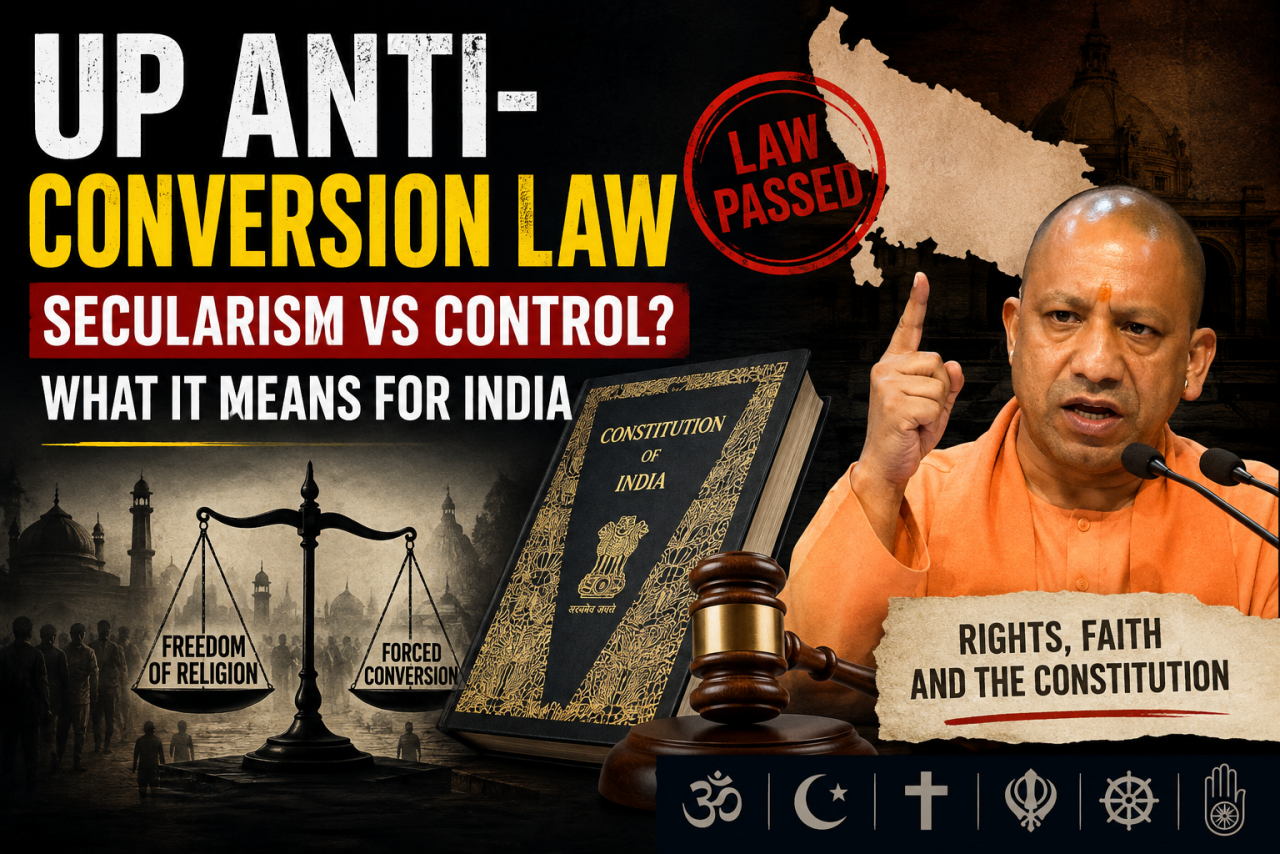
Can a secular democracy stop forced conversions without restricting personal freedom? Uttar Pradesh's anti-conversion law has reignited one of India's most complex constitutional debates.
Should a secular democracy regulate religious conversions through criminal law? The question has become increasingly significant after the Uttar Pradesh government strengthened its anti-conversion legislation, one of the country's strictest laws on religious conversion. As India's most populous state, home to more than 240 million people, Uttar Pradesh often sets the tone for national political debates. The state's evolving anti-conversion framework has therefore attracted attention far beyond its borders.
The Uttar Pradesh Prohibition of Unlawful Conversion of Religion Act, introduced in 2021 and subsequently amended to impose harsher penalties, was presented by the state government as a measure to prevent forced, fraudulent, or coercive religious conversions. The law was largely framed around concerns that vulnerable individuals, particularly women, were being manipulated into changing their faith through deception or marriage. This narrative became closely associated with the politically charged phrase "love jihad," a term frequently used by several right-wing organisations to describe alleged conspiracies involving interfaith marriages between Muslim men and Hindu women. However, the existence of any organised "love jihad" conspiracy has remained legally unsubstantiated, making the phrase itself highly contested.
Supporters of the legislation argue that freedom of religion also includes the freedom not to be coerced into changing one's faith. They contend that the state has a constitutional responsibility to protect citizens from conversions achieved through force, fraud, undue influence, or allurement. From this perspective, the law is viewed as an instrument to safeguard vulnerable individuals rather than to restrict genuine religious freedom.
Critics, however, see the law very differently. They argue that the legislation shifts the burden of proof, criminalises consensual interfaith relationships, and gives authorities sweeping powers that can be misused. The amendments have further increased prison terms, made several offences non-bailable, and expanded the categories of people who can file complaints. Civil liberties advocates fear that such provisions create an atmosphere where personal relationships and religious choices become matters of criminal investigation rather than individual liberty.
The political context surrounding the law has also drawn attention. The Uttar Pradesh government strengthened the legislation after the 2024 Lok Sabha elections, in which the ruling Bharatiya Janata Party secured 33 of the state's 80 parliamentary seats, its weakest performance in Uttar Pradesh since 2014. Political observers have debated whether the tougher provisions were intended solely to address unlawful conversions or whether they also served to reinforce the party's core ideological agenda ahead of future electoral contests. While the government rejects this interpretation, the timing has inevitably become part of the public discourse.
Another controversial administrative measure emerged when the state directed eateries and shops along the Kanwar Yatra route to prominently display the names and identities of their owners. Supporters described the move as a transparency measure for pilgrims, while opponents viewed it as potentially discriminatory. The Supreme Court later stayed the implementation of the directive, highlighting the continuing judicial scrutiny of policies touching upon religious identity.
The debate surrounding the anti-conversion law ultimately returns to the Indian Constitution. Articles 25 to 28 guarantee every citizen the freedom of conscience and the right to freely profess, practise and propagate religion, subject to public order, morality and health. These constitutional protections recognise both the individual's freedom to adopt a faith and the state's authority to regulate activities that involve coercion or fraud. The challenge lies in maintaining a balance between preventing exploitation and preserving genuine religious liberty.
India's extraordinary diversity makes this balance especially important. Hindus constitute the majority of the population, while Muslims, Christians, Sikhs, Buddhists, Jains and several other religious communities have lived together for centuries. Uttar Pradesh itself has one of the country's largest Muslim populations, accounting for nearly one-fifth of its residents. In such a plural society, laws dealing with faith inevitably carry social and political consequences that extend well beyond legal interpretation.
India's civilisational history also offers an important perspective. Over centuries, the subcontinent experienced the rule of various dynasties, including several Islamic kingdoms, followed by nearly two centuries of British colonial rule. Despite these historical transformations, Hinduism remained the country's largest religious tradition and continued to evolve through cultural resilience rather than state protection. This historical continuity leads many scholars to argue that India's religious traditions have demonstrated remarkable endurance without requiring extraordinary legal safeguards against demographic change.
The larger question is therefore not whether forced conversions should be prohibited. Few would dispute that coercion, fraud and intimidation deserve legal punishment. The real constitutional debate concerns whether existing criminal laws are sufficient or whether specialised anti-conversion legislation risks restricting voluntary religious choice and interfaith marriages. The answer will shape not only the future of religious freedom in Uttar Pradesh but also India's understanding of secularism in the twenty-first century.
A secular democracy is judged not merely by how it protects the majority but by how confidently it safeguards the rights of every individual, regardless of faith. The continuing legal and political debate over Uttar Pradesh's anti-conversion law reflects the delicate task of balancing public order, individual liberty and constitutional values in one of the world's most diverse societies.
Should a secular democracy regulate religious conversions through criminal law? The question has become increasingly significant after the Uttar Pradesh government strengthened its anti-conversion legislation, one of the country's strictest laws on religious conversion. As India's most populous state, home to more than 240 million people, Uttar Pradesh often sets the tone for national political debates. The state's evolving anti-conversion framework has therefore attracted attention far beyond its borders.
The Uttar Pradesh Prohibition of Unlawful Conversion of Religion Act, introduced in 2021 and subsequently amended to impose harsher penalties, was presented by the state government as a measure to prevent forced, fraudulent, or coercive religious conversions. The law was largely framed around concerns that vulnerable individuals, particularly women, were being manipulated into changing their faith through deception or marriage. This narrative became closely associated with the politically charged phrase "love jihad," a term frequently used by several right-wing organisations to describe alleged conspiracies involving interfaith marriages between Muslim men and Hindu women. However, the existence of any organised "love jihad" conspiracy has remained legally unsubstantiated, making the phrase itself highly contested.
Supporters of the legislation argue that freedom of religion also includes the freedom not to be coerced into changing one's faith. They contend that the state has a constitutional responsibility to protect citizens from conversions achieved through force, fraud, undue influence, or allurement. From this perspective, the law is viewed as an instrument to safeguard vulnerable individuals rather than to restrict genuine religious freedom.
Critics, however, see the law very differently. They argue that the legislation shifts the burden of proof, criminalises consensual interfaith relationships, and gives authorities sweeping powers that can be misused. The amendments have further increased prison terms, made several offences non-bailable, and expanded the categories of people who can file complaints. Civil liberties advocates fear that such provisions create an atmosphere where personal relationships and religious choices become matters of criminal investigation rather than individual liberty.
The political context surrounding the law has also drawn attention. The Uttar Pradesh government strengthened the legislation after the 2024 Lok Sabha elections, in which the ruling Bharatiya Janata Party secured 33 of the state's 80 parliamentary seats, its weakest performance in Uttar Pradesh since 2014. Political observers have debated whether the tougher provisions were intended solely to address unlawful conversions or whether they also served to reinforce the party's core ideological agenda ahead of future electoral contests. While the government rejects this interpretation, the timing has inevitably become part of the public discourse.
Another controversial administrative measure emerged when the state directed eateries and shops along the Kanwar Yatra route to prominently display the names and identities of their owners. Supporters described the move as a transparency measure for pilgrims, while opponents viewed it as potentially discriminatory. The Supreme Court later stayed the implementation of the directive, highlighting the continuing judicial scrutiny of policies touching upon religious identity.
The debate surrounding the anti-conversion law ultimately returns to the Indian Constitution. Articles 25 to 28 guarantee every citizen the freedom of conscience and the right to freely profess, practise and propagate religion, subject to public order, morality and health. These constitutional protections recognise both the individual's freedom to adopt a faith and the state's authority to regulate activities that involve coercion or fraud. The challenge lies in maintaining a balance between preventing exploitation and preserving genuine religious liberty.
India's extraordinary diversity makes this balance especially important. Hindus constitute the majority of the population, while Muslims, Christians, Sikhs, Buddhists, Jains and several other religious communities have lived together for centuries. Uttar Pradesh itself has one of the country's largest Muslim populations, accounting for nearly one-fifth of its residents. In such a plural society, laws dealing with faith inevitably carry social and political consequences that extend well beyond legal interpretation.
India's civilisational history also offers an important perspective. Over centuries, the subcontinent experienced the rule of various dynasties, including several Islamic kingdoms, followed by nearly two centuries of British colonial rule. Despite these historical transformations, Hinduism remained the country's largest religious tradition and continued to evolve through cultural resilience rather than state protection. This historical continuity leads many scholars to argue that India's religious traditions have demonstrated remarkable endurance without requiring extraordinary legal safeguards against demographic change.
The larger question is therefore not whether forced conversions should be prohibited. Few would dispute that coercion, fraud and intimidation deserve legal punishment. The real constitutional debate concerns whether existing criminal laws are sufficient or whether specialised anti-conversion legislation risks restricting voluntary religious choice and interfaith marriages. The answer will shape not only the future of religious freedom in Uttar Pradesh but also India's understanding of secularism in the twenty-first century.
A secular democracy is judged not merely by how it protects the majority but by how confidently it safeguards the rights of every individual, regardless of faith. The continuing legal and political debate over Uttar Pradesh's anti-conversion law reflects the delicate task of balancing public order, individual liberty and constitutional values in one of the world's most diverse societies.
















Leave a Comment