
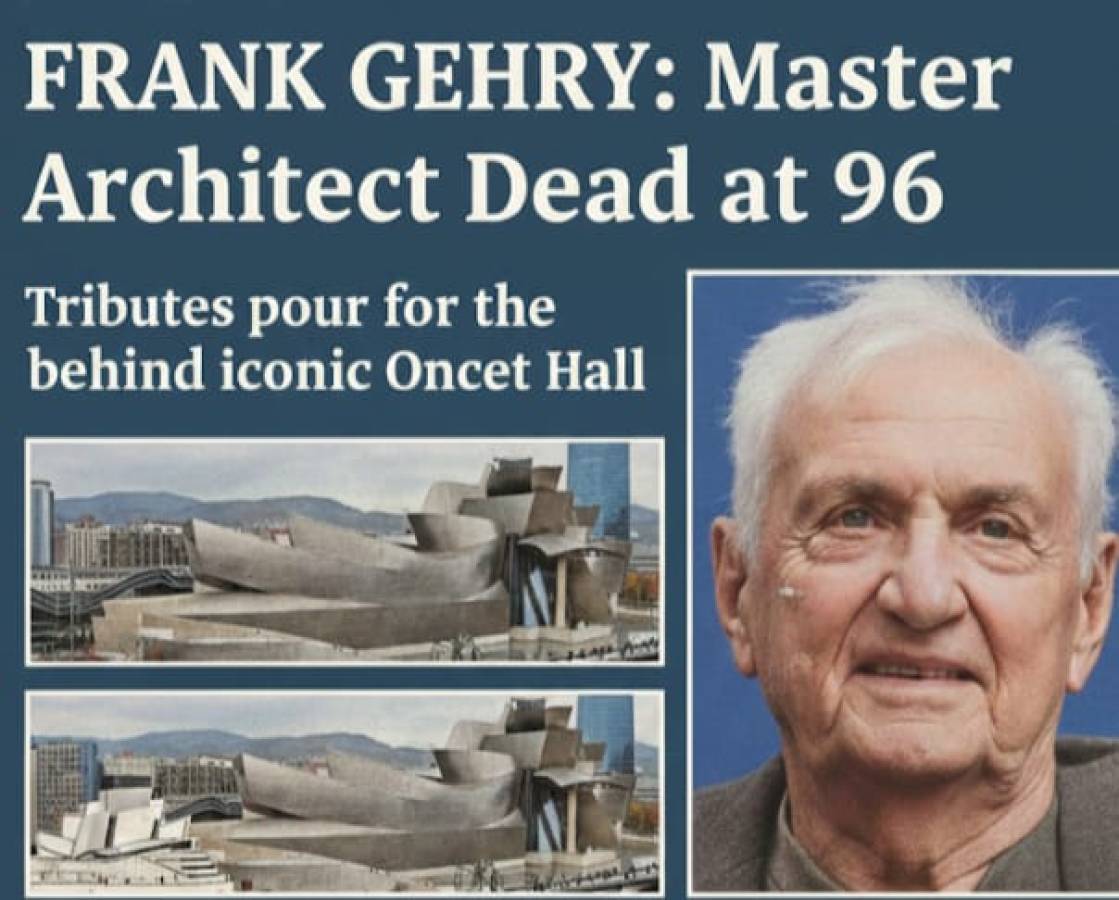
The world of architecture mourns the loss of Frank Gehry, the Canadian-American master architect whose daring, whimsical, and sculptural designs captivated critics and audiences alike. Gehry passed away on Friday (December 05, 2025) at the age of 96, leaving behind a monumental legacy defined by buildings that transcend mere function to become dynamic, unforgettable works of art.
Widely regarded as one of the most influential architects of his generation, Gehry's creations dot the global landscape, instantly recognizable for their signature undulating surfaces, bold forms, and unconventional materials. His iconic works include the Guggenheim Museum Bilbao in Spain and the Walt Disney Concert Hall in Los Angeles.
A Style that Defied Convention
Gehry's style, often categorized as Deconstructivism, was a radical departure from the minimalist modernism that dominated the 20th century. He embraced fragmentation, motion, and a collage-like aesthetic, transforming industrial and everyday materials like corrugated metal and chain-link fencing into expressive elements. He believed architecture should not be confined to neat, predictable squares, but should instead be a reflection of the collision of thoughts, music, and art, providing a backdrop for human life.
His most famous commissions, particularly in his later career, pushed the boundaries of form and technology. The shimmering, titanium-clad Guggenheim in Bilbao, completed in 1997, is perhaps his crowning achievement. This architectural masterpiece not only put the city of Bilbao on the cultural map, coining the term the "Bilbao Effect" for the economic revitalization spurred by a single show-stopping building, but also catapulted Gehry into the echelon of "starchitects." The Walt Disney Concert Hall, with its billowing, sail-like stainless steel curves, similarly became a beloved Los Angeles landmark, celebrated for its superb acoustics and visual drama.
His major works also include the Fondation Louis Vuitton in Paris, an ethereal structure of glass and wood that resembles a grand sailing ship, and the Dancing House in Prague, a striking structure of two towers resembling a dancing couple. Even his first notable work, the renovation of his own Santa Monica home, where he wrapped a 1920s bungalow in layers of chain-link and plywood, signaled his intention to disrupt the architectural status quo.
From Toronto to Global Acclaim
Born Ephraim Owen Goldberg in Toronto, Canada, on February 28, 1929, Gehry's early life saw him move to Los Angeles with his Jewish family in the mid-1940s. He later changed his surname to Gehry to avoid the antisemitism he experienced, a decision he sometimes regretted but which nonetheless marked a turning point.
His academic journey was diverse, studying architecture at the University of Southern California and briefly city planning at Harvard University, a program he did not complete. He spent time working with fellow architect Victor Gruen, a pioneer in the design of shopping malls, before establishing his own practice in Los Angeles in 1962. It was in the late 1970s and 1980s that his rebellious style began to attract international attention, winning him the prestigious Pritzker Architecture Prize in 1989.
The news of his death prompted an outpouring of tributes from leaders and fellow professionals. Former Canadian Prime Minister Jean Chrétien called Gehry's contribution "unmistakable," while architect Frank Lloyd Wright’s representative, Meagan Lloyd, said Gehry was perhaps the big-name architect to emerge from "the elite group" that included figures like Renzo Piano and Norman Foster.
Frank Gehry's work was proof that buildings could possess the movement and emotion of sculpture. He remained productive late into his life, continually challenging both the limits of materials and the very definition of what architecture could be. His imaginative designs, facilitated by an early adoption of advanced computer software to manage complex forms, ensure his influence will be felt for generations to come.



























Leave a Comment